11 Different Types of Ring Mounts & Why They Matter
If you’re shopping for a diamond engagement ring or a special gift for a special someone, you may find yourself comparing and contrasting different types of ring styles. When making your selection, one key piece of jewelry terminology will be helpful: the ring mount.
Different types of ring mounts have different styles and appearances, as well as various levels of durability and affordability. Curious to know more? Here’s everything there is to know about 11 distinct types of ring mountings.

What You Will Learn
What is a Ring Mount? (And How Does it Differ From Different Types of Ring Settings?)
Before we can fully explore all the various ring mounting types, it’s important to define what exactly a ring mount is and to answer the question: How do engagement ring mountings differ from engagement ring settings?
If you’ve read our complete guide to ring settings here, then you know that this term refers to just the components of a ring that actually hold and protect the gemstones, whether it’s the crown and prongs surrounding the center diamond of a solitaire engagement ring or the larger center stone and smaller side stones of a three-stone ring. If you take away the metal band, you’re left with the ring setting (in most cases),
Common engagement ring settings include:
- Traditional prong setting
- Cathedral setting
- Bezel setting
- Tension style setting
- Halo setting
- Basket setting
In contrast, a “ring mount” refers to the entire ring besides the gemstones, such as the shank (another term for the metal band). As such, technically, a ring mount does encompass the ring’s setting.
To summarize, here’s what sets these two structural parts apart:
- A ring setting is everything that holds the gemstones in place, excluding the ring’s metal band.
A ring mount is everything but the gemstones, including the ring’s metal band.
11 Different Types of Ring Mounts
With a greater understanding of a ring’s structure, we can now uncover the types of mounts you may come across in your shopping for an engagement ring or other types of ring — and what sets them all apart.
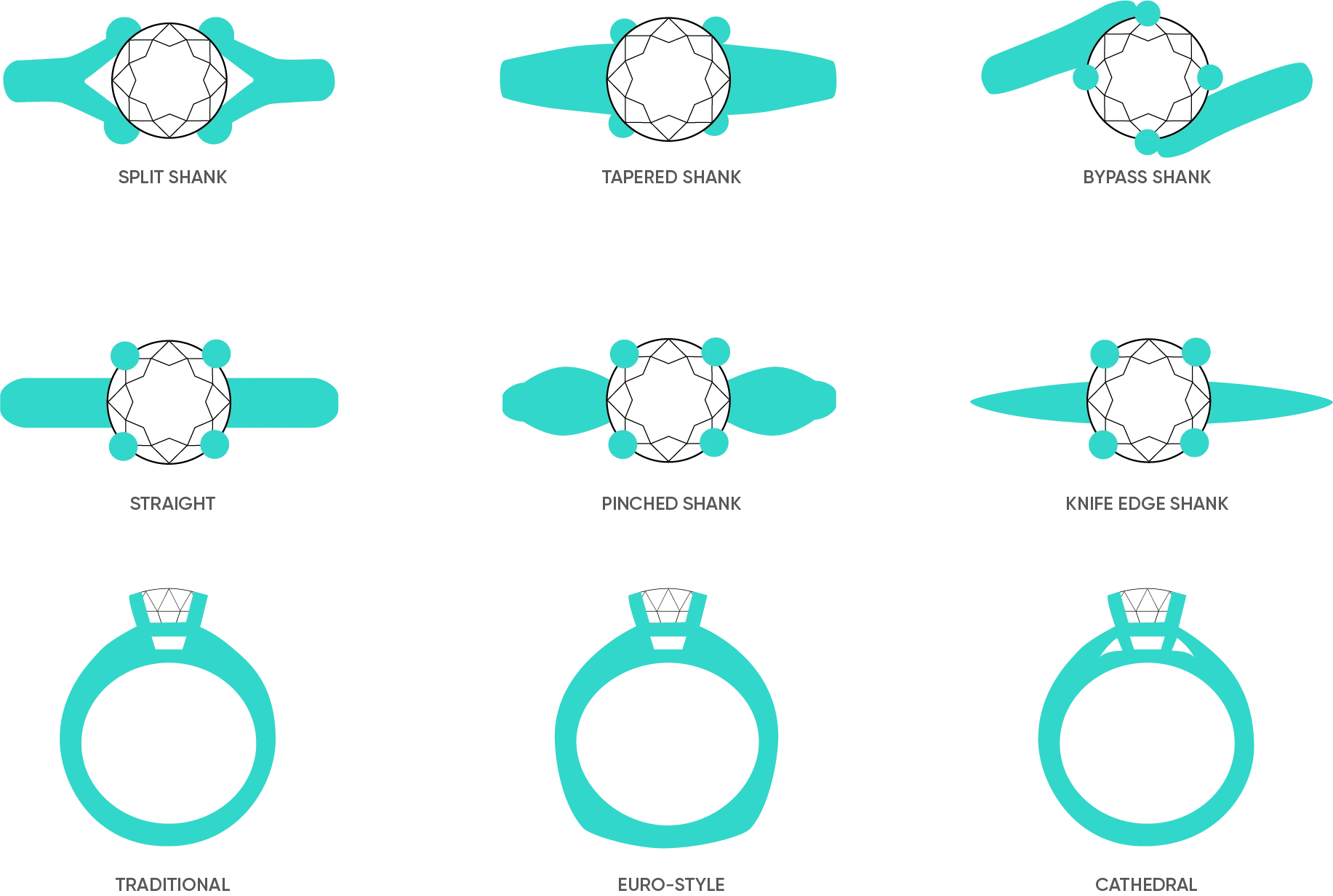
Mount with Straight or Traditional Shank
A ring mount with a straight shank is the most traditional option. As its name implies, it’s just a straight band with a completely even circle all the way around.
Mount with Split Shank
A mount with a split shank features a band that splits at the top, near the center stone. This style is very similar to the cathedral mount detailed below in terms of elegance and romantic appeal. However, it does not feature a window when viewed from the side, as the cathedral mount does.
Mount with Tapered Shank
A mount with a tapered shank features a ring band that gradates. The band goes from broader to more narrow, though the exact point at which the width changes is flexible. It may mean that the band is wider near the center stones, or it can be wider near the underside of the band.
Mount with Bypass Shank
A mount with a bypass shank or band, sometimes called a crossover band, features a more stylized design. Rather than offering a complete, even circle, a bypass shank curves around the ring’s single center stone on either side. The ends of the band do not appear to meet; instead, they loop below and atop the center stone.
Mount with Pinched Shank
A mount with a pinched shank features a band that appears to be “pinched” on either side of the center stone. As such, the band narrows on either side of the center stone to a near-point.
Mount with Knife-Edge Shank
A mount with a knife-edge shank features a band that appears as if it’s been filed on either side until it produces a pointy edge; the design continues around the band’s center. The look provides more dimension and depth.
Mount with Euro-Style Band
A Euro-style band is flat on the bottom (the side of the band nearest your palm). This structural detail is quite beneficial, especially if you have a larger center stone, as it prevents the ring from rotating too much on the finger.
Cathedral Mount
A cathedral mount features two metal elements that swoop up from the main band and connect with the ring’s prongs, where the typically solitaire stone is positioned. These metal elements create a small window between the prongs and the band, providing an elegant appearance. There’s a reason why it’s a popular engagement ring style.
Bar or Channel Set Mount
In this style, the ring’s band features either one channel or two horizontal parallel channels, within which tiny stones fit in a continuous line.
Tension-Setting Mount
In a tension-setting mount, two sides of the metal band come together to hold the center stone tightly between them. There are no prongs in this mount style—by all appearances, the center stone appears to be almost floating. While this may appeal to some individuals’ personal style, it’s not for everyone and does pose durability issues, as the lack of prongs means the stone isn’t fully supported.
The Pavé Setting Mount
Hailing from the French word for “paved,” a pavé setting mount features a band with small diamonds around the exterior for a texturized effect. However, this mount differs from the channel set or bar mount, as the diamonds are not inlaid in a neat row in a depressed channel. Instead, the diamonds appear individually applied to the band’s exterior.
Ring Mounts FAQs
What is the Most Durable Ring Mount?
The most durable ring mounts securely hold your stones in place, such as channel set mounts or ring mounts with a bezel (a thin metal rim that encircles the gemstones) and no prongs.
What is the Least Durable Ring Mount?
Mounts that have high settings and prongs are the least durable, as the high setting exposes the gemstone to more potential damage, and the prongs can easily catch on clothes and surfaces.
What is the Most Affordable Ring Mount?
Any ring mount with a solitaire stone will be the most affordable option.
What is the Most Expensive Ring Mount?
Generally, the more diamonds included in a ring mount, the more expensive it will be. This includes ring mounts such as the pavé setting or channel set and mounts that feature diamond halos.
How Do I Know Which Ring Mount is Right for Me?
You’ll want to consider a few factors when deciding which ring mount is right for you. While style and appearance are undoubtedly important, cost and durability are other factors to consider. Ideally, you should try different mount styles in person to see which ones look best with your unique finger and hand shape.

Protect All of Your Favorite Rings
Whether you’re shopping for an engagement ring, a statement ring, or anything in between, be sure your precious pieces are always protected from loss, damage, and unforeseen accidents.
BriteCo’s comprehensive coverage will protect a range of jewelry pieces. Get your fast and free quote now.
Related Articles:
A Quick Guide to Gem Inclusions
What are Romantic Style Engagement Rings?
What are the Parts of an Engagement Ring?
Breaking Up? You Might Need a Divorce Ring
Best Types of Engagement Ring Storage
How to Wear an Eternity Ring
Types of Rough Diamonds
Quiz:
The Engagement Ring Calculator You’ve Been Searching For and it’s FREE!

UP NEXT: What are the Odds of Losing or Damaging Jewelry?

Author