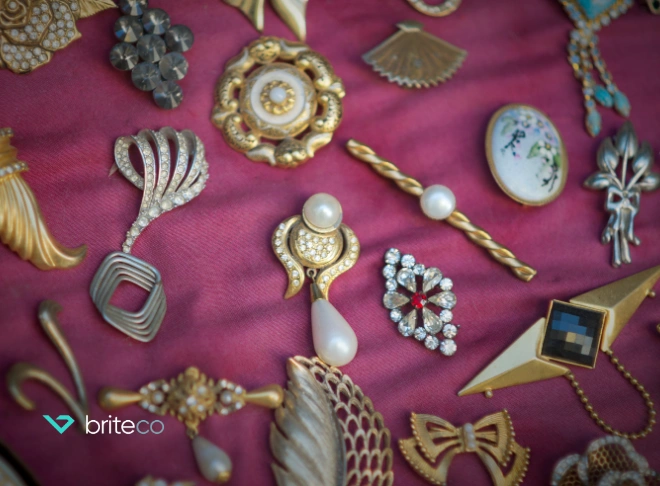
1920s Jewelry: Art Deco Geometry, Platinum Glam, & Roaring ’20s Flair
1920s jewelry is most closely tied to the Art Deco movement and its characteristic elements, such as angular shapes, geometric designs, lots of symmetry, and high-contrast glamour. These are all designs that appeared in the revolutionary era’s long pearl necklaces, black onyx jewelry, platinum settings, and dramatic drop earrings, among other trends.
Want to channel some of these 1920s jewelry styles for yourself, or are you on the hunt for vintage 1920s jewelry at your local antique shops or estate sales? Below, you’ll find the staple hallmarks of 1920s-style jewelry, so you know what to look for. We also provide modern styling ideas and the do’s and don’ts of maintenance, so you can shop, inherit, and wear authentic 1920s jewelry with confidence.
What You Will Learn
1920s Jewelry Fashion: Top 10 Jewelry Trends That Would’ve Been Popular in the Roaring Twenties

1. Art Deco Jewelry
The 1920s were the decade of the Art Deco movement, and jewelry was very much aligned with this artistic trend. Some of the period pieces you may find could include Art Deco rings to earrings to brooches and beyond.
Authenticity tip: Authentic Art Deco jewelry is typically defined by strong symmetry, crisp lines, stepped or gradient shapes, and repeating patterns, often with millegrain detail or fine linework.
Style tip: To incorporate Art Deco jewelry into your look today, consider pairing one geometric centerpiece, such as a ring or bracelet, with other modern basics like hoop earrings.
2. White Metal and Diamond Light-Up Looks
Jazz-age fashion often combined white metals such as platinum with diamonds to ensure that the gemstones popped and glimmered at their brightest.
Authenticity tip: To confirm that a 1920s piece is authentic, inspect it for fine, precise setting work and intricate, under-gallery details.
Style tip: When you’re ready to wear it, let this white metal and diamond piece be your all-occasion neutral that you can use to dress up casual outfits or formalwear.
3. High-Contrast Black-and-White Designs
Like Art Deco fashion that often combined high-contrast colors like black and white, 1920s jewelry styles followed suit, pairing black accents like onyx and dark enameling with bright stones in a geometric layout.
Style tip: If you come across one of these pieces, consider wearing it with a monochrome outfit for a sharp, modern vibe.
4. Filigree & Lace-Like Metalwork
Filigree rings and similar lace-like metalwork provide a feminine vibe to vintage jewelry, while also being rather complex and maximalist.
Authenticity tip: If you think you have a 1920s filigree piece on your hands, look for airy, lacey patterns; delicate pierced work; and fine details that are more intricate than what you could get in modern, mass-produced pieces.
Style tip: When you wear such a piece, keep your other jewelry minimal. The filigree will speak for itself and shouldn’t compete with other accessories.
5. Calibre Cuts and Mosaic Settings
Mostly seen in vintage-inspired pieces today, the calibre cut refers to small, fancy-cut stones that are shaped so that they fit in with a bunch of other similar stones. It’s almost like a puzzle, placed in a mosaic-style setting.
Authenticity tip: Authentic calibre-cut mosaic settings will feature stones in clean channels and rows, and the stones should appear seamless.
Style tip: Consider wearing a calibre-cut ring as a cocktail ring, and make it the highlight of your entire outfit.
6. Egyptian Revival and Similar Exotic Motifs
Another hallmark of jewelry in the 1920s reflected a broader trend of an increasing interest in Egyptian archaeology and history. As such, you can find authentic 1920s pieces that incorporate scarabs and lotus forms roaming alongside the typical Art Deco geometry.
Style tip: If you’re lucky enough to have one of these items, use it as a conversation piece. Pair it with other understated jewelry and let that Egyptian Revival piece shine.
7. Sautoir Necklaces & Long Layering Chains
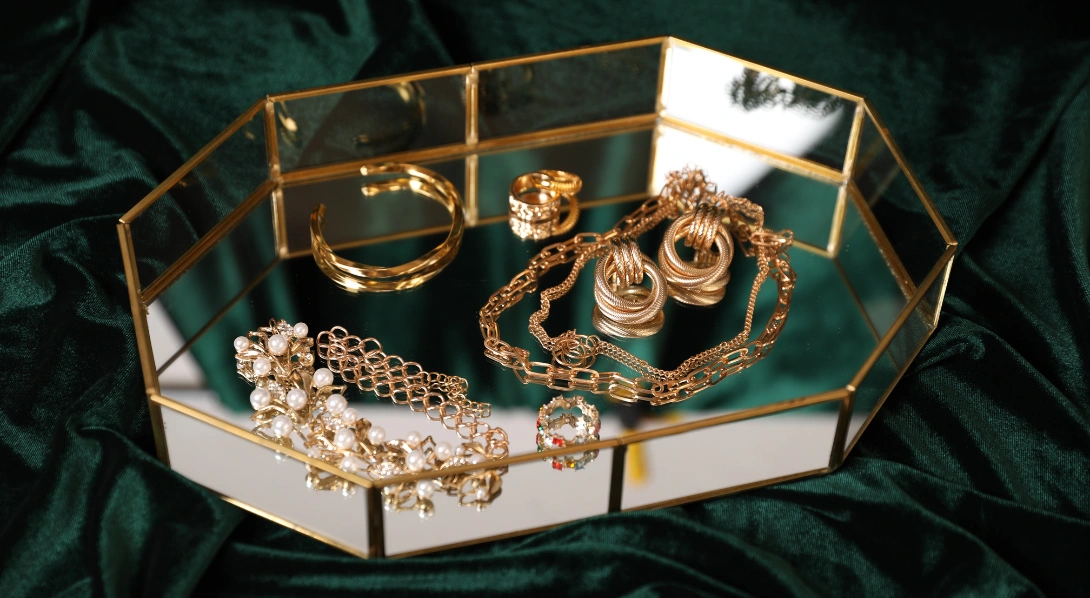
Many depictions of flappers today incorporate sautoir necklaces and similar long, layered chains, which were characteristic of the 1920s. Chains, beaded necklaces, and pendant-adorned necklaces with tasseled ends could reach below waist-length. These necklaces hung loosely, highlighting the wearer’s shape.

Style tip: Similarly, if you have one of these pieces, wear it with a sleek dress or close-fitting shirt-and-pants combo, letting the necklace bring attention to your shape in an homage to the vintage flapper style.
8. Long Pearl Strands
Likewise, long strands of faux pearls were popular in 1920s costume jewelry. So, if you’re shopping for pearls from this era, don’t assume they are natural. Verify before valuing the piece and note the clasp style and knotting quality as well.

Style tip: Whether real or faux, you can wear these long pearl strands with a blazer or button-down blouse for a modern, high-low mix. Add in some bangles or stacking bracelets, too, if you really want to play up an authentic look from the era.
9. Dramatic Drop Earrings & Chandelier Earrings
Just as necklaces were long in the 1920s, so were the earrings; drop, chandelier, and similar styles were commonplace as eveningwear accessories.
Authenticity tip: To verify if a pair of earrings is truly from the 1920s, look at the hinges and similar hardware to determine if they’re authentic to the time.
Style tip: When wearing these kinds of earring, pair them with an up-do so that there’s nothing obstructing the view of your fabulously long accessories.
10. Brooches and Bar Pins
Ornate gem brooches worn in this era incorporated geometric, Art Deco styles and architectural lines. They were often used as cloche hat accessories.
Authenticity tip: To determine the authenticity of large gemstone brooches, you’ll want to look at the hardware to ensure it’s consistent with the time period, and consider whether the piece’s overall wear and tear is consistent with the claimed age.
Style tip: Wear your pin on a blazer lapel, sweater, scarf, or handbag for a nod to the past.
How to Identify Authentic 1920s Pieces
To ensure a piece is authentically from the 1920s, and not merely a modern reproduction, look at the construction, materials, and maker’s marks.
Construction Details
Play close attention to the back of the piece. You should see clean finishing, thoughtful structure, and era-appropriate findings.
Materials Typical of the 1920s
Fine 1920s pieces often feature white metals (like platinum or white gold) and precise stone settings. Meanwhile, costume jewelry from the era may use early synthetics or glass beads.
Hallmarks and Maker’s Marks
Check for purity marks and maker signatures. Additionally, keep in mind that if something is being sold as an estate piece, that doesn’t guarantee that it’s of a certain age; an “estate” piece is just one that’s been previously owned.
A Quick Authenticity Checklist
- Check closures and overall construction quality
- Examine materials used, including metals, stone settings, and gemstones
- Look for stamps and maker’s marks
- Compare motifs such as geometry and symmetry against known 1920s trends
Want a deeper dive into age and authenticity? See our guide to identifying vintage jewelry.
The Best Care & Storage for 1920s Jewelry
When you find the perfect piece of 1920s vintage jewelry, keep it in pristine condition by following proper jewelry care and cleaning practices for antique pieces.
- Dry clean first: Before soaking or cleaning your jewelry with water, try dry cleaning it first, using a soft brush and microfiber cloth. But always avoid soaking pieces with fragile settings.
- Be cautious with ultrasonics: Avoid using an ultrasonic cleaner for delicate, previously repaired, or unknown-condition pieces, unless you’re working with a professional jeweler.
- Give special attention to pearls: Pearls should be the last thing you put on when getting ready and the first thing you take off at the end of the day. Additionally, wipe them down after every wear to remove oils and cosmetics.
- Use separate storage: Store antique items alone and separate from all other pieces so that they’re not susceptible to scratching from other hard stones or metals.
- Check prongs and closures: Every few months, check the prongs and closures for looseness or damage and get them repaired if you see anything off.
Vintage Jewelry from the 1920s FAQs
Is 1920s Jewelry Antique Or Vintage?
Jewelry from the 1920s might be considered antique or vintage, depending on the exact production year. Antique jewelry is anything over 100 years old, while vintage is anything that’s 50 to 100 years old.
Are Long Pearl Necklaces from the 1920s Always Real Pearls?
No, necklaces featuring faux pearls were popular in the 1920s, so don’t assume a 1920s pearl necklace features the real thing.
What Is a Calibré-Cut Setting?
A calibre setting features small, geometric semi-precious stones that are designed to fit together like a puzzle, in a channel or similar setting.
Can I Clean Art Deco Jewelry in an Ultrasonic Cleaner?
It’s best not to clean any antique or vintage jewelry in an ultrasonic cleaner, as it can ultimately damage the jewelry.
Should I Get an Appraisal for 1920s Jewelry?
Yes, if you want to insure the jewelry or if you just want to confirm its value and historical significance, get an appraisal.
Protect Your 1920s Pieces with Jewelry Insurance
If your 1920s engagement ring, bracelet, or heirloom piece becomes a favorite for daily wear, you may want to consider dedicated jewelry insurance to help protect it from loss, theft, or damage. Get your free and easy online jewelry quote from BriteCo now — it only takes a minute!
And explore our other period piece guides, such as our guides to 1970s jewelry, 1980s jewelry, and 1990s jewelry.
Related Articles:
US States with the Most Jewelry Theft
Is an Antique Cut Diamond Right for You?
How To Keep Layered Necklaces From Tangling
How Much is Permanent Jewelry?
How long does permanent jewelry last?
Top 10 1940s Jewelry Trends
Get a Quote:
The Easy Way to Insure Your Jewelry - and Save Money!
UP NEXT: 1930s Jewelry Trends: A Guide to Art Deco Style

Author