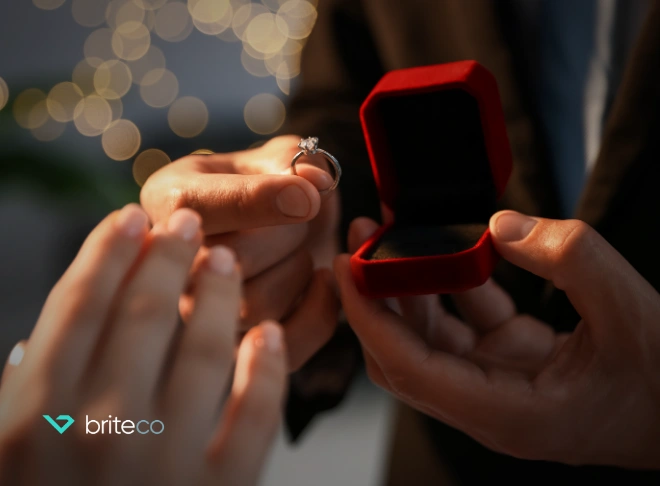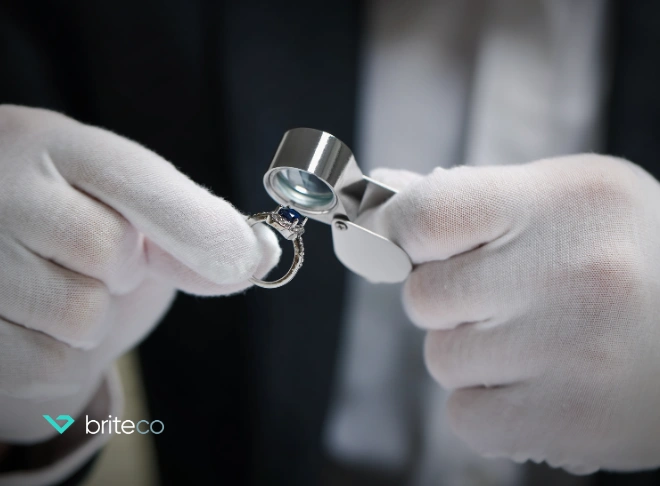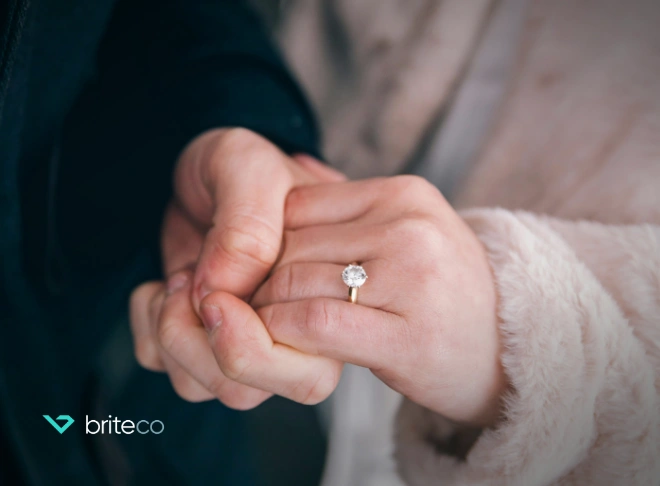
Set your engagement ring budget at whatever price point you can comfortably afford, rather than following outdated salary rules or adhering to certain societal expectations. As you’re deciding how much to spend on an engagement ring, your financial comfort, partner’s expectations, ring preferences, and values ultimately should determine how much you spend.
Yes, the average engagement ring price — $4,600 per The Knot’s 2026 Real Weddings Study — can give you an idea of what you might spend, but it still shouldn’t influence your decision. Remember: An engagement ring should be meaningful and special, not a source of financial stress.
Tips for buying an engagement ring you can afford:
- Understand the average engagement ring cost as context.
- Decide how much you can comfortably spend.
- Prioritize your partner’s preferred ring style over diamond size.
- Compare diamond, lab-grown, vintage, and alternative gemstone options.
- Avoid high-interest debt when it’s time to make your purchase.
- Leave room for engagement ring insurance, an appraisal, any needed resizing, and future wedding costs in your long-term budget.
Keep reading to learn from BriteCo jewelry expert Rachel Akmakjian about what impacts the cost of an engagement ring, how you can save money on an engagement ring, and more.
What You Will Learn
- The Real Answer: Spend What You Can Comfortably Afford
- What Is the Average Engagement Ring Cost?
- Is the Three-Month Salary Rule Still Relevant?
- How to Set an Engagement Ring Budget
- What Affects Engagement Ring Price?
- How the Four C’s Change Diamond Price
- Lab-Grown Diamonds, Natural Diamonds, and Diamond Alternatives
- Settings, Metals, and Style Choices That Affect Cost
- Where to Shop: Online Retailers, Local Jewelers, and Diamond Districts
- Smart Ways to Save Without Sacrificing Meaning
- Costs to Plan for After You Buy the Ring
- Should You Finance an Engagement Ring?
- Engagement Ring Budget FAQs
- Conclusion: The Right Ring Budget Is the One That Fits Your Life
The Real Answer: Spend What You Can Comfortably Afford
While an engagement ring can be a significant purchase, always base your budget on what you can comfortably afford given your current financial situation.
Before setting your engagement ring budget in stone, consider your income and savings, existing debt, monthly cash flow, and whether or not financing would create unnecessary stress. Keep in mind that, after the proposal, you’ll have upcoming wedding expenses to cover, too.
The ring itself will also come with extra costs beyond what’s listed on the price tag, such as resizing fees and insurance. (Not sure when to insure an engagement ring? Do so as soon as possible after purchasing the ring!)
Additionally, think about how your budget aligns with your partner’s personal style and ring expectations, as well as your shared values. For example, do you, as a couple, value gem size, quality, history, customization, or practicality most?
Bottom line: A good engagement ring budget is one that lets you buy a meaningful ring without impacting your financial stability.
What Is the Average Engagement Ring Cost?
The national average amount that couples spend on an engagement ring is $4,600, per The Knot 2026 Real Weddings Study. However, there’s no rule that you must spend this amount on an engagement ring, and budgets vary greatly.
Keep in mind that averages are increased by higher-budget purchases, and many, many couples spend much less than this, and still choose a beautiful ring. Additionally, a vast array of factors influence pricing, including location, retailer, diamond type and carat size, metal, and setting/design.
So, don’t feel pressured to spend the average or above the average, if it doesn’t fit your financial reality.
Is the Three-Month Salary Rule Still Relevant?
The three months rule — that you should budget the equivalent of three months’ salary for an engagement ring — was a marketing campaign-fueled ploy to encourage shoppers to spend more, and it is no longer relevant.
“Most couples don’t follow that old idea,” Akmakjian says, “and instead they spend based on their own financial comfort. For some that might be above the average, for others, it’s way below.”
Following the three-month rule, someone with the average US salary would spend roughly $15,000 on a ring, and that is far above what many buyers actually spend. Most spend somewhere around one month’s salary.
| Old Rule | Why It Doesn’t Work | A Better Approach |
|---|---|---|
| Spend three months’ salary on an engagement ring | Ignores debt, savings, location, wedding plans, and partner preferences | Set a ring budget based on your financial comfort |
| Spend one month’s salary on an engagement ring | Still arbitrary and doesn’t fit someone’s personal circumstances | Build a ring budget around your real cash flow |
| Spend the national average on an engagement ring | Doesn’t consider your personal circumstances | Use averages only for context, not as a rule |
Once you do have that ring in hand, who pays for engagement ring insurance? If you purchased the ring, go ahead and insure it now. Then, you can turn the policy over to your fiancé, post-proposal, if desired.
How to Set an Engagement Ring Budget
- Add up the amount of total savings you currently have available.
- Subtract the amount you might need for an emergency fund and to maintain financial stability.
- Account for existing debt as well.
- Estimate your upcoming wedding budget, plus moving, travel, and/or honeymoon costs.
- Consider additional costs, such as resizing fees and insurance. You can estimate how much engagement ring insurance costs by multiplying your ring budget by 0.05-1.5%.
- Decide whether you’ll need to finance the ring. (Make sure to compare all your payment options and their terms, promotional periods, interest rates, and payoff timing before committing. Paying interest will make the ring cost more.)
- Set your budget based on the above and choose a hard upper limit before shopping.
Comfortable Ring Budget = Available Savings + Planned Monthly Payments − Debt/Wedding Pressure Buffer
What Affects Engagement Ring Price?
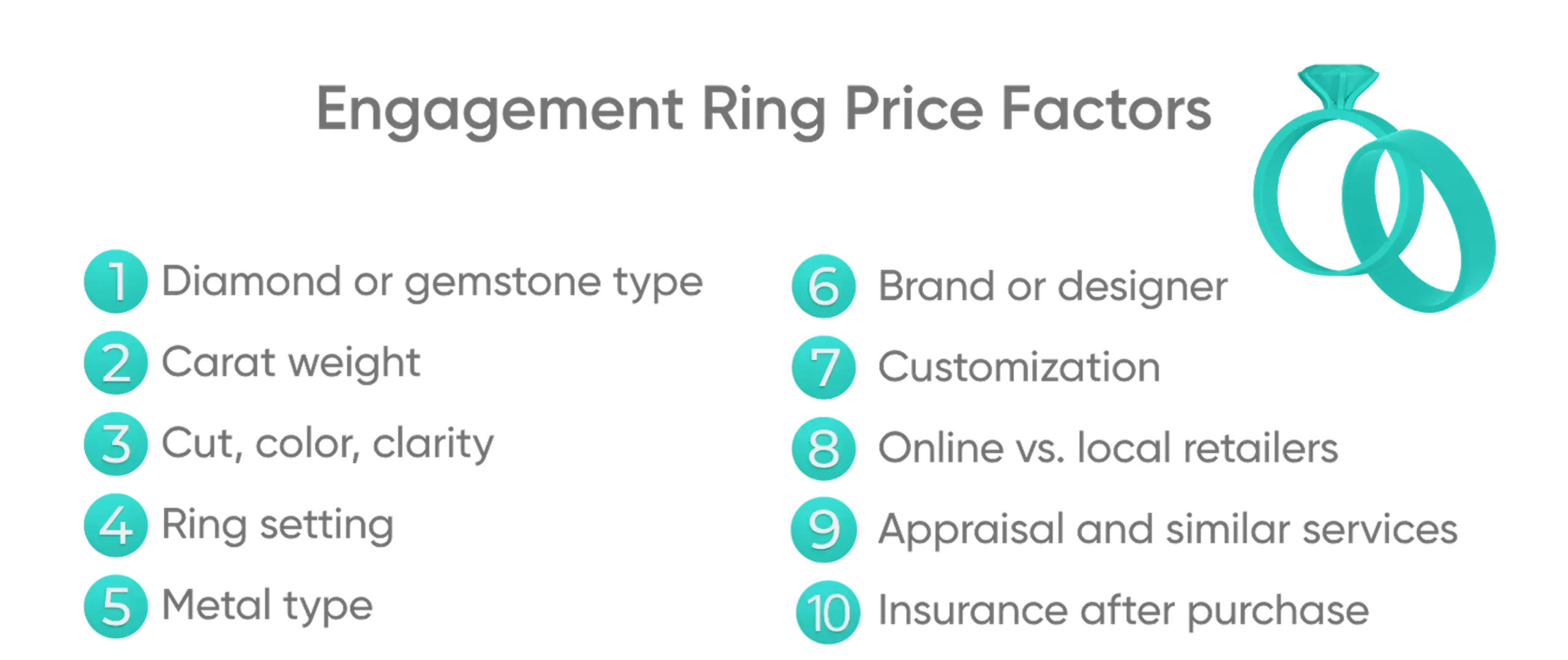
Engagement rings come in at a huge range of price points, as cost will vary based on stone and metal choice, craftsmanship, brand, diamond sourcing, retailer, and any additional services.
The biggest factors affecting price include:
How the Four C’s Change Diamond Price
The better the cut, the higher the carat weight, the clearer the color, and the greater the clarity, the more expensive diamond engagement rings will be.
- Cut: Strongly affects sparkle and should be prioritized when shopping
- Carat weight: Strongly affects price, especially near whole-carat marks
- Color: Depending on personal preference and metal choice, you often can be a little more relaxed about diamond color and save some money
- Clarity: Many inclusions are not visible to the naked eye, so, again, you can be a little more relaxed about clarity if you want to save cash
It’s entirely possible to purchase a high-quality diamond while also saving a bit, as you make a few tradeoffs. You can often adjust your color, clarity, or carat priorities to get a better price on a diamond.
| If you want to save money… | Consider… | Why? |
|---|---|---|
| Without losing sparkle | Prioritize diamond cut over size | Cut affects diamond brilliance |
| With no visible downgrades | Choose a diamond with eye-clean clarity, rather than a higher clarity rating | Imperfections are often invisible to the naked eye |
| Without sacrificing style | Choose a diamond that’s slightly under a whole carat | Prices can drop near carat thresholds |
| On a yellow gold ring | Choose a diamond with a lower color grade | Warm metal can hide warmth in a diamond |
Lab-Grown Diamonds, Natural Diamonds, and Diamond Alternatives
When comparing a lab grown vs. natural diamond engagement ring, as well as engagement rings that feature diamond alternatives, in general, lab-grown diamonds will be more affordable than natural diamonds, while still being held to the same Four C’s standards.
“More couples than ever are choosing lab-grown, not just for price, but also ethical and environmental reasons,” Akmakjian says. “With lab-grown options, couples have more flexibility to prioritize what matters most to them, whether that’s size, quality, or budget savings.”
Meanwhile, diamond alternatives also may help you achieve a desired style at a lower price.
| Option | Cost | Best For | Potential Downsides |
|---|---|---|---|
| Natural diamonds | Usually cost more | Traditional buyers, as natural diamonds remain the standard for most | Prices can rise quickly, based on the 4 C’s |
| Lab-grown diamonds | Often cost less | Those who want a larger diamond on a budget | Resale possibilities and long-term value aren’t as great as what you’d get with a natural diamond |
| Moissanite | Costs less | Those who want sparkle and size, but don’t need a diamond | It’s just not a diamond |
| Sapphire/Other alternative gemstones | Varies widely | Those seeking individuality and color variety | The stones’ durability varies |
| Vintage rings | Varies widely | Shoppers who want a ring with character and history | You’ll need to check the ring’s condition very carefully |
Settings, Metals, and Style Choices That Affect Cost
Beyond the center stone, several factors that can also affect the cost of an engagement ring include the ring setting, precious metal chosen for the band, and overall style.
Important factors affecting ring cost, beyond the center stone:
- Ring settings: Some types of ring settings are more expensive than others, with a solitaire setting being more affordable than a three-stone setting, and pavé being more affordable than a halo setting.
- Band style: Simple bands will be more affordable than those featuring detailed craftsmanship.
- Precious metal: White gold and yellow gold are more affordable than platinum.
- Design: Custom work will generally be more expensive than buying an existing ring at the jewelry counter.
- Wedding bands: If you need a matching wedding band with a specific design, that can further increase the costs.
- Maintenance: Some rings require greater long-term maintenance or care, such as rings with risky, high-profile settings.
Where to Shop: Online Retailers, Local Jewelers, and Diamond Districts
When you’re ready to go engagement ring shopping, you have a lot of options, including online retailers, jewelry stores, and your local diamond district. In-person shopping provides a greater degree of hands-on care and potential future services like repairs and cleaning, and online options offer convenience and customization.
| Where to Shop | Best For | Pricing Considerations | Service Considerations | Red Flags to Watch Out For |
|---|---|---|---|---|
| Online Retailers | Buyers who want convenience and a lot of options all in one place. | You can find great deals online, but keep in mind what you’re sacrificing: seeing the ring in person, hands-on jeweler expertise, etc. | You may be able to virtually talk to a jeweler, and returns and warranties may be offered | Unclear policies, poor customer reviews |
| Local Jewelry Stores | Those who want to browse rings in person and establish a relationship with a local jeweler | Prices may be higher than what you’ll find online, but you may be able to negotiate | Personalized guidance, ring sizing, cleaning, repairs, and ongoing maintenance | High-pressure sales, vague warranties and information regarding the piece itself |
| Diamond Districts | Experienced shoppers who’ve purchased jewelry in the past | Lots of potential savings, but pricing can vary | Services will differ between vendors | High-pressure sales and vague warranties or guarantees |
| Custom Jewelers | Buyers who want something completely unique to them | Generally more expensive, unless you work with a designer with less experience | While you can expect a large degree of service during the design process, service may be limited after the purchase | No written contract, unclear timeline considerations |
| Vintage/Estate Sellers | Those who want a piece with history and character | Prices can range considerably based on factors such as history, provenance, materials, etc. | Expertise in the vintage/estate jewelry world, but likely little service after purchase | Missing documentation, unclear photos |
| Direct-to-Consumer Brands | Those who want a quick, contemporary, convenient shopping process | You can often find great deals from direct-to-consumer brands, due to their low overhead | Virtual consultations, return policies and warranties; if the brand has a showroom, you may be able to get additional services after purchase | Limited in-person opportunities, unclear or vague warranties or return policies |
“Where you live plays a huge role in how much money you spend on an engagement ring,” Akmakjian says. “In big cities like New York, Los Angeles, or Chicago, it’s common to see budgets above the national average, sometimes well over $10,000. Meanwhile, in smaller towns or rural areas, couples often spend less, sometimes closer to $3,000 to $4,000.”
When buying engagement rings, compare prices but don’t let price be the only deciding factor as you weigh your options. Compare like-for-like specs only. A cheaper ring is not automatically a better deal if stone quality, the seller’s return policy, available certification, or the ring’s craftsmanship is less than ideal.
Once you’ve found the perfect ring for you, learn how to insure an engagement ring, and keep it protected from theft, loss, accidental damage, and more.
Smart Ways to Save Without Sacrificing Meaning
Your dream ring could cost significantly less if you:
- Buy just under whole-carat weights. “Going to 0.99 or 1.99 can save you money while looking almost identical to the eye,” Akmakjian says.
- Prioritize a great cut over buying the average engagement ring carat size.
- Choose eye-clean clarity.
- Use yellow gold to make warmer diamonds look intentional.
- Consider lab-grown diamonds.
- Consider vintage rings.
- Choose a simpler setting.
- Start with a starter ring and upgrade later.
- Compare quotes from multiple retailers.
- Shop during promotional periods.
- Avoid paying for features your partner will not notice or value.
Costs to Plan for After You Buy the Ring
The cost of an engagement ring is only the first in a long line of expenses that will also include:
- A ring appraisal
- Engagement ring insurance
- Resizing, if needed
- Ongoing cleaning and maintenance
- Repairs, if needed
- Wedding bands (so two rings extra)
- Future upgrades
- A travel ring or safe storage
- Financing interest, if applicable
Consider purchasing engagement ring insurance (How does engagement ring insurance work?), as well as matching wedding rings, at the same time you purchase the engagement ring.
Remember: If your engagement ring uses up your entire budget, you may be unprepared for future resizing, insurance, maintenance, or wedding expenses.
Should You Finance an Engagement Ring?
Financing an engagement ring can be a good option, but it’s important to analyze your payment options and pick the right one for your financial situation, so you don’t end up paying interest and, as a result, more than you should for the ring itself.
If you can’t use your own cash savings for the ring, you might consider credit cards or jewelry store financing with 0% interest rates, and then plan to pay off the ring before the promotional period ends. Other options include personal loans, layaway, and split payment plans. Always consult financial advisors for major budget decisions.
Before financing a ring, ask yourself:
- Can I comfortably afford the payment every month?
- What will I do when the promotional APR ends?
- Is there a prepayment penalty?
- Will the ring still fit within the broader wedding budget?
- Would a lower-cost ring create less stress?
As you evaluate financing and whether or not it’s the right choice for you, don’t forget to look into how much engagement ring insurance costs for your specific ring, so you can factor that expense into your budget as well.
Engagement Ring Budget FAQs
How much should you spend on an engagement ring?
You should spend however much your budget can comfortably accommodate. Don’t feel pressured to spend the average, or to follow the antiquated “three months” rule.
Is the three-month salary rule still relevant?
No, the three-month salary rule that dictates you should spend the equivalent of three months of your salary on an engagement ring is no longer relevant. If most Americans did so today, they would spend about triple what the average couple spends on an engagement ring.
What is the average engagement ring cost?
In 2026, average couples spend $4,600 on an engagement ring.
Is $1,000 enough for an engagement ring?
Yes, if that’s what’s most comfortable for your budget, you can absolutely find an engagement ring for $1,000, if you’re flexible about what the best engagement ring for your fiancé might look like.
Is $5,000 enough for an engagement ring?
Five thousand dollars is more than enough for an engagement ring, as it’s actually over what the average couple spends.
Conclusion: The Right Ring Budget Is the One That Fits Your Life
“The best engagement ring budget should not simply be the highest number you can justify,” Akmakjian says. “It should be the amount that lets you choose a meaningful ring while preserving the financial stability and life you are building alongside your partner.” Don’t rely on averages, outdated salary-based rules, or social media to dictate your budget; look to your financial reality, partner’s preferences, and your shared goals instead.
Once you choose your ring, the next step will be to document it (you’ll need an appraisal and to learn how to photograph jewelry for insurance purposes), and then protect it with coverage equivalent to its value.
Check your price for engagement ring and wedding ring insurance now.
Quiz:
The Engagement Ring Calculator You’ve Been Searching For and it’s FREE!
UP NEXT: How Much Does Engagement Ring Insurance Cost?

Author