When a couple is getting engaged, either person in the relationship can pay for the engagement ring insurance. But ideally the individual who actually owns and possesses the engagement ring would pay for their own jewelry insurance policy.
It’s not always that straightforward, though. The original ring buyer may hold on to the ring for months or longer before proposing, at which point their fiancé then takes ownership of the ring. So who pays for engagement ring insurance based on the timing?
- Before the proposal, the one proposing and buying the ring will typically insure it first.
- Then, after the proposal, the one who wears the ring will take over the policy.
- However, if the ring is financed, shared, transferred from one owner to another, or added to a household policy, necessary coverage details may vary based on several factors.
“Traditionally it’s been whoever’s purchased the ring has purchased the insurance along with it,” says BriteCo founder and CEO Dustin Lemick. “By no means is that the standard anymore.”
Let’s look at everything you need to know about paying for an engagement ring insurance policy, including not only who pays, but also when to buy coverage and what to do after the ring is paid off, you get married, or move.
What You Will Learn
- Who Pays for Engagement Ring Insurance Before the Proposal?
- Who Pays After the Proposal?
- Can You Transfer Engagement Ring Insurance After the Proposal?
- Who Pays If the Couple Lives Together, Rents, or Shares a Home?
- Is Homeowners or Renters Insurance Enough?
- Why Specialized Jewelry Insurance May Be the Cleaner Option
- What Documents Does the Payer Need?
- How Much Should the Payer Expect to Spend?
- Warranty Vs. Insurance: Who Pays for What?
- What Happens If You Need to File a Claim?
- What If the Ring Is Financed or Returned, or Ownership Changes?
- Checklist: How to Decide Who Should Pay and Get Insured
- Engagement Ring Insurance FAQs
- Conclusion: The Right Person to Pay Is the Person Who Can Keep Coverage Accurate
Who Pays for Engagement Ring Insurance Before the Proposal?
Before the proposal, the engagement ring purchaser often will get the ring insured initially, as they actively have the ring in their possession, control where it is stored, and are at risk of losing their financial investment if anything happens to the ring before they propose.
In terms of when to insure an engagement ring, the buyer should secure a policy immediately after purchase.
Proposal planning creates ample opportunity for loss, theft, and damage, as engagement rings are frequently hidden, transported, shown to family members and friends, and traveled with. Theft from a car, mysterious disappearance after showing someone the ring, or accidental loss during proposal practice — it’s all a very real possibility.
Who Pays After the Proposal?
After the proposal, it’s often best for the person actively wearing the ring to take over the engagement ring insurance policy contract and its payments. They’re the one determining the ring’s level of risk and they will be best equipped to make a claim, if ever needed.
However, this isn’t a hard and fast rule, as situations may vary based on ring payment status, individual households, and insurer requirements.
| Scenario | Who pays for insurance | What to check |
|---|---|---|
| The buyer is still paying for the ring | The buyer may keep paying for the insurance, as they still have a financial investment in the ring | Ownership and lender/payment obligations |
| The ring recipient owns and wears the ring | The recipient may take over the insurance payments if they fully own the ring | That the policyholder name and address is correct on the insurance policy, after the transfer of ownership |
| The couple shares finances and a household | Either partner can pay or they can pay jointly | Billing and policy details reflect the correct payee(s) |
| The ring is transferred or returned | If the ring is transferred, so is the policy (if the new owner desires); otherwise pursue policy cancellation | Your insurer’s policy update or cancellation process |
Note that the policyholder and the person actively paying the premium are not always the same.
Can You Transfer Engagement Ring Insurance After the Proposal?
An insurance policy may be updated or transferred to another person after a proposal, but it’s dependent upon your insurance company and its policy terms.
If you’re able to transfer the policy:
- Update the policyholder name to that of whoever currently owns and wears the ring.
- Update the policy mailing address if the wearer lives at a different address.
- Update the policy billing information if the new policyholder will be paying the premium.
- Confirm that your various coverage options will still apply after the transfer.
- Ask your insurer whether a new quote or underwriting review is needed.
- Save the updated policy documents.

Who Pays If the Couple Lives Together, Rents, or Shares a Home?
If a couple lives together, they may consider sharing the cost of engagement ring insurance, and either purchasing a stand-alone jewelry insurance policy or using their existing homeowners insurance or renters insurance for coverage.
However, keep in mind that a standard home insurance or renters insurance policy may not provide enough coverage for the average engagement ring.
| A Couple’s Living Situation | How to Pick Coverage and Who Pays |
|---|---|
| The ring buyer and wearer live separately | Where is the ring primarily kept? Whoever holds possession of the ring should cover it and pay for the coverage |
| Couple lives together and rents | See if your existing renters coverage will cover the full value of your ring and, if so, consider adding it to the policy you both already pay for |
| Couple owns a home | Does the couple’s existing homeowners policy limit jewelry coverage? If so (and it’s likely), the couple may purchase a standalone policy together |
Then, once you’re married or if you move, adjust your coverage accordingly. The policyholder and/or address on your policy may need updating.
Is Homeowners or Renters Insurance Enough?
Homeowners and renters policies provide very limited personal property protection, and high-value jewelry often needs specific scheduling or separate, standalone jewelry coverage.
Homeowners and renters insurance only protects jewelry under very specific circumstances (loss and accidental damage are not covered, for example). Even when a claim is accepted, these policies rarely pay out jewelry’s full appraised value, and also require a deductible, leaving you with not-insignificant out-of-pocket costs. Additionally, claims can affect your future premiums.
“This ring is worn every single day. It’s exposed to travel, workouts, hand-washing, airports, outdoor activities, pretty much everything,” Lemick says. “If it gets damaged, stolen, or accidentally lost — and trust me, it happens more often than people even realize — your homeowner’s or renter’s policy usually won’t cover it fully.”
Before assuming your jewelry is covered in full by homeowners or renters insurance, check your policy’s coverage limits. In many cases, additional coverage in the form of stand-alone jewelry insurance is necessary to fill in the gaps left behind by homeowners’ and renters’ limited coverage.
Why Specialized Jewelry Insurance May Be the Cleaner Option
A specialized jewelry insurance policy can be easier to manage in situations where one person bought the ring, another wears it, the ring may move between addresses, and/or a couple wants jewelry-specific coverage.
As compared to standard home/renters insurance, standalone policies come with more comprehensive coverage and benefits such as:
- Worldwide coverage that matters for travel, honeymoons, and destination proposals
- Coverage for up to 125% of a ring’s appraised value
- Coverage for loss, theft, damage, and mysterious disappearance
- Easy online updates to policyholder status, address, etc., after the wedding
- Jewelry-focused claims processes that allow for working with a preferred jeweler
What Documents Does the Payer Need?
Before buying or updating an engagement ring insurance policy, the intended policyholder should gather the following documents:
- Receipt or proof of purchase
- Appraisal or valuation (Do I need an appraisal to get jewelry insurance? Yes, you’ll want to get your ring appraised, if you haven’t yet)
- Diamond certificate, if available (jewelers typically provide this at the point of sale)
- Photos of the ring
- Metal, stone, and setting details
- Your jeweler information
- The address where the ring will be kept
- Existing policy details, if adding coverage elsewhere
Documentation such as this helps the insurer understand the ring’s value and potential replacement needs.
How Much Should the Payer Expect to Spend?
Pricing for engagement ring insurance depends on the ring’s value, your location, your chosen deductible, and your chosen coverage type, among other factors. But engagement ring insurance usually starts at around 1%-2% of the ring’s value per year, meaning a ring that you bought for five thousand dollars may cost as little as $50 per year to insure.
Given that, many couples find engagement ring insurance worth the cost.
Whether the payer is the ring buyer, wearer, or both (the best payer arrangement is the one that keeps coverage active and correctly tied to the ring), keep in mind that low-cost premiums can mean a higher deductible at claim time, resulting in more out-of-pocket responsibility for you. It may make more sense to opt for higher premiums with a $0 deductible. Additionally, the higher your ring’s value, the higher your premium will be.
Factors that will impact how much you spend on engagement ring insurance:
- The ring’s value
- Your location
- Your chosen deductible
- Chosen coverage type
Warranty Vs. Insurance: Who Pays for What?
A warranty and insurance are two separate forms of jewelry protection (and either person can pay for either), with a jewelry warranty covering certain maintenance and manufacturing issues, and insurance covering loss, theft, and accidental damage.
So what will engagement ring insurance cover vs. your ring’s warranty coverage?
| Protection Type | Usually Paid For By | Usually Helps With | Usually Does Not Replace |
|---|---|---|---|
| Jeweler warranty | Buyer or ring owner | Maintenance, some defects, possible rhodium plating or resizing terms | Loss, theft, broad accidental damage |
| Insurance | Buyer, wearer, or couple | Covered loss, theft, accidental damage, repair/replacement | Normal wear or exclusions in the policy |
What Happens If You Need to File a Claim?
The person listed on the insurance policy should file any necessary jewelry claim, but both partners may need to share documentation with the insurer, if one purchased the ring originally and the other now wears it.
Here’s how jewelry insurance works when you file a claim:
- Gather your appraisal, receipt, photos, and claim details.
- File the claim as soon as possible after the theft, loss, or damage occurs.
- Ask whether repair or replacement must be approved by the insurer before work starts.
- Confirm whether the policy allows use of a preferred jeweler.
- Save all claim communications.
- Get your repair or replacement.
BriteCo’s claim process starts with an online claim form, and for replacements BriteCo pays as much as 125% of jewelry’s value for a piece of the same kind.
What If the Ring Is Financed or Returned, or Ownership Changes?
| Scenario | Who Pays for Insurance | Other Steps to Take |
|---|---|---|
| Ring is financed | The ring wearer may pay for insurance, or the purchaser may pay for insurance while they continue to pay off the ring, as they still have a financial interest in the ring. | Whoever pays, make sure the ring is insured as quickly as possible and keep all relevant documents on hand, in case they’re needed for a claim. |
| Ring is paid off after the proposal | The ring wearer typically pays, unless the couple lives together and they share the expense. | After the ring is paid off, ensure that your coverage and covered value are consistent with the ring’s current value. |
| Couple moves to a new address | The same person paying for the policy will continue to do so. | Notify the insurer of the new address, and inquire whether your premium will still be the same. Geographic location affects insurance cost, and a new underwriting review may be necessary. |
| Ring is returned after a breakup | The original ring buyer is now responsible for paying for insurance. | Remove the former owner from the policy and consider if you want to continue insuring the ring (if you keep it) or if you plan to sell the ring. |
| Ring is upgraded or reset | The same person paying for the policy will continue to do so. | Get the jewelry reappraised and supply that new appraisal to your insurer. |
| You had the ring reappraised | The same person paying for the policy will continue to do so. | Supply that new appraisal to your insurer. |
| Ring is added to a shared household insurance policy | Whoever pays for the household insurance policy would then be paying for the ring insurance. | Make sure the household insurance policy provides enough coverage for the ring and schedule it if necessary. |
Contact your insurer anytime the ring ownership or address changes, you get a new appraisal, or billing responsibilities change.
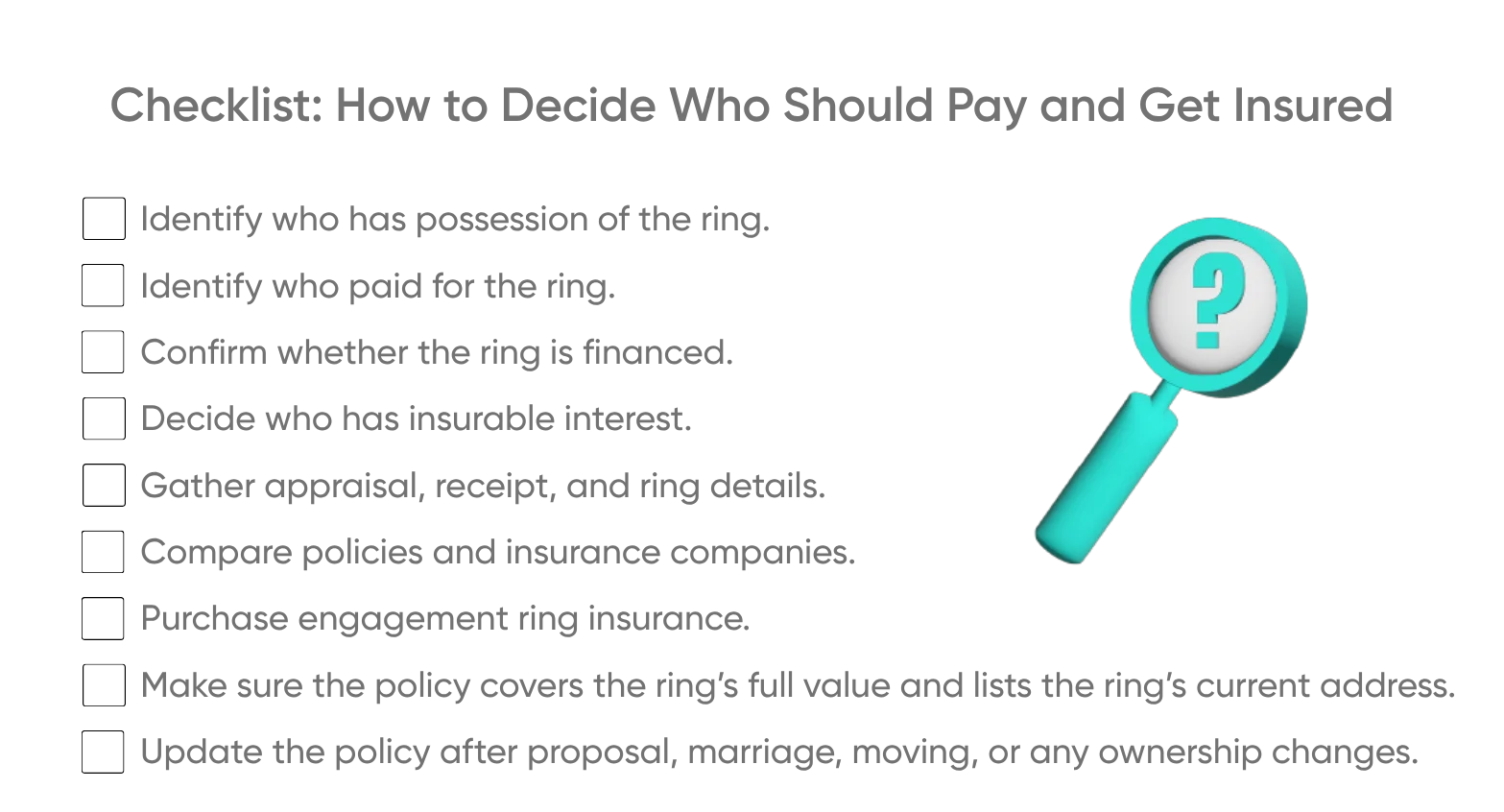
Checklist: How to Decide Who Should Pay and Get Insured
Engagement Ring Insurance FAQs
Who pays for engagement ring insurance?
Typically whoever has the ring in their possession will pay for the engagement ring insurance.
Does the buyer or wearer insure the ring?
Typically the buyer insures the ring immediately after purchase, and then turns the policy over to the wearer after proposal.
Can I insure a ring before I propose?
Yes, and in fact, you should always insure a ring before you propose. Ideally, right after you buy the ring, you’ll get it covered. Loss, theft, or damage can all occur between ring purchase and proposal.
Can engagement ring insurance be transferred after the proposal?
Yes, most jewelry insurance companies will allow you to transfer the policy after the proposal. Verify with your specific provider.
Can I insure a ring I did not buy?
Yes, even if you did not pay out of pocket for the ring yourself, if it’s in your possession, you may insure it.
Conclusion: The Right Person to Pay Is the Person Who Can Keep Coverage Accurate
“The right person to pay for engagement ring insurance,” Lemick says, “is the person who can keep the policy accurate, active, and tied to the ring’s real ownership and location.”
Before the proposal, the buyer usually pays for engagement ring insurance; after the proposal, the wearer, owner, or couple may take over depending on ownership and insurable interest. The most important thing is maintaining a sense of security as circumstances change.
See why engagement ring insurance is absolutely worth it and protect your ring today. Get an online engagement ring insurance quote fast.
Appraisal Tool:
The Easiest Way to Get a Professional Jewelry Appraisal Valuation!
UP NEXT: December is Proposal Season: What the Data Says About Holiday Engagements

Author