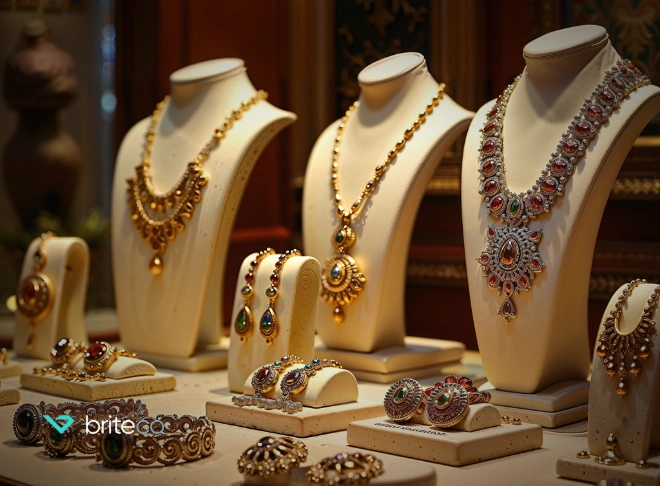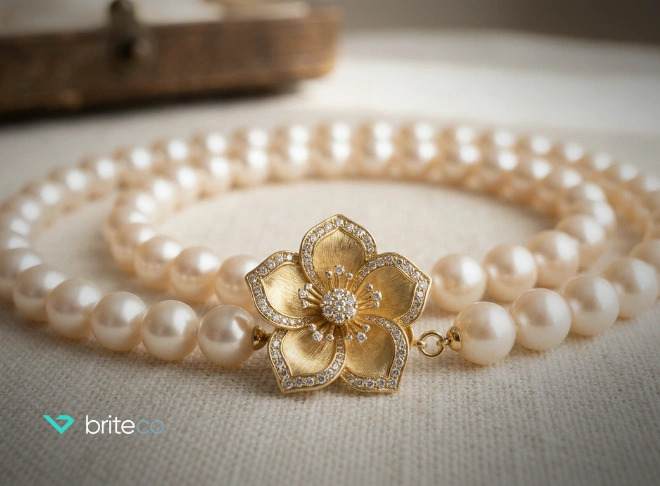
Vintage 1950s jewelry is characterized by Hollywood glamour and mid-century modern aesthetics, incorporating cultured pearls, rhinestone sprays, matching sets known as demi-parures, floral designs, and more.
Below, you’ll find the 10 1950s jewelry trends that defined the era, tips for how to identify authentic 1950s jewelry and accessories, and ways you can adapt this jewelry to fit your modern wardrobe. Plus, get advice for caring for jewelry from the 1950s.
Want to learn more about jewelry through the ages? Explore our decades series further, with our guides to jewelry from the 1970s, 1980s, and 1990s.
What You Will Learn
Top 10 1950s Jewelry Trends
 1. Pearl Power
 1. Pearl Power
Prominent 1950s jewelry styles made ample use of pearls, with women wearing them in single and double strands and as stud pearl earrings.
To identify 1950s pearl jewelry today, look for uniformed cultured pearls, and pieces that feature fishhook or screw clasps. Patina is also common on pearls from this era.
Consider wearing a 1950s pearl necklace as part of your bridal clothing, or, more casually, layering short strands with crewnecks or a similarly modest neckline.
2. Aurora Borealis Rhinestones
Aurora borealis (or AB) rhinestones are glass rhinestones that feature a lustrous, multicolored sparkle, and they could be found in many 1950s necklaces, earrings, brooches, and bracelets.
You can identify authentic 1950s AB rhinestones by looking for an iridescent coating and a foil backing.
Today, try wearing them with a cocktail dress, little black dress, cigarette pants, or similar clothes and outfits. (And, when caring for jewelry that features these rhinestones, avoid any soaking or ultrasonic cleaners, both of which can damage them.)
3. Demi-Parures
The demi-parure trend refers to matching boxed sets of jewelry that often included a necklace, bracelet, clip-on earrings, and sometimes a brooch as well.
If you’re shopping for one of these sets specifically, always look to see if the original box is included in the purchase, as it can add value.
When styling demi-parures today, wear one favorite piece from the set on a day-to-day basis, but then break out the full set for special occasions.
4. Clip-On and Screw-Back Earclips
Clip-on and screw-back earrings, known as earclips, were a popular pick for many women, enabling the wearer to accessorize with earrings with no need for pierced ears.
Today, 1950s earclips can be identified by looking at a piece’s hardware. Spring tension and screw mechanisms were common, as were paddle and comfort pads. As far as trendy designs, heavy clusters of gemstones, beads, or the aforementioned Aurora Borealis rhinestones were popular.
For a more comfortable wear, add silicone pads to any 1950s earclips you’d like to style, and pair heavier earclips with a sleek hairdo.
5. Cocktail Rings
Cocktail rings wowed by incorporating gemstones arranged in starburst patterns or the ballerina design, which looks like a ballerina’s twirling tutu when viewed from above.
You can often identify this 1950s costume jewelry by its raised settings, radiating baguettes, or prong-set clusters.
When wearing cocktail rings, use them as a solo statement piece, as your only ring, with bracelets kept to a minimum, if incorporated at all.
6. Floral Sprays
Flowers go in and out of popularity as a jewelry motif, and, in the 1950s, they were in.
More specifically, 1950s style jewelry depicted flowers through the use of layered metalwork and pave rhinestones, and articulated petals were also popular.
If you’re lucky enough to land a 1950s floral brooch, pin it at the shoulder of a blouse or sweater, or convert it into a pendant for wearing as a necklace.
7. Atomic & Starburst Motifs
We already mentioned starburst designs for cocktail rings, but the entire atomic and starburst aesthetic was a favored choice during this time in history, across jewelry.
Jewelry that followed this aesthetic often featured orb-like settings, radiating spikes, and/or space age symmetry.
Today, let these iconic pieces shine on their own, by pairing them with modern minimalism.
8. Thermoset & Lucite Plastics
A hard, durable plastic material — known as Thermoset or Lucite, and available in a range of colorful hues — was used to make a variety of jewelry in the 1950s and the decades immediately preceding and following.
Pieces crafted from authentic Thermoset or Lucite plastic should be lightweight and warm to the touch, and you may be able to spot seams from the pieces’ original mold.
Wear these pieces with neutrals and allow their blues, reds, yellows and other bright tones to pop. Don’t store these pieces near heat, as it could damage the plastic.
9. Charm & ID Bracelets
Charm and ID bracelets have been around for a long time, and produced across many decades (and even now!), but 1950s charm and ID bracelets were more likely to feature heftier linked chains, with engraved ID plates. Travel-related and club charms were a favorite, and they’re still a nice retro find today, given that they lend the piece a historic, storied element.
Style vintage charm and ID bracelets alongside plain bangles and keep any rings simple.
10. Sweater Clips

A sweater clip features two decorative clips connected by a chain, with each clip fastened to either side of a button-up sweater or cardigan, keeping it in place. Often, these sweater clips featured the popular motifs of the day, like florals or bows, as well as rhinestones.
A sweater clip can be worn on your own cardigan, or on your collar.
How to Identify Authentic 1950s Pieces
- Look for hardware tells, such as clip-on or screw-back earrings, fold-over or box clasps, and safety chains on bracelets.
- Look for popular materials of the day, such as Aurora Borealis rhinestones, Thermoset plastics, and cultured pearls.
- Examine jewelry hallmarks, such as maker’s marks, stamps, and purity marks.
While shopping, also keep in mind that just because something is called “estate” jewelry, that doesn’t mean that it’s vintage or antique. Estate jewelry is any jewelry previously owned by another individual.
Want a deeper dive? See our guide to identifying vintage jewelry.
Care & Storage (Damage-Prevention Basics)
Reduce accidental damage to 1950s accessories and jewelry by always opting for a dry cleaning method first, avoiding ultrasonic cleaners, giving special attention to pearls and plastics, and checking your hardware regularly.
Dry Clean First
Before cleaning any jewelry using water and soap, try wiping away smudges or debris with just a soft brush and a microfiber cloth. While water and a gentle dish soap may be suitable for cleaning, say, silver or gold chain bracelets from this era, or a gemstone such as a diamond or ruby, you should avoid soaking foiled rhinestones under all circumstances.
No Ultrasonic
Don’t forget that you should never use an ultrasonic cleaner for jewelry featuring rhinestone crystal.
Pearl Care
Pearls require an extra level of care, and you should always put them on last when getting dressed, after you’ve applied all cosmetics, perfumes, lotions, etc. Then, take them off first when getting undressed. After each and every wear, wipe them off with a soft cloth.
Thermoset/Lucite
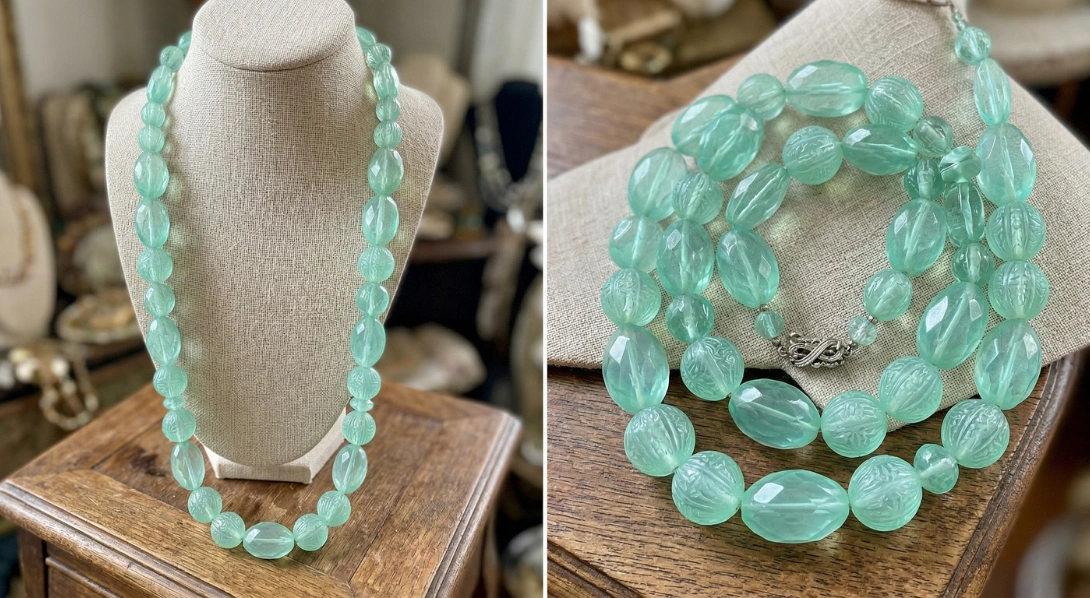
For plastics, avoid storing them near, or ever exposing them to, heat or solvents. When storing these pieces, use breathable pouches.
Hardware Checks
Every quarter or so, inspect your vintage jewelry’s hardware, such as clasps and earclips, and ensure they’re working properly. This can ensure that you don’t accidentally lose a piece while you’re wearing it.
FAQs
1. What jewelry did women wear in the 1950s?
Pearls, rhinestone sprays, floral/bow brooches, and matching sets were staples.
2. What is a demi-parure?
A coordinated set of jewelry, often including a necklace, bracelet, and earclips, and sometimes a brooch.
3. How can I tell Aurora Borealis rhinestones from regular ones?
Look for an iridescent coating and foil backs, which are indicative of Aurora Borealis rhinestones.
4. Were clip-on earrings common in the 1950s?
Yes — most earrings in the 1950s were clip-on or screw-back.
5. Can I clean rhinestone jewelry in an ultrasonic jewelry cleaner?
Avoid ultrasonic cleaners for jewelry featuring glued or foil-back stones. Stick to dry cleaning methods instead.
6. What do jewelry stamps and symbols mean?
Maker’s marks and purity stamps identify a piece’s origin and metal. Learn more with our guide to jewelry stamps.
7. Is “estate” the same as “vintage”?
No — “estate” means jewelry was previously owned and it can be any age. “Vintage” jewelry refers to jewelry that’s between 50 and 100 years old.
Grow Your Collection of Vintage Jewelry — Then Protect It, with Comprehensive Jewelry Insurance
Enjoy the timeless elegance of 1950s jewelry styles when you learn to identify authentic pieces from this era and then how to incorporate them into your own wardrobe effortlessly.
Learn more about vintage jewelry when you explore our guides to jewelry from the 1970s, 1980s, and 1990s. Additionally, learn more about vintage jewelry identification and how to identify jewelry stamps and marks so you’re prepped for your next thrifting trip.
Then, protect your favorite pieces throughout your entire jewelry collection with comprehensive and specialty jewelry insurance from BriteCo. Get your quick and easy jewelry insurance quote now.
Related Articles:
Gender-Neutral Jewelry: A Practical Guide to Inclusive Style
How Often Should Jewelry Be Appraised?
The Most Famous Stolen Jewelry in History
Top 10 1940s Jewelry Trends
The 1960s Jewelry Styles Worth Bringing Back
Appraisal Tool:
The Easiest Way to Get a Professional Jewelry Appraisal Valuation!
UP NEXT: What are the Odds of Losing or Damaging Jewelry?

Author