There is no universally “better” choice when deciding between a lab-grown vs. natural diamond engagement ring. A lab-grown diamond is usually a better fit if your priority is maximizing stone size and quality for your budget. Natural diamonds may be a better fit if rarity, geological origin, tradition, and stronger secondary-market demand matter more to you and your fiancé.
BriteCo’s recent data surrounding lab-grown’s share of the engagement ring market, as well as median stone prices and sizes, shows that demand for lab-grown diamond engagement rings is up, with these rings featuring larger stones for a smaller price:
- Lab-grown diamonds’ share of the market: 47% in 2025 → 51% in January-June 2026
- 2025 median ring sales price: $4,557 for lab-grown diamond rings vs. $12,961 for natural diamond rings
- 2025 median center stone: 2.16 ct in lab-grown diamond rings vs. 1.52 ct in natural diamond rings
With help from BriteCo gemologist Kaitlyn Rigdon, let’s compare the options further, so you can decide whether a lab-grown vs. natural diamond engagement ring is best for you.
What You Will Learn
- Lab-Grown Vs. Natural Diamond Engagement Ring: Which is Better for You?
- What Engagement Ring Buyers are Choosing Now
- Upfront Price: What Does Your Budget Actually Buy?
- Appearance and Durability: Is There a Practical Difference on the Hand?
- Grading Reports and Documentation: What Should You Ask For?
- Long-Term Market Value and Resale: Where the Difference Matters
- Tradition, Sentiment, and Rarity: Which Story Matters to You?
- Appraisal, Replacement Value, and Insurance
- Decision Table: Lab-Grown Vs. Natural Engagement Ring by Buyer Priority
- Lab-Grown Vs. Natural Diamond Engagement Ring FAQs
- Final Takeaway — Buy the Ring That Matches Your Priorities
Lab-Grown Vs. Natural Diamond Engagement Ring: Which is Better for You?
For engagement ring buyers, rings with lab-grown diamonds (a.k.a. synthetic or cultured diamonds) often offer a greater size and quality of stone for a smaller budget, while natural diamond engagement rings offer a greater sense of tradition.
| Lab-Grown Diamonds May Fit Better If… | Natural Diamonds May Fit Better If… |
|---|---|
| You want a greater carat size for the same budget | Geological rarity matters to you |
| You prioritize color/clarity at a lower price | Tradition matters strongly to you and your fiancé |
| A lower upfront spend suits your budget | You care more about the ring’s established resale demand |
| You want a ring with a large visual presence | You specifically want an earth-formed stone |
| Diamond origin is less important than appearance | Heirloom symbolism is part of the ring’s appeal |
Choose Lab-Grown if Size and Budget Lead the Decision
When you buy a lab diamond, you can often get a larger size stone, but at a more modest price point — without sacrificing the diamond’s quality, color, or clarity in the slightest (as lab diamonds are geologically identical to diamonds from nature).
With that money saved, you can redirect those dollars toward a nicer ring setting, your wedding, your honeymoon, or other upcoming priorities.
Choose Natural if Rarity and Origin Matter More
Natural stones, meanwhile, are rare and have an existing, established resale market. A natural diamond may be a good pick if you value these stones’ geological origin, finite natural supply, and traditional symbolism.
What Engagement Ring Buyers are Choosing Now
BriteCo’s Lab-Grown vs. Natural Diamond Report found that, currently, approximately half of engagement ring buyers are choosing lab-created diamonds.
Check out more data from the report:
| Metric | Natural Diamonds | Lab-Grown Diamonds |
|---|---|---|
| 2025 share of the engagement ring market | 53% | 47% |
| Jan-June 2026 share of the engagement ring market | 49% | 51% |
| 2025 median engagement ring sales price | $12,961 | $4,557 |
| 2025 median engagement ring center stone carat weight | 1.52 ct | 2.16 ct |
| 2025 median engagement ring price per carat | $8,428 | $2,057 |
Lab-Grown Used in Half of New Engagement Rings
Lab-grown diamonds appeared in 51% of newly appraised engagement rings from January through June 2026, up from 47% in 2025. As lab-grown diamonds continue to account for more and more of the industry’s supply of engagement rings, it’s clear that this option is no longer merely a niche alternative. “They are absolutely a good fit for engagement rings,” Rigdon says.
Lab-Grown Buyers are Choosing Larger Center Stones
Most lab-grown diamond buyers opt for larger stones. Observational market data finds the median center stone carat weight for lab-grown diamond rings in 2025 being 2.16 ct, in comparison to 1.52 ct for natural diamond rings.
That said, not everyone is purchasing a larger center stone when they go lab-grown. Some choose the same size stone that they might’ve purchased otherwise, and either enjoy the savings or opt for a diamond with a greater clarity or quality.
Upfront Price: What Does Your Budget Actually Buy?
Current engagement ring cost data reveals that, in 2025, the median cost of a natural diamond engagement ring was $12,961 and the median cost of a lab-grown diamond engagement ring was $4,557.
These savings allow shoppers to buy a larger center stone, buy a stone with a better color or clarity, or just spend less overall.
Compare Real Sales Price, Not Just Advertised Discount Percentages
In 2025, the median cost of a natural diamond engagement ring was $12,961 and the median cost of a lab-grown diamond engagement ring was $4,557. The median engagement ring price per carat was $8,428 for natural diamond rings and $2,057 for lab-grown diamond rings.
Bigger Stone Vs. Higher Specs Vs. Lower Spend
When comparing lab-grown vs. natural diamond engagement rings based on cost alone, ask yourself: If you’ll be spending the same no matter which you choose, what would you prioritize: carat size, color/clarity grades, natural origin, or getting a deal?
Your answer will help you narrow down your priorities and may just reveal which of the two options is best for you.
Appearance and Durability: Is There a Practical Difference on the Hand?
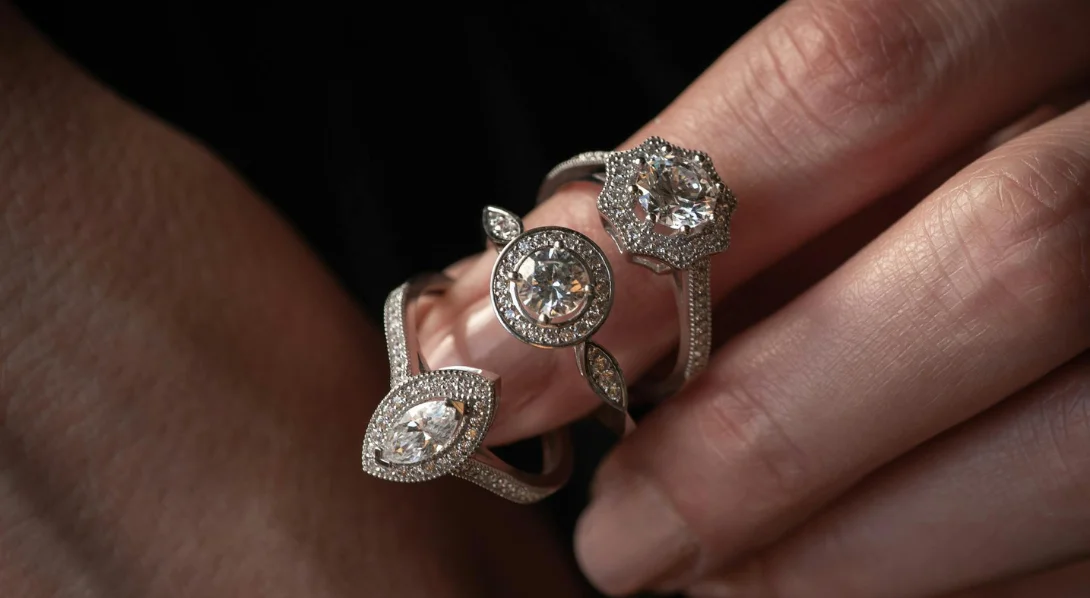
Lab-grown and natural diamonds share the same chemical composition, so if you’re asking if lab-grown diamonds are real, the answer is a resounding yes. “Lab-grown diamonds have the identical physical and chemical properties of natural diamonds,” Rigdon says. “The only difference is how they were made.” Both are suitable for daily-wear engagement rings.
| What You Can See in a Diamond | What You Can Prove Only Through Gemological Testing and Reporting |
|---|---|
| Size, clarity, cut, and color | Whether the diamond was lab-grown or mined, and, if the former, how the diamond was lab-grown |
Can You Tell Lab-Grown from Natural with the Naked Eye?
No, you cannot tell a lab-grown from natural diamond with the naked eye. Both exhibit the same fire, sparkle, brilliance, and visual performance when cut to high quality. “Even with a microscope,” Rigdon says, “it’s hard to tell the difference.” A grading report and specialist testing can confirm a diamond’s origin.
Are They Equally Durable for Daily Wear?
Both natural and lab-grown diamonds rate 10 on the Mohs hardness scale. They’re identical in terms of crystal structure and material, no matter if the stone was formed in a lab last week or under the earth’s crust billions of years ago.
Grading Reports and Documentation: What Should You Ask For?
When it comes to documentation and grading, lab-grown and natural diamonds are held to the same standards, and so you should always, before buying, verify and document the diamond’s:
- Origin
- Carat
- Color
- Clarity
- Cut
- Measurement
- Polish/symmetry
- Grading report number
- Laser inscription if applicable
Compare IGI, GIA, and GCAL Reports
When comparing IGI vs. GIA vs. GCAL, rest assured that all offer certified diamond grading services for lab-grown diamonds and natural diamonds alike, but the organizations may differ in terms of their methodology, reporting, and market positioning.
Their report confirms your diamond’s origin and all the details mentioned above, and is a valuable piece of documentation that you’ll need for future appraisals or insurance coverage.
Keep the Grading Report, Receipt, and Appraisal Separate
Your grading report, receipt, and appraisal are all different forms of diamond and jewelry documentation:
- Grading report: Describes/grades the diamond
- Receipt: Proves your transaction/purchase price
- Appraisal: Estimates a diamond’s replacement value for insurance or other valuation purposes
All are important and should be stored safely and separately.
Long-Term Market Value and Resale: Where the Difference Matters
Neither lab-grown nor mined diamonds are a guaranteed financial investment. However, natural diamonds currently have a more established resale market, while lab-grown prices have experienced substantial downward pressure as production has expanded.
BriteCo’s current data shows lab-grown price per carat fell from $4,622 in 2019 to $2,057 in 2025, while natural diamonds’ price per carat was $8,428 in 2025.
Natural Diamonds and Resale
When compared to lab-grown diamonds, there’s typically a stronger resale market for natural diamonds, though it’s not guaranteed. This is due to natural diamonds’ perceived rarity, stronger demand, and the established buyer-dealer network.
Lab-Grown Price Trends and Resale
Man-made diamonds have a significantly lower resale value than natural stones, as evolving technology makes lab-grown stones easier and faster to produce, making them more accessible. “If you sell your lab-grown diamond, you’re going to get pennies on it,” Rigdon says, “as opposed to selling a natural diamond where you’re going to get dollars. It’s really not even comparable.”
However, that market pricing does not negate the stones’ durability, beauty, and quality, which are equal to that of a mined stone.
Tradition, Sentiment, and Rarity: Which Story Matters to You?
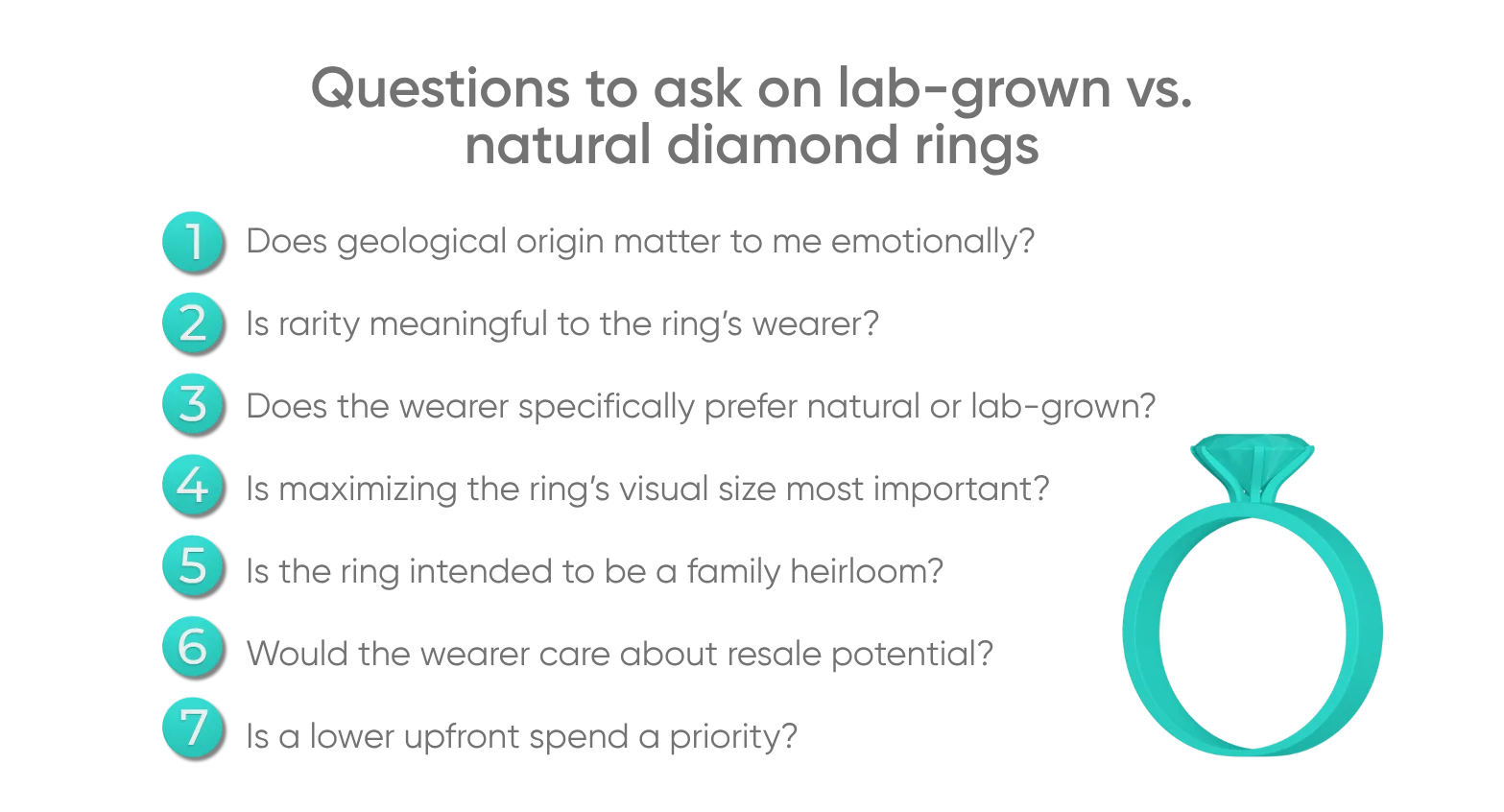
Beyond the finances, durability, and geological makeup, other factors that might influence someone’s decision to buy a natural vs. lab-grown diamond include tradition, sentiment, and rarity.
As you’re shopping for an engagement ring, ask yourself:
Why Some Buyers Prefer Natural
Some buyers prefer natural diamonds due to their increasing rarity as mining slows, their natural geological origin, the traditional symbolism of a natural diamond, and/or the established secondary market. “Natural diamonds hold their value a lot more than a lab-grown diamond,” Rigdon says. ”So if you ever want to upgrade in the future and trade in your diamond, you’re better off with a natural diamond.”
Why Some Buyers Prefer Lab-Grown
Other buyers prefer laboratory grown diamonds due to their preference for the diamond being sourced from a controlled laboratory environment, the ability to purchase a larger-sized or higher quality diamond at a smaller budget, and/or the low upfront cost.
Appraisal, Replacement Value, and Insurance
Whether you’re insuring real diamonds or a lab stone, your insurance cost will depend in part upon your diamond’s appraisal documentation and replacement value — not necessarily what you paid for the diamond upfront.
| Term | What It Means |
|---|---|
| Purchase price | What the buyer paid |
| Appraised/replacement value | Estimated current cost to replace like kind and quality |
| Resale value | What another buyer might pay in the secondary market |
Purchase Price Is Not Insurance Replacement Value
Do not assume that what you originally paid for any diamond is equal to its insurance replacement value. A range of factors influence replacement value, including documented characteristics (like chemical composition, clarity, etc.) and the current retail cost of replacing the piece.
Full, comprehensive insurance coverage based on the replacement value will ensure that, if a covered loss occurs, you can purchase a piece of like kind and quality, today — no matter what you paid for that piece originally.
Decision Table: Lab-Grown Vs. Natural Engagement Ring by Buyer Priority
“Some people like the rarity and the value that’s associated with natural diamonds,” Rigdon says, “while other people want to go for the size and the affordability of a lab-grown diamond.”
| Your Priority | Likely Better Fit | Why |
|---|---|---|
| Maximum carat for budget | Lab-grown | Lower current sales price per carat |
| Highest specs for fixed budget | Lab-grown | More budget room for a better size/color/clarity |
| Lowest upfront spend | Lab-grown | Current median sales price is substantially lower |
| Geological rarity | Natural | Formed naturally with finite supply |
| Traditional engagement-ring preference | Natural | Established historical positioning |
| Stronger resale-market expectation | Natural | More established secondary market |
| Everyday durability | Either | Both are diamond material, identical and with no difference in durability |
| Visual beauty/brilliance | Either | Quality and cut matter more than origin alone |
| Insurance eligibility | Either | Both can be insured when properly documented |
| Heirloom symbolism | Personal choice | Depends on what “heirloom” means to the couple |
| Biggest stone without raising budget | Lab-grown | BriteCo data shows larger median lab-grown center stones are available at lower prices |
Use our engagement ring comparison calculator to further weigh your options.
Lab-Grown Vs. Natural Diamond Engagement Ring FAQs
Are Lab-Grown Diamonds Real Diamonds?
Yes. Lab-grown diamonds have the core chemical and physical properties of a mined diamond, although their origin and growth environment differ from natural stones.
Can You Tell a Lab-Grown Diamond from a Natural Diamond by Looking at It?
No, regardless of which of the two primary methods (chemical vapor deposition or high pressure high temperature) was used to create the lab-grown diamond, it will not be visually different from a natural diamond.
Are Lab-Grown Engagement Rings Cheaper Than Natural Engagement Rings?
Yes. According to BriteCo’s data, 2025 median sales prices were $4,557 for lab-grown rings and $12,961 for natural-diamond rings.
Are Lab-Grown Diamonds as Durable as Natural Diamonds?
Yes, both are diamond material and both rate a 10 on the Mohs hardness scale.
Can a Lab-Grown Engagement Ring Be Insured?
Yes. BriteCo’s offers engagement ring insurance for both lab-grown and natural diamonds.
Final Takeaway — Buy the Ring That Matches Your Priorities
“The lab-grown vs. natural engagement-ring decision,” Rigdon says, “is less about which diamond is ‘real’ and more about which tradeoff you value: maximum size and quality for your budget, or natural rarity, tradition and a more established secondary market.”
- Lab-grown diamonds → Generally give you more size and specs for the dollar.
- Natural diamonds → Offer rarity, geological origin, and stronger established resale-market expectations.
- Either → Can offer excellent beauty, brilliance, and durability when well cut and graded.
- Both → Require accurate documentation when appraisal/replacement value matters.
Once you choose the ring that fits your priorities, keep its receipt, grading report, and appraisal documentation together so its characteristics and replacement value are clearly recorded. Then, get your jewelry insurance quote online in seconds.
Buying Guide:
The Secret to Diamond Buying: Natural vs Lab Grown
UP NEXT: How Much Does Engagement Ring Insurance Cost?

Author