As a couple, taking the next step to wedded bliss is a big one with many aspects to consider. Naturally, that includes thinking about engagement rings, what to buy, and how much to spend.
Whether you’re looking to buy an engagement ring or just curious about what people are really shelling out for rings these days, we’ve got the inside scoop. We’ve crunched anonymous data from appraisals for engagement ring insurance from our US customers to get you the latest numbers so you can budget accordingly.
Key Takeaways:
Average Engagement Ring Cost in the US
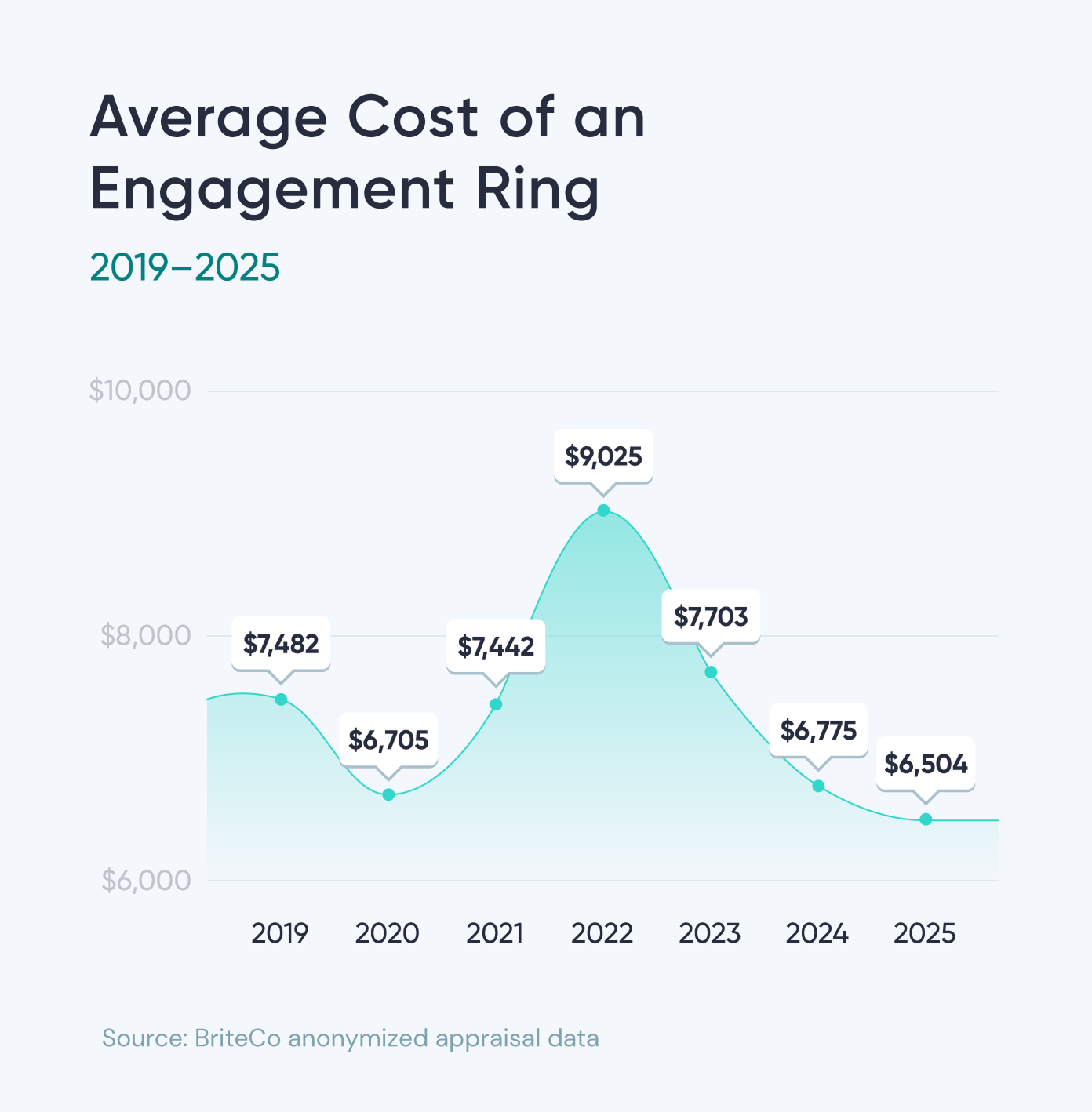
According to our data, the average engagement ring cost in the US is $6,504 in 2025. This reflects a downward trend in spending on engagement rings, as the 2024 average was $6,775, down from a five-year high of $9,025 in 2022.
Engagement ring spending tends to be cyclical, usually in line with overall consumer spending habits and concerns, along with market forces that impact prices. McKinsey consumer sentiment data for 2025 shows that more than 60% of consumers are changing their spending habits, with more than half cutting back on “nonessential” spending — not that an engagement ring isn’t essential!
What will $6,504 get you when buying an engagement ring? There are many choices at or around that price point, from diamond solitaire rings weighing one carat or more to three-stone rings, including diamonds or gems. You can get a beautiful ring in almost any style at that average price point.
What Is an Engagement Ring’s Cost by Color and Clarity?
When we talk about the color of a diamond, it actually refers to the degree of a diamond’s colorlessness. A “D” color diamond has no visible color and is the most expensive, while a diamond with a “Z” color appears light yellow and is the least expensive. Diamond color is graded as follows:
| Color Grade: | Diamond Color Characteristic: |
| D, E, F | Colorless (the rarest and most expensive) |
| G, H, I, J | Near colorless |
| K, L, M | Faint yellow |
| N, O, P, Q, R | Very light yellow |
| S, T, U, V, W, X, Y, Z | Light yellow (the least rare and least expensive) |
Diamond clarity is graded on the absence of flaws visible when the diamond is magnified by 10x. Internal flaws are known as “inclusions,” while external flaws are known as “blemishes.” Clarity is graded as follows, with FL being the most expensive grade and I3 the least expensive:
| Clarity Grade: | Definition: |
| FL – Flawless | There are no flaws under 10x magnification |
| IF – Internally flawless | No inclusions, but there may be minor blemishes |
| VVS1 and VVS2 – Very, very slightly included | Has minute inclusions that are difficult to see under magnification |
| VS1 and VS2 – Very slightly included | Has minor inclusions, not typically noticeable to the naked eye |
| SI1 and SI2 – Slightly included | Has noticeable inclusions under magnification, which may be visible to the naked eye |
| I1, I2, and I3 – Included | Has obvious inclusions under magnification and probably visible to the naked eye |
Diamonds are graded by color, then by clarity. They can also be grouped by whether they are natural or lab-grown. Our data shows a comparison between 2020 and 2025.
Across all grades, we found the average cost of the highest grade lab-grown diamonds has decreased $8,613 over the last five years, hitting $5,670 in 2025, after a high of $14,283 in 2020. That’s a significant amount that can be redirected to wedding expenses!
Among natural diamonds, there was an increase in average cost across all grades except for the highest grade. Diamonds of the highest grade saw an average decrease from $19,466 to $17,552. So, if you’ve got your heart set on a natural diamond, expect that prices will likely keep climbing. A combination of high demand for natural diamonds, supply chain disruptions, and economic sanctions is keeping diamond prices high.
Average Cost of D-F Diamond Color Engagement Rings
As mentioned above, D-F colors are the “colorless” grades of diamonds that usually make for the highest diamond ring cost. According to our comparative data from 2020 and 2025, overall more people are buying lab-grown diamonds in this category than ever before, likely due to the increased prices of natural diamonds. D-F colored diamonds make up 53% of all diamond engagement ring purchases, showing that people prioritize a better quality color even while managing tighter budgets.
| Distribution of Natural Diamond vs. Lab-Grown D-F Diamond Color | ||
| 2020 | 2025 | |
| Natural Diamond | 71% | 24% |
| Lab-Grown Diamond | 29% | 76% |
Looking at the average cost, we’ve broken it down by diamond clarity for 2025 data:
| Clarity | Natural Diamond | Lab-Grown Diamond |
| IF/FL | $17,551.81 | $5,669.49 |
| VVS | $18,581.07 | $4,553.06 |
| VS | $16,084.43 | $4,446.87 |
| SI | $12,278.25 | $4,542.04 |
| I | $9,122.80 | No data reported |
For couples watching their ring budget, lab-grown diamonds are cheaper by quite a bit — approximately two months of the national average salary, or around four national median monthly mortgage payments! You get the idea. At a time when most consumers are concerned about rising costs and monitoring spending, lab-grown diamonds are getting the nod.
Average Cost of G-H Diamond Color Engagement Rings
G-H are the higher grades of “near colorless” diamonds. According to our data, this is the second most popular category people purchase from, making up 30% of 2025 diamond engagement ring sales. Of those, the majority purchased are natural diamonds (81%).
| Clarity | Natural Diamond | Lab-Grown Diamond |
| IF/FL | $16,117.93 | No data reported |
| VVS | $17,213.12 | $4,811.80 |
| VS | $13,393.11 | $4,119.47 |
| SI | $10,697.54 | $3,787.91 |
| I | $7,984.14 | $4,175.25 |
While there has been a shift in consumer sentiment to embrace lab-grown diamonds, particularly among younger generations, natural diamonds are getting a marketing push from the world’s biggest suppliers. Natural diamonds have an associated prestige, and diamond sellers suggest that their relative rarity makes them more “special” for engagement rings. We predict that in the future, natural diamond engagement rings may once again become the dominating trend.
Average Cost of I-J Diamond Color Engagement Rings
I-J color diamonds are the next grade down from near colorless diamonds. Our data shows that these rank third among 2025 diamond engagement ring purchases, with a 14% share. Of those purchased, 95% were natural diamonds.
| Clarity | Natural Diamond | Lab-Grown Diamond |
| IF/FL | $12,612.26 | No data reported |
| VVS | $13,166.17 | $3,471 |
| VS | $12,203.30 | $4,023.74 |
| SI | $10,311.44 | $4,969.18 |
| I | $7,901.69 | $3,400 |
Average Cost of K-M Diamond Color Engagement Rings
K-M color diamonds are classed as “faint yellow.” In 2025, they represented 2.6% of all diamond engagement rings insured by BriteCo, showing that people are prioritizing colorless or near-colorless diamonds. Of these, 98% were natural diamonds.
| Clarity | Natural Diamond | Lab-Grown Diamond |
| IF/FL | No data reported | No data reported |
| VVS | $10,778.59 | No data reported |
| VS | $9,279.90 | $4,269 |
| SI | $8,520.63 | $6,313 |
| I | $6,872.97 | No data reported |
Average Cost of N-Z Diamond Color Engagement Rings
N-Z color diamonds are either “very light yellow” or “light yellow.” These make up 0.4% of all diamond engagement rings insured by BriteCo in 2025, continuing to highlight a trend for buying better quality diamond colors. Of those sold, 95% were natural diamonds, but given their small share of total engagement rings sold, we believe there might be outlying data that counters the trends we’re observing in other diamond color classes.
| Clarity | Natural Diamond | Lab-Grown Diamond |
| IF/FL | $10,500 | No data reported |
| VVS | $11,073.75 | No data reported |
| VS | $8,637 | No data reported |
| SI | $8,193.89 | No data reported |
| I | $5,959.50 | No data reported |
What Is the Cost of a Fancy Colored Diamond Ring?
According to our data, the average cost of a fancy colored diamond ring in 2025 is $23,525.
Diamonds can naturally come in a range of colors outside of the colorless grades that were covered in the previous section. These are known as “fancy colored” diamonds and, since they’re rarer than colorless diamonds, the average cost is significantly higher.
Color rarity is one determining factor in the price of fancy colored diamonds. Pink and blue diamonds are some of the rarest, while yellow diamonds are more common. There are also brown, purple, green, red, orange, black, and grey diamonds.
Fancy colored diamonds are graded based on their hue, tone, and saturation. Grades are a bit more complex than colorless diamonds because they account for the fact that not all colored diamonds have the same color depth. Typically, the most intense colors will cost more than lighter-colored diamonds. The scale range is:
- Lightest
- Faint
- Very Light
- Light
- Fancy Light
- Fancy
- Fancy Intense
- Fancy Vivid
- Fancy Dark
- Fancy Deep
What Is the Cost by Carat of an Engagement Ring?
Diamond weight is measured in carats, based on a points system where one carat equals 100 points. The more carats, the more expensive the diamond.
Smaller diamonds are naturally found more frequently than one-carat or larger diamonds, so if you’re comparing prices, don’t be surprised if two half-carat diamond rings cost less than one full-carat diamond ring. The largest diamond ever found was the Cullinan Diamond, discovered in South Africa in 1905. Weighing in at a whopping 3106 carats, the diamond was cut into numerous smaller stones. If it were in one piece today, it would be estimated to be worth around $2 billion.
According to our data, in 2025 you can expect to spend $6,307 on a 0.5- to 1.0-carat natural diamond ring, or $3,453 for a lab-grown diamond of the same weight. The 1.0-carat size remains the most common choice for natural diamond engagement ring weight in the US, while 2.0 carats is more common for lab-grown diamonds.
Cost to Buy a Lab-Grown Vs. Natural Diamond Engagement Ring
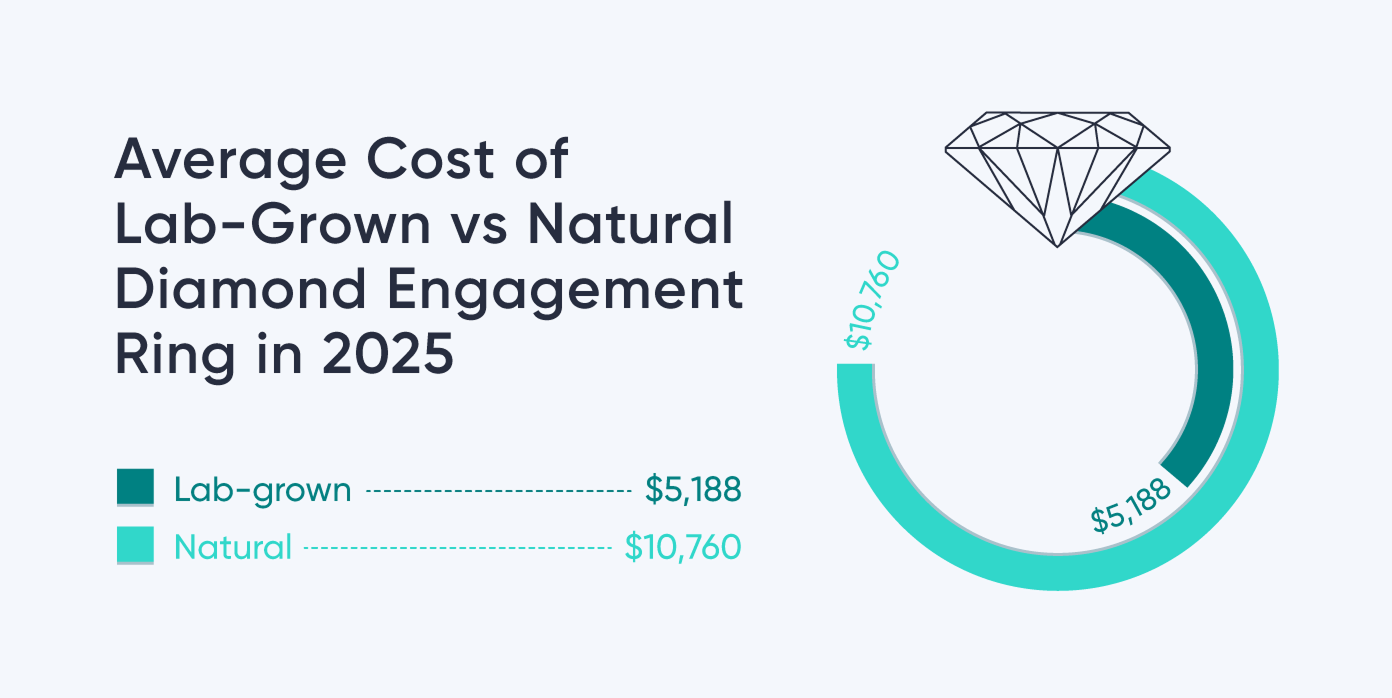
The average cost of a lab-grown diamond engagement ring in 2025 is $5,187.55, while the average cost of a natural diamond ring is $10,760.09.
Lab-grown diamonds are getting more attention and growing in popularity among couples as they represent a cheaper, more environmentally sustainable alternative to natural diamonds, while maintaining the same chemical properties that make a diamond “real.” According to our 2025 Lab-Grown Vs. Natural Diamond Report, Millennials and Gen Z are helping to drive a surge in lab-grown diamond popularity, along with factors such as manufacturing efficiencies that keep costs down.
Cost to Buy a Gemstone Engagement Ring
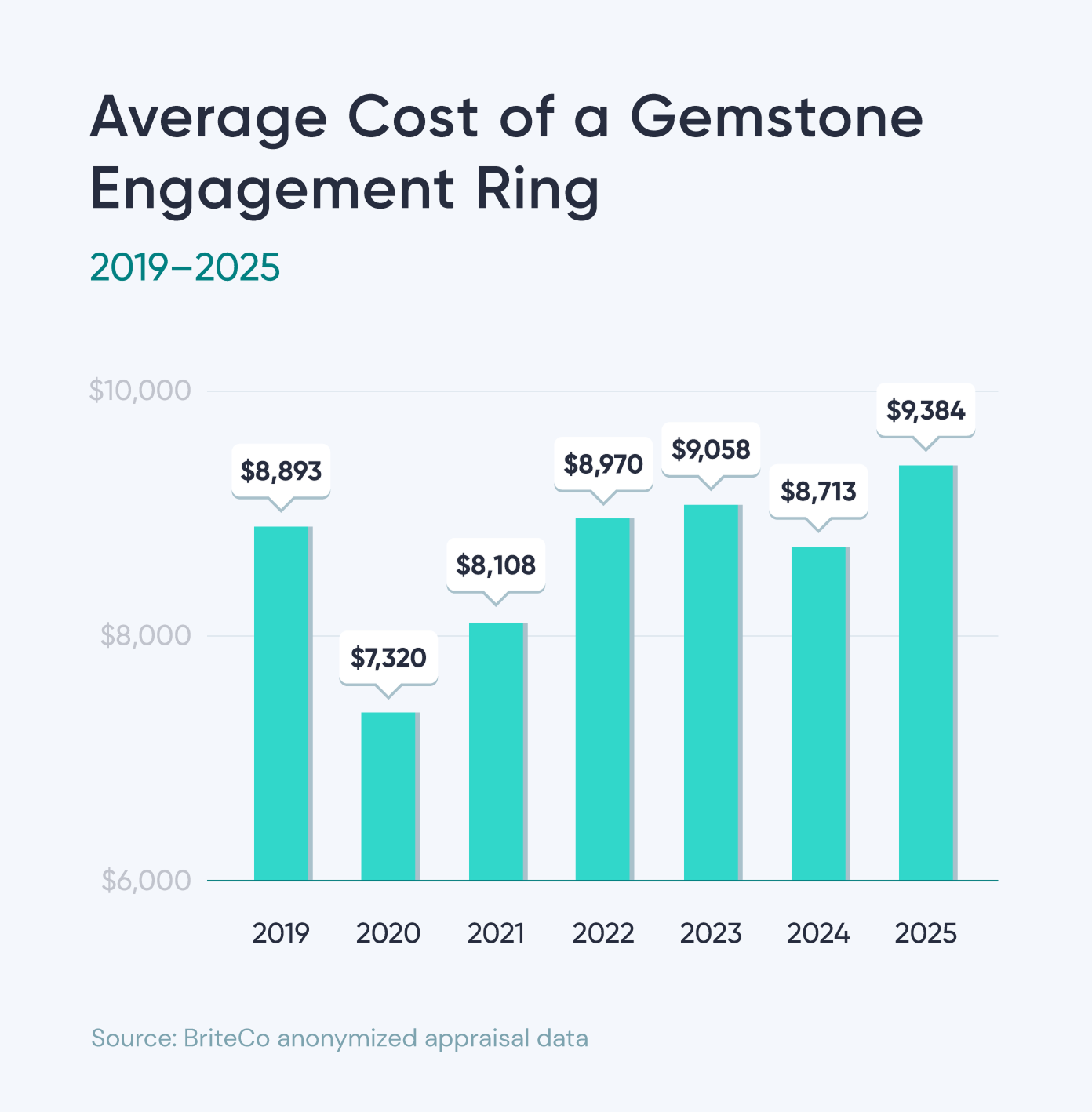
The average cost to buy a gemstone engagement ring in 2025 is $9,384. This higher price reflects the majority of purchases (almost 64%) holding AAA grade gems. This is the highest grade assigned to gems like rubies and sapphires, indicating the stone is close to perfect.
With the higher grades of natural diamond rings costing between $15,000 and $18,000 on average, gemstones can be a great choice for a high-quality stone at a lower price point. Engagement ring shoppers may find their budget stretches to a more unique ring design or a bigger-looking stone for the money.
How Much Should You Spend on An Engagement Ring?
You might be tempted to just “follow your heart” when buying an engagement ring, but setting a budget is an important part of the ring-buying process. Many people wonder how much they should spend, and the bottom line is there’s no “right” answer, just what’s right for you.
Consider how far out your planned engagement is; if you have more time to save up, perhaps you can splurge on a more expensive ring. These days, many couples already have intermingled finances before getting engaged, so make sure your engagement ring spending fits within your agreed-upon budget.
You may have heard of the “three-month rule.” That engagement ring price rule suggests you should budget three months’ salary to buy a ring. This began with a 1930s marketing campaign, hatched by a diamond brand with an obvious interest in encouraging people to spend more. The good news? You can ignore it. While there’s no expectation today to spend three months’ salary, it’s still worth making sure you and your partner have a common understanding of budget expectations for a ring.
Engagement Ring Budget Tips
Here are a few quick tips for budgeting for your engagement ring:
- Plan ahead for sale periods. Many jewelers typically offer sale prices on rings during the holidays.
- Consider vintage rings. Vintage or family rings can offer classic, high-quality designs, although don’t assume they’ll be cheaper.
- Look online. Online retailers have lower overheads and may be able to offer better pricing.
- Negotiate with jewelers. Some may have room to negotiate on price. You won’t know if you don’t ask!
- Prioritize diamond cut. With the right cut, even a lower-grade diamond can shine, so if you’re on a tight budget, prioritize the cut first.
Methodology
We collected anonymous data from appraisals on customer engagement ring purchases between 2019 and 2025. Data points included the type of engagement ring, the type and quality of stone, and the origin of the stone. Analysis is based on average costs across the data points measured.
Protect Your Engagement Ring with BriteCo
The average engagement ring cost in 2025 is $6,504, slightly lower than recent years, although some types of rings have seen a cost increase. Overall, diamond engagement rings are still the most popular, while people are spending more on gemstone engagement rings on average.
Whatever the dollar value of your engagement ring, gain some peace of mind by protecting it against loss, theft, damage, or mysterious disappearance with jewelry insurance from BriteCo.
Find out more about how you can insure your engagement ring in case of the unexpected and get your free quote in minutes.

Author