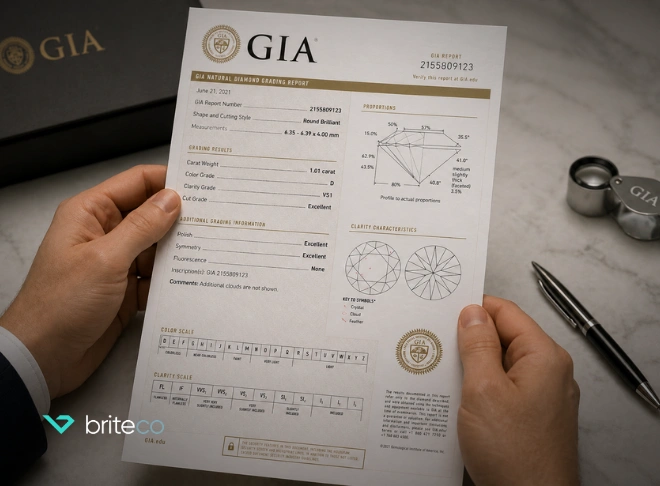
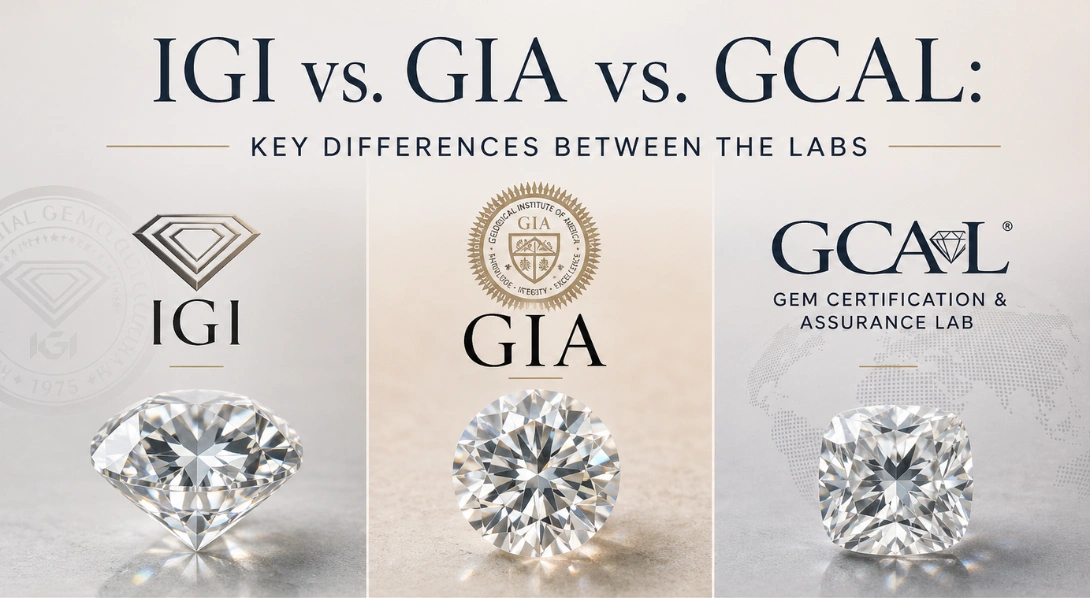
The Gemological Institute of America (GIA), International Gemological Institute (IGI), and Gem Certification & Assurance Lab (GCAL) are all independent gemological laboratories that conduct diamond grading, with GIA being the most established, IGI offering expertise in lab-grown diamond evaluation, and GCAL providing consumer-first, guaranteed grading.
If you’re currently in the market for a diamond, you’ll likely receive a gem certification or grading report from one of these three organizations — but which is best?
Here’s what you need to know about how these organizations differ, with thoughts from Andrew Elawar, founder and owner of Chrysella Fine Jewelry and Diamonds in Woodbridge, VA.
What You Will Learn
IGI vs. GIA vs. GCAL: Who the Labs Are
International Gemological Institute
The International Gemological Institute has been certifying diamonds since its founding in 1975, and works with brands and companies all around the world to provide diamond certificates for both lab-grown and natural diamonds.
IGI reports include details regarding a diamond’s cut, clarity, color, carat weight, polish, symmetry, and fluorescence. It also offers diagrams that show the diamond’s proportions and inclusions, as well as a laser inscription.
Gemological Institute of America
Founded in 1931, the Gemological Institute of America is renowned as the most trusted in the diamond industry. It’s the gold standard among jewelers and, in fact, the GIA is largely credited for popularizing the 4 Cs of diamond grading. If you have a choice in diamond certifications, this is the one you want to go with.
A GIA certificate will include grades for cut, clarity, color, and carat, as well as details regarding fluorescence, polish, optical symmetry, and more.
Gem Certification & Assurance Lab
Founded in 2001, the Gem Certification & Assurance Lab may be much newer, but it also takes a very modern approach to diamond grading.
A GCAL diamond certificate will include not just an analysis related to the 4 Cs, but also a light performance analysis, photos of the diamond at up to 10x magnification, a proportion diagram, and more. “They’ve spent a lot on their tech,” Elawar says, “and their certificates cover a whole wide range of things that some reports don’t.”
Additionally, GCAL reports offer an accuracy guarantee, for greater consumer protection — and it’s the only one of the three organizations that does so.
GIA vs. IGI vs. GCAL: Consistency and Strictness
Obviously, all of these three labs will aim for consistency in their grading. But tolerances, levels of strictness, and methodologies may differ, and GIA is generally known for its particularly strict grading standards.
“We focus mainly on GIA because their standards are very consistent,” says Elawar, a GIA graduate gemologist. “You can assure yourself that you’re going to get an accurate color description, accurate clarity description, and of course, cut and carat weight.”
IGI may be a little more lenient. As such, some buyers may seek grading reports from multiple organizations to compare and contrast their results. If one grading report says that a diamond is of a lesser quality than another grading report, then it could impact the overall price or value.
Suggested Read: A Complete Guide to Gemstone Certification

GCAL vs. IGI vs. GIA: Reports for Lab-Grown Diamonds
As lab-grown diamonds are chemically and physically identical to mined diamonds, all three organizations offer lab-grown diamond grading — though IGI now is “completely dominating” that segment, Elawar says.
“They’re going to be less expensive than the other laboratories,” he adds. “And they had a first-mover advantage in getting these stones that were being produced in mass quantities and getting them graded as quickly and as accurately as they could. I think that’s what gave him the edge.”
An IGI lab-grown diamond report will include information about the diamond’s shape, cutting style, dimensions, 4 Cs, polish, symmetry, and fluorescence. It may also include information about the techniques used to make the lab-grown diamond.
The GIA offers three different lab-grown diamond services: an overall assessment of the diamond’s quality, a colored diamond report, and a color identification. Add-on services include laser inscription, digital photography, light performance reporting, and a diamond color treatment letter.
A GCAL certificate for a lab-grown diamond includes multiple diagrams, a laser inscription, light performance profile, and the 4 Cs grades, as well as cut grading for specific cuts.
Considering a Lab-Grown Diamond Ring?
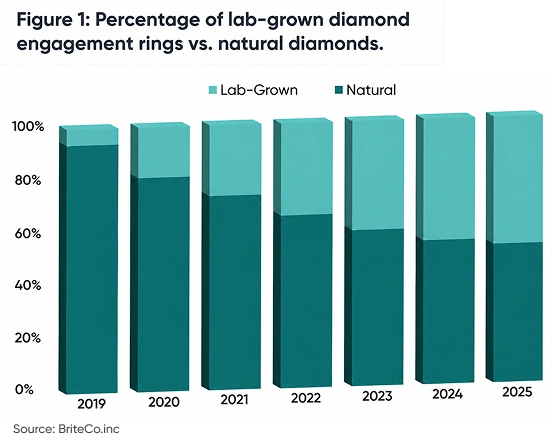
If you’re thinking about buying a lab-grown diamond engagement ring, you certainly wouldn’t be alone. According to the BriteCo Lab-Grown vs. Natural Diamond Report, over the past five years, lab-grown diamonds have grown in popularity tremendously, and they now account for more than 45% of all engagement rings purchased in the US.
Begin shopping for your perfect diamond engagement ring with our lab-grown engagement ring shopping guide.
How to Verify Any Diamond Report (3-Step Checklist)
Fake reports “do happen, unfortunately,” Elawar says. So it’s important to verify a physical diamond report with the provider’s online database to ensure the report is authentic and accurate.
Doing so is very easy:
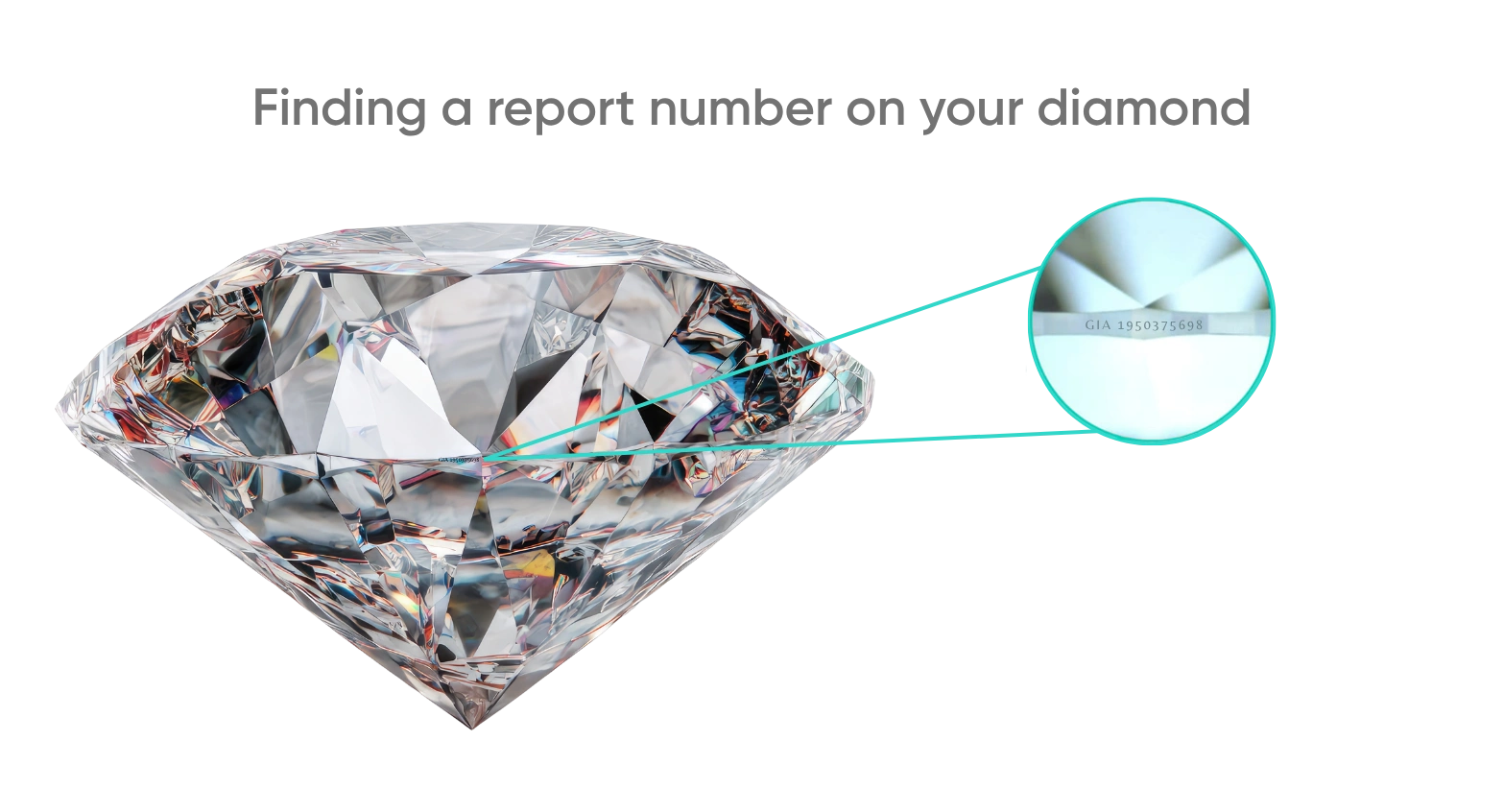
- Locate the report number and the number inscribed on the diamond’s girdle and verify that they match.
- Then, enter the number into the grading laboratory’s online database to ensure that all specs in the physical report match what is in the database.
- If you see any data that does not match, such as incorrect proportions or a differing clarity plot, follow up with the diamond seller.
A Diamond Report vs. an Appraisal
A diamond report describes the diamond’s physical characteristics, while an appraisal assigns value. As such, while both of these types of documentation are important, they do differ in purpose.
You’ll want a diamond report any time you purchase a diamond, to verify the diamond’s quality and that you’re actually getting what you’re paying for. The diamond appraisal, though, allows you to later insure the diamond for the appropriate amount, so that you have enough coverage to replace or repair the diamond jewelry if necessary.
An insurer may ask you to provide both an appraisal and a diamond certificate or report before providing you with a policy. Getting that jewelry insurance coverage is one of the first things you’ll want to do after purchasing a new piece of diamond jewelry, for protection from Day 1.
Do You Absolutely Need a Diamond Report or Certificate?
While a seller isn’t required to provide a diamond certificate, it is a marker of legitimacy and an assurance that the diamond is authentic and the details the seller is claiming — such as carat weight, color grade, etc. — are accurate.
“It’s 100% necessary in this day and age,” Elawar says, “especially since lab-grown diamonds and natural diamonds are pretty much indistinguishable to the naked eye. A diamond report ensures that you know exactly what you have.”
GCAL vs. GIA vs. IGI: FAQs
Is GIA stricter than IGI?
While labs aim for consistency in strictness and methodologies overall, perceptions may vary. All three of the main labs — GCAL, GIA, and IGI — have their pros and are respectable options.
What makes GCAL different?
GCAL is known for its tech-savvy approaches to diamond grading. Additionally, GCAL-certified diamonds come with a certification guarantee.
Do all labs use the same color letters?
Yes, all labs use the diamond color scale established by GIA.
Can the same diamond grade differently?
Occasionally, minor variances can occur between two labs or submissions.
How do I verify a GIA report?
You can verify your GIA report by using the report number and inscription, and checking the number in the GIA Report Check tool online.
Do I need a lab report for insurance?
Sometimes! You’ll typically need an appraisal for insurance, and the appraiser may request a lab report. The insurer may then request a lab report as support for your policy.
Which lab focuses most on lab-grown?
IGI, GIA, and GCAL all provide reporting for lab-grown diamonds, but IGI is considered the premier laboratory for lab-grown diamond grading.
The Most Important Part of Buying a Diamond?
The most important part of buying a diamond you love comes later — in protecting it with specialized jewelry insurance. Yes, the lab report is very important, and you should verify it to ensure you’re getting an authentically priced diamond.
However, refrain from shopping for a diamond based on lab reports alone. A report from any of these three labs will be well-respected within the industry.
Once your lab report is verified, get your appraisal. Then, protect the sparkle and brilliance of your valuable ring with specialized jewelry insurance that will help you replace or repair your diamond in the event of loss, theft, mysterious disappearance, or accidental damage.
Get your quick jewelry insurance quote now.
Related Articles:
How Much Cheaper are Lab Grown Diamonds?
Moissanite vs Diamond vs Lab: How to Choose?
Do Lab Grown Diamonds Hold Their Value?
Are Lab Grown Diamonds Real?
Cubic Zirconia vs. Moissanite
Buying Guide:
The Secret to Diamond Buying: Natural vs Lab Grown

UP NEXT: What are the Odds of Losing or Damaging Jewelry?

Author