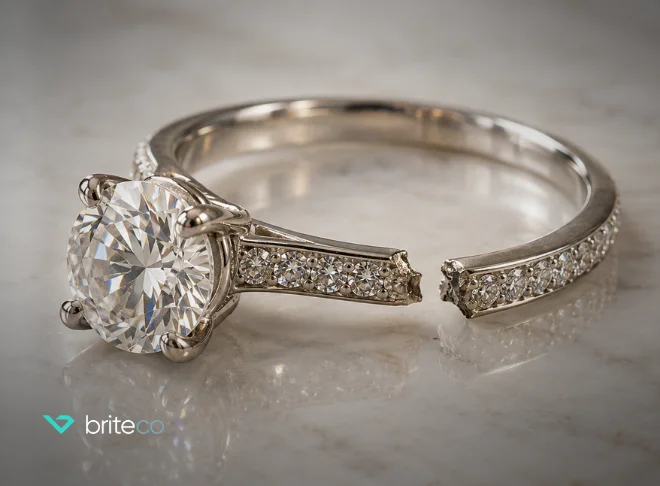
The cost to repair or replace jewelry out of pocket can range from under $100 for simple fixes to several hundred dollars for complex repairs, while replacing lost, stolen, or unrecoverable jewelry can cost the full appraised value of the piece.
Out-of-pocket jewelry repair costs — like for minor fixes such as resizing, clasp repair, or prong work — are financially manageable for most. However, actually replacing jewelry becomes expensive quickly, with engagement rings, diamonds, luxury watches, custom pieces, and heirlooms often costing thousands or tens of thousands of dollars to replace.
Jewelry insurance can help pay to repair or replace jewelry after a covered loss, theft, damage, or mysterious disappearance.
In short:
- A small jewelry repair = Often manageable out of pocket
- Major repairs or replacing a missing stone = Can become expensive quickly
- Total loss or a theft = You risk paying the full replacement cost out of pocket, into the thousands
Here’s what BriteCo jewelry expert Rachel Akmakjian has to say about some average out-of-pocket costs and how to avoid them.
What You Will Learn
- Jewelry Repair Vs. Replacement: The Short Answer
- Common Jewelry Repair Costs You Might Pay Out of Pocket
- Ring Resizing, Prong Repair, and Stone Tightening Costs
- Cost to Replace a Lost Ring, Diamond, or Piece of Jewelry
- What if the Jewelry Is Damaged Beyond Repair?
- Why Out-of-Pocket Replacement Costs Can Be Higher Than You Expect
- Jewelry Repair Costs Vs. Insurance Costs: When Insurance Starts to Make Sense
- Out-of-Pocket Cost if Homeowners or Renters Insurance Falls Short
- Mysterious Disappearance: When You May Pay the Full Replacement Cost Yourself
- How Jewelry Insurance Helps Pay for Repair or Replacement
- Replacement Value Vs. Actual Cash Value
- What Documentation Reduces Out-of-Pocket Risk?
- Out-of-Pocket Costs for Engagement Rings
- Out-of-Pocket Costs for Watches, Heirlooms, and Custom Jewelry
- Warranty, Maintenance Plan, or Insurance: Which Pays?
- What to Do Before Paying for Jewelry Repair Out of Pocket
- Real-Life Cost Scenarios: Pay Out of Pocket or File a Claim?
- FAQ: How much does it cost to repair jewelry?
- Cost to Repair or Replace Jewelry Out of Pocket: Final Takeaway
Jewelry Repair Vs. Replacement: The Short Answer
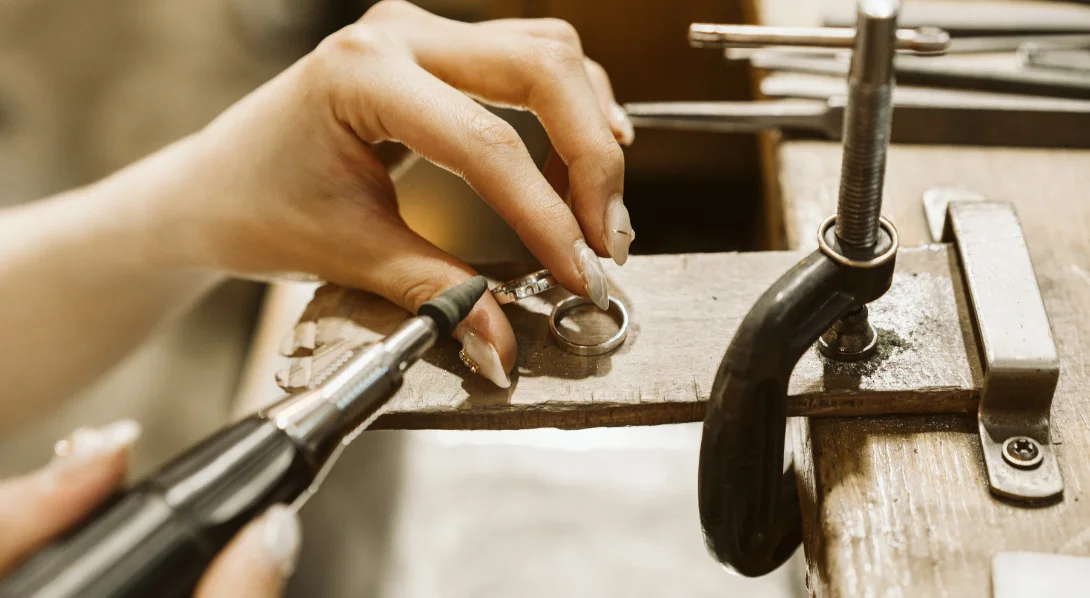
A jewelry repair means paying for labor and materials to fix a piece you still have. A replacement means paying for a comparable new piece when the original is gone, destroyed, stolen, or not worth repairing.
| Jewelry Repair | Jewelry Replacement |
|---|---|
| Can include resizing, soldering, clasp replacement, stone tightening, prong repair, polishing, and more | Needed when an item (or a piece of the item, like a gemstone) is lost, stolen, destroyed, or uncoverable |
How does jewelry insurance work in your favor in either circumstance?
If you have a policy that protects 100% of your piece’s value, with a $0 deductible, and the repair or replacement is related to a covered event, you’ll pay zero out of pocket, regardless of the final cost.
Common Jewelry Repair Costs You Might Pay Out of Pocket
Simple jewelry repair services often cost less than replacing a piece of jewelry. But final jewelry repair prices depend on factors such as the piece’s metal, design, and stones; labor required for the repair; and local jeweler pricing.
| Repair Service | Typical Price |
|---|---|
| Ring resizing | $50-$150 for sizing down; $80-$250 for sizing up ($20-$50 for stone repositioning during resizing, per stone) |
| Chain solder | $25-$100* |
| Clasp replacement | $20-$250* |
| Prong retipping | $20-$80* |
| Stone tightening | $25-$60* |
| Stone resetting | $50-$150* |
| Polish/rhodium plating | $50-$150* |
| Watch battery replacement or minor watch service | $10-$150* |
*Typical jeweler estimates
Always request a written estimate before approving a repair, so you’re aware of the costs ahead of time.
Ring Resizing, Prong Repair, and Stone Tightening Costs
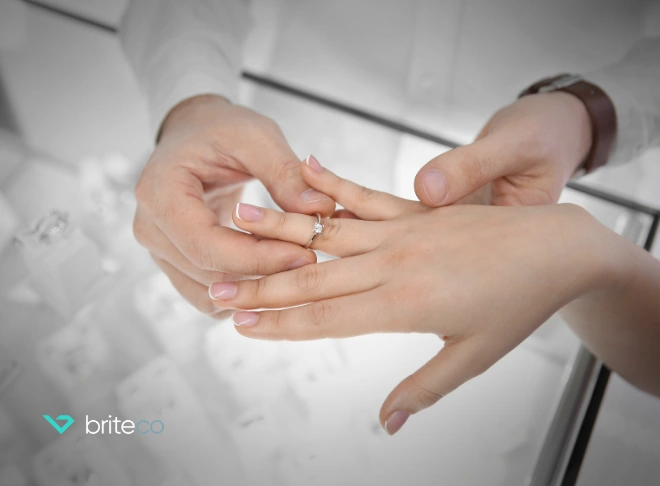
A simple ring resize is often affordable, but repairs and resizes become more expensive if the work involves a stone, prongs, or complex setting.
Ring resizing
How much does it cost to resize a ring? In general, $50-$150 for sizing down and $80-$250 for sizing up, with $20-$50 added for every stone that needs to be repositioned during the resizing. “Sizing up costs more because it often requires adding new metal that must be shaped, soldered, and blended seamlessly with the existing band,” Akmakjian says. “On rings with engraving, milgrain, or a shaped/contoured band, this gets trickier and pricier because the pattern has to be matched or re-cut.”
Prong repair / retipping
“A single prong tip is cheap,” she says. “But once several prongs are worn thin or a ring has multiple loose stones, a jeweler often has to rebuild the entire prong structure rather than patch individual ones. That means more labor, more precious metal, and more risk of a stone falling out mid-repair.”
Stone tightening / resetting
The amount of labor and risk increases when dealing with pavé, halos, and large center stones, so repair costs will be higher for jewelry with these features. In addition, “older pieces may use metals, alloys, or fabrication techniques that modern jewelers can’t replicate with standard tools,” Akmakjian says. “This often requires a specialist or hand fabrication, which costs more than routine repair.”
Cost to Replace a Lost Ring, Diamond, or Piece of Jewelry
The cost to replace lost jewelry is usually the cost of buying a comparable item, usually far greater than the cost of a small repair
Depending on the exact piece of jewelry, replacement costs could encompass not only the number on a piece’s price tag, but also:
- Labor to create custom work, if used in the original piece
- Taxes and jeweler markup
- An updated appraisal after replacement
In some cases, rather than replacing an entire piece, you may just need to replace a diamond or gemstone, one of the matching side stones, or the setting or mounting.
Situations wherein a replacement might be necessary? Say you lose one earring from a pair, or the center goes missing from your engagement ring. Maybe your engagement ring is stolen altogether, or your luxury watch is lost. Perhaps you lose an heirloom that’s impossible to match exactly.
Whatever the case may be, the sentimental value of that original piece is difficult to replace, which is why thorough jewelry documentation and comprehensive insurance coverage matter — to get you as close to the original piece as possible, in the event of a loss.
What if the Jewelry Is Damaged Beyond Repair?
If jewelry is significantly damaged, you may end up paying for a replacement instead of a repair.
It may not make sense to fix damage or restore a piece under certain circumstances, like if:
- The metal is structurally compromised
- Gemstones are destroyed or missing
- The setting is too damaged to safely hold stones
- The repair cost is comparable to the piece’s replacement value
“One-of-a-kind or handmade pieces may rely on techniques, materials, or a maker’s specific hand that simply can’t be reproduced today,” Akmakjian says. “If it’s broken in a way that can’t be reverse-engineered, it may be gone for good.”
Before you move forward with a repair, ask your jeweler to evaluate the piece and answer the following questions:
- Can it be repaired safely?
- Will the repair affect value?
- Is replacement more cost-effective?
- Do I need a new appraisal after repair or replacement?
Why Out-of-Pocket Replacement Costs Can Be Higher Than You Expect
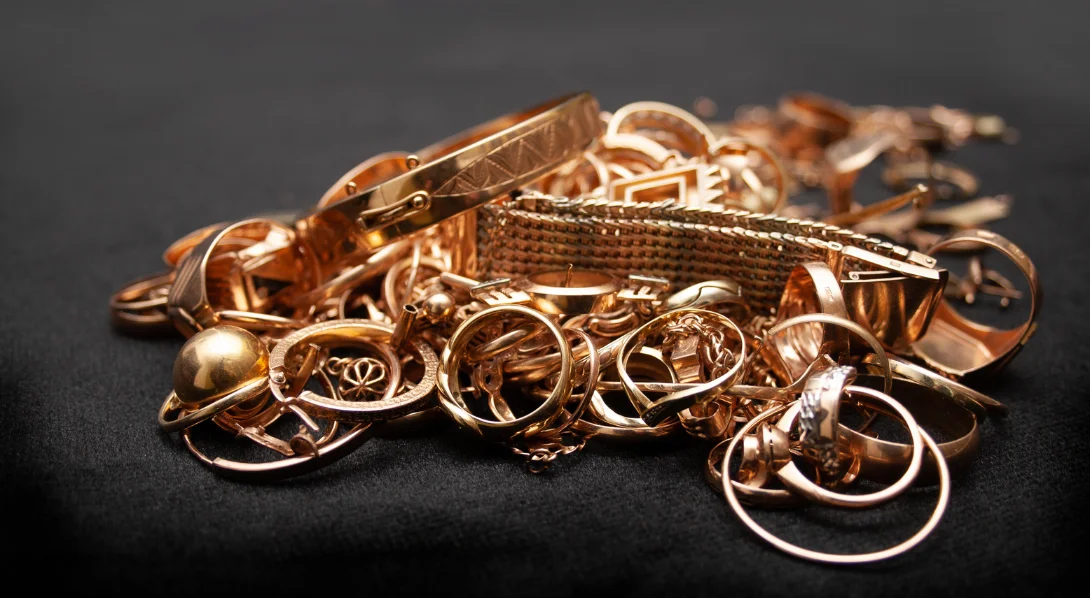
The replacement cost for a piece of jewelry may be higher than you expect, because jewelry prices, the price of precious metals and gemstones, labor costs, and custom-work costs all change over time.
“Gold, platinum, and diamond/gemstone prices fluctuate independently of general inflation, often rising faster; gold and platinum especially have seen significant run-ups over the past couple decades,” Akmakjian says. “A ring bought when gold was $400/ounce costs very differently to remake when gold is well over $2,000/ounce.” Other stones may be scarcer now, too.
Designer and brand premiums evolve as certain ones go in and out of fashion. Inflation and economic changes affect labor costs. Additionally, if you’re trying to replace an heirloom or vintage piece, reconstructing the same type of piece can require special (and costly) attention.
As such, don’t rely on your old, original purchase receipt to estimate your out-of-pocket replacement costs for a piece of jewelry. Instead, an up-to-date appraisal will ensure you have the most accurate idea of what you can expect to pay.
How often should jewelry be appraised? Experts recommend updating jewelry appraisals every two to three years, or sooner after upgrades to the material, damage, or major metal or gemstone value changes.
Jewelry Repair Costs Vs. Insurance Costs: When Insurance Starts to Make Sense
Buying jewelry insurance starts to make sense when the potential replacement price for a piece of jewelry is much higher than the annual premium you would pay for coverage.
Your out-of-pocket risk is the cost of jewelry repair or full replacement. Your insurance cost is your annual premium plus a deductible (if any applies). Compare those two numbers and weigh the financial risks.
While rates range based on a variety of factors, standard jewelry insurers charge about 1%-2% of jewelry’s appraised value per year, while BriteCo policies generally cost 0.5%-1.5%.
| Needed repair or replacement | Does insurance make sense? |
|---|---|
| Minor clasp repair | Pay for it out of pocket; no need for jewelry insurance |
| $300-$800 stone or setting repairs | Evaluate available coverage premiums and deductibles, as the insurance may cost less than the repairs |
| $5,000+ lost ring | Insurance definitely makes sense |
| $10,000+ watch or heirloom | Insurance is a must |
So, is jewelry insurance worth it? For many, yes.
Out-of-Pocket Cost if Homeowners or Renters Insurance Falls Short
If homeowners or renters insurance does not fully cover your jewelry, you may owe the difference between the policy payout and the actual repair or replacement cost, in the event of a claim.
Homeowners and renters insurance policies often come with low jewelry sub-limits (around $1,500), high deductibles, and exclusions for certain kinds of loss (like mysterious disappearance). Furthermore, they may pay out actual cash value for jewelry claims (so the replacement cost minus depreciation), rather than the actual replacement cost.
When deciding between scheduled jewelry insurance vs. homeowners coverage, look at all the fine print and how you are and aren’t covered, before you determine which option is best for you. If you don’t, you could just find that your out-of-pocket costs for jewelry repair or replacement are a lot higher than anticipated.
| Common Issues with Jewelry and Homeowners and Renters Insurance | The Result? |
|---|---|
| Low sub-limits, around $1,500, plus a deductible | If you need to replace a $3,000 watch stolen during a burglary, and you have a $1,000 deductible, you’ll end up paying $1,500 for the replacement, out of pocket |
| Exclusions for certain kinds of loss, like mysterious disappearance | If there’s no theft, and your engagement ring vanishes without cause, you’ll have to pay to replace it fully out of pocket |
| May pay out actual cash value | If you need to replace a $1,000 necklace, but the necklace’s actual cash value is $750 today, your policy will not give you enough to fully replace the necklace, even if you have no deductible and even though the current replacement value falls beneath the sub-limit |
Mysterious Disappearance: When You May Pay the Full Replacement Cost Yourself
If jewelry disappears without a clear explanation and your insurance policy does not cover mysterious disappearance, you may be responsible for the full replacement cost.
Mysterious disappearance means that a piece is gone, but there is no clear theft, accident, or known event that would have caused the loss. Most homeowners and renters policies do not offer mysterious disappearance coverage.
Events that would fall under “mysterious disappearance” include:
- A stone falls out of a ring somewhere in your house and disappears
- A ring slips off your finger while you’re running errands
- Your bracelet isn’t in your suitcase after you bring it on vacation
How Jewelry Insurance Helps Pay for Repair or Replacement
Jewelry insurance helps reduce out-of-pocket costs by paying to repair or replace covered jewelry after covered events.
The process is simple. To secure jewelry insurance, you need documentation of your pieces’ value, after which you can get a quote and purchase coverage. Then, if the jewelry needs repair or a replacement, you contact your insurers and ask them to explain how to file a jewelry insurance claim. Making a specialized jewelry claim typically involves submitting an online form, providing documentation such as photos or a police report if applicable, and working with the provider to repair or replace the item.
What jewelry insurance can pay for:
- Replacements for lost jewelry (including jewelry lost under mysterious disappearance)
- Replacements for stolen jewelry, worldwide
- Repairs for accidentally damaged jewelry
- Routine maintenance to prevent future jewelry damage and loss
Replacement Value Vs. Actual Cash Value
Replacement value is what it costs to replace an item today; actual cash value may factor in depreciation. If insurance uses actual cash value in the event of a claim, it can leave you with a larger out-of-pocket gap.
- Replacement Value: What a comparable item costs now
- Actual Cash Value: The cost of a comparable item, minus depreciation
So, if your replacement cost for a piece of jewelry is $8,000, but your policy payout after limits and depreciation is only $4,000, you’re left to pay the remaining $4,000 out of pocket. Be sure to have a regular appraisal timetable so your insurer can always know what your jewelry is worth.
What Documentation Reduces Out-of-Pocket Risk?
When working with your insurer, having good documentation — especially a current appraisal — for your jewelry will reduce the risk of paying more out of pocket.
Keep the following items on hand:
- A current appraisal
- Itemized receipts
- Clear item photos
- Lab reports or grading reports
- Repair and upgrade records
- Warranty or care plan documents
- Your insurance policy declarations page
Gather and save all of this before a loss or accident has a chance of occurring.
While an appraisal is not always required, it is a good idea to get one, as it’s your strongest overall documentation. Then, update your appraisal every two to three years, or sooner if you make upgrades to the piece, it’s damaged, or there are major market changes.
Out-of-Pocket Costs for Engagement Rings
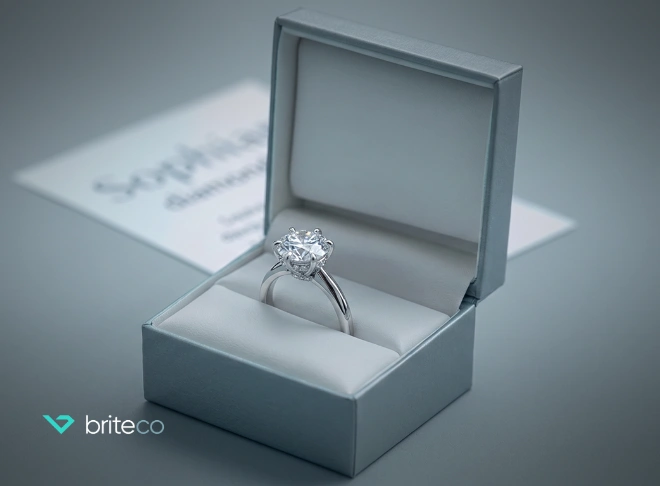
Engagement rings are one of the most important pieces to protect via comprehensive engagement ring insurance, as the costs to repair or replace an engagement ring can be financially quite painful.
| Engagement Ring Service Needed | Estimated Cost |
|---|---|
| Resizing | $50-$150 for sizing down; $80-$250 for sizing up ($20-$50 for stone repositioning during resizing, per stone) |
| Tightening or resetting stones | $25-$150 |
| Replacing missing side stones | $50-$400 |
| Replacing a center stone | $500-Thousands |
| Replacing an entire lost ring | $5,000 and up |
Meanwhile, jewelry insurance costs 1%-2% of the jewelry’s appraised value per year, and the cost of the initial required appraisal will only be $65-$200, depending on ring value and complexity.
Out-of-Pocket Costs for Watches, Heirlooms, and Custom Jewelry
Luxury watches, antiques and heirlooms, custom jewelry such as engagement rings, and designer jewelry can all be more expensive to repair or replace because they may require special expertise, hard-to-source parts, or a custom re-creation altogether.
Additionally, anytime you need to replace an item that needs to be identical to another — such as a lost earring or side stone — that increases costs as well.
In the case of some of these higher-cost items, like heirlooms, the emotional value of the item may be irreplaceable, but insurance can still help cover financial replacement or restoration costs.
(Specifically wondering how does watch insurance work? It’s the same as jewelry insurance, protecting your watch in the event of loss, theft, mysterious disappearance, and accidental damage.)
Warranty, Maintenance Plan, or Insurance: Which Pays?
A warranty or care plan may cover maintenance or certain defects, but insurance is usually what helps with larger losses like theft, disappearance, or full replacement.
| Jewelry Need | Warranty or Insurance? |
|---|---|
| Routine cleaning | Warranty |
| Prong maintenance | Warranty or some insurance |
| Manufacturing defect | Warranty |
| Accidental damage | Insurance |
| Lost diamond | Insurance |
| Stolen ring | Insurance |
| Mysterious disappearance | Insurance |
| Total replacement | Insurance |
When comparing jewelry insurance vs. warranty, don’t think of it as an either/or choice. You should have both forms of protection, as they often complement one another, providing assistance under different circumstances.
What to Do Before Paying for Jewelry Repair Out of Pocket
Before paying for any repairs out of pocket, confirm if the repair can be covered by your insurance, warranty, or a store care plan.
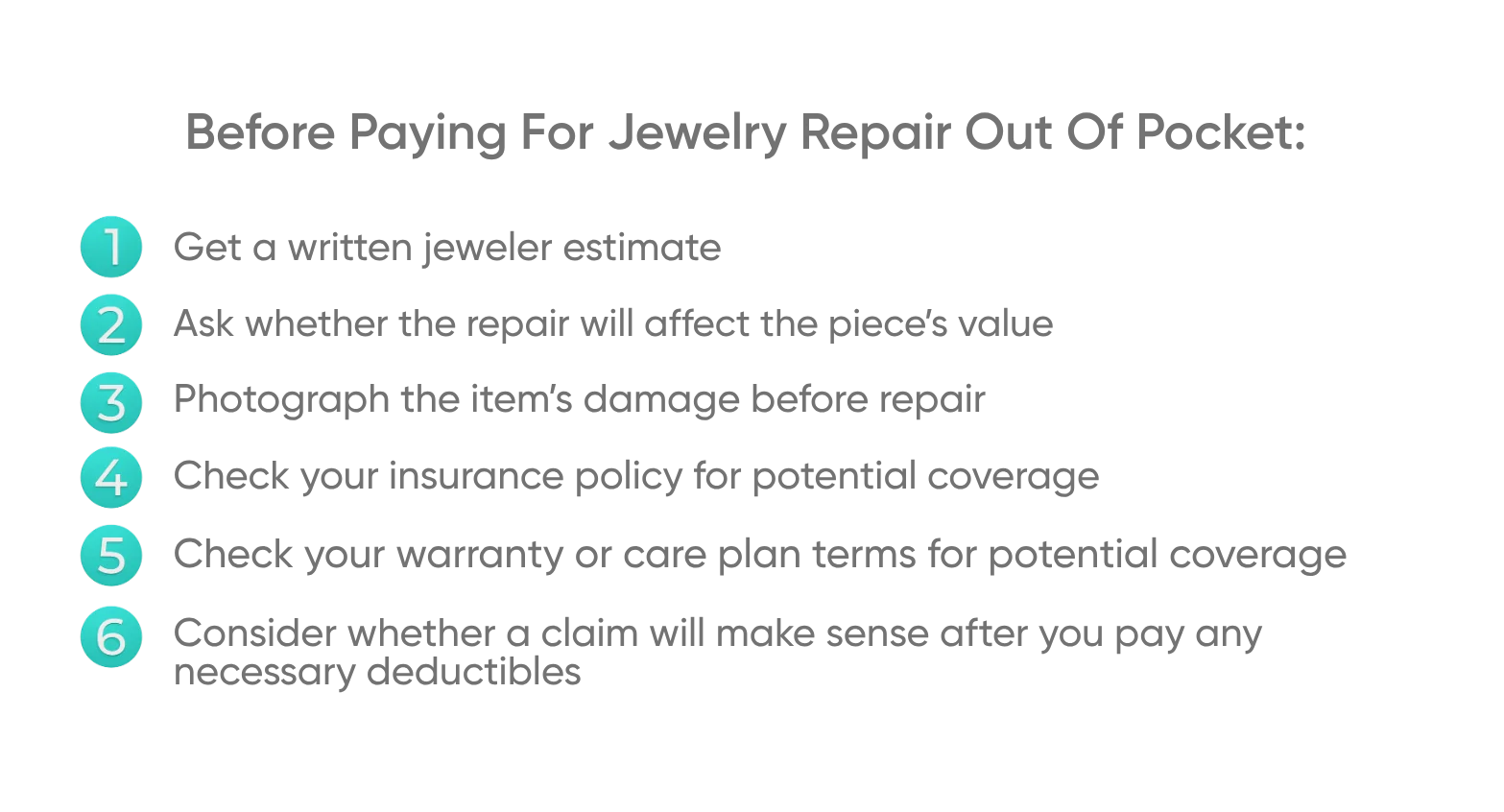
Then, once the repair is actually complete, if it was major and/or affected the piece’s value, update your appraisal.
Real-Life Cost Scenarios: Pay Out of Pocket or File a Claim?
Whether you should pay for a repair or replacement out of pocket or file a claim with your insurance will depend on the cost of the repair or replacement, your insurance policy terms, and your deductible amount.
| Repair or Replacement Situation | Pay Out of Pocket or File a Claim? |
|---|---|
| $60 chain repair | Pay for it out of pocket |
| $180 ring resizing and stone tightening | See if your warranty will cover this, or if your insurance deductible is more than the service cost. If the deductible is more, pay out of pocket rather than filing a claim |
| $700 missing side stone | Check your insurance and appraisal and potentially file a claim |
| $4,000 center stone replacement | Likely worth filing a claim, if coverage applies |
| $10,000 stolen ring | File a claim, if coverage applies |
Ultimately, your insurance should reduce your loss risk and eliminate the need to pay for expensive repairs and replacements, while charging a fractional premium.
FAQ: How much does it cost to repair jewelry?
Is it cheaper to repair or replace jewelry?
Often, it’s cheaper to repair jewelry than replace it altogether, unless the jewelry has been significantly damaged.
How much does it cost to resize a ring?
On average, it costs $50-$150 to size a ring down, and $80-$250 to size a ring up (plus $20-$50 for stone repositioning during resizing, per stone).
Does jewelry insurance pay for repairs?
If the jewelry damage was caused accidentally, or during a covered event, then jewelry insurance will likely pay for repairs, after you submit a claim.
Does homeowners insurance pay full replacement cost for jewelry?
Homeowners insurance typically does not pay full replacement cost for jewelry. Instead, many policies pay out actual cash value, which is the replacement cost minus depreciation.
What happens if jewelry disappears and I don’t have coverage?
If a piece mysteriously disappears and you do not have jewelry insurance, you can attempt to find the piece on your own. If you cannot, and if you choose to replace it, you will pay out of pocket.
Cost to Repair or Replace Jewelry Out of Pocket: Final Takeaway
Minor jewelry repairs may be affordable and easily paid for out of pocket, but major repairs, missing stones, theft, loss, and mysterious disappearance can turn into a major, full-replacement-value expense.
If replacing a piece yourself would hurt financially, compare the annual cost of jewelry insurance against the item’s appraised value and your realistic risk. Then:
- Get an appraisal and take photos of your pieces
- Ask your jeweler for a written repair estimate for any existing damage
- Get a jewelry insurance quote before you’re facing a future bill for a full replacement
Get a Quote:
The Easy Way to Insure Your Jewelry - and Save Money!
UP NEXT: What are the Odds of Losing or Damaging Jewelry?

Author