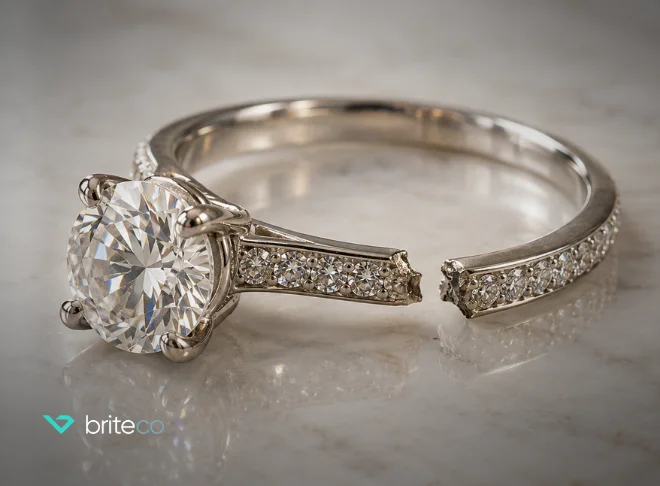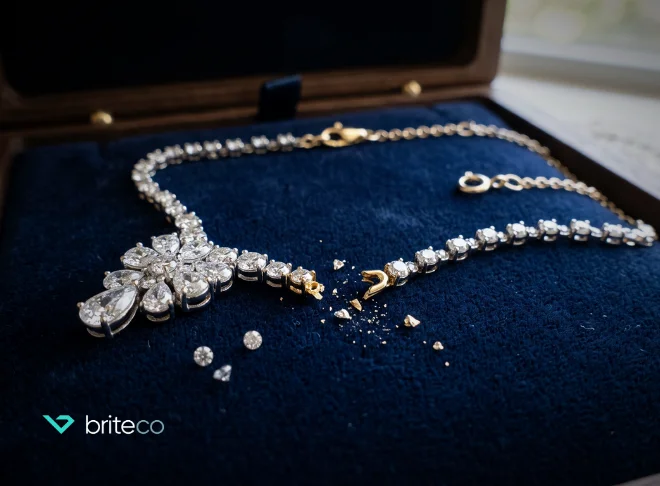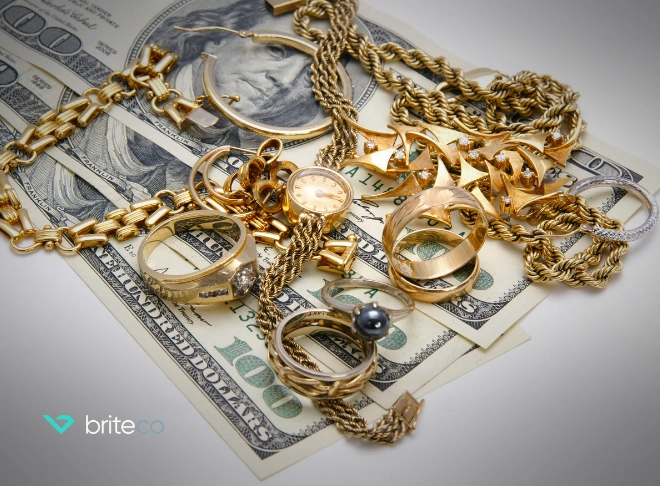

You should insure jewelry the moment you own it, especially if replacing that jewelry out of pocket would be expensive, stressful, or even impossible.
Timing is crucial for engagement rings and other newly purchased jewelry, heirlooms, travel pieces, and upgraded jewelry. All are at a higher risk of the real-life mishaps that jewelry insurance will protect you from (in fact, BriteCo advises insuring engagement rings right at the time of purchase, before the proposal!).
So, when should you insure jewelry?
- Insure new jewelry immediately
- Insure jewelry before travel or public wear
- Update existing jewelry insurance after new appraisals, upgrades, or value changes
Keep reading for BriteCo founder and CEO Dustin Lemick’s advice about when to get jewelry insurance, how jewelry insurance works, and how to choose coverage.
What You Will Learn
- The Best Time to Insure Your Jewelry
- When to Insure an Engagement Ring
- Should You Insure Jewelry Before Wearing It Publicly?
- How Long Do You Have to Insure New Jewelry?
- When to Insure Older Jewelry and Family Heirlooms
- At What Value Should You Insure Jewelry?
- When to Insure Jewelry Before Travel, Events, or Shipping
- When to Update Jewelry Insurance After an Upgrade or Appraisal
- Homeowners/Renters Rider Vs. Stand-Alone Jewelry Insurance: When to Choose Which
- What Documents Should You Have Before You Buy Jewelry Insurance?
- How to Buy Jewelry Insurance Once You’re Ready
- What If Something Happens Before You Insure It?
- Claims Process: What Happens If Something Happens After You’re Covered?
- Special Cases: Watches, Loose Stones, Collections, and Repairs
- FAQs About When to Get Jewelry Insurance
- When Should I Get Jewelry Insurance? Final Timeline
The Best Time to Insure Your Jewelry
The best time to insure jewelry is immediately after a purchase, inheritance, or transfer of ownership — before the piece is worn, stored casually, shipped, or packed for travel.
Always confirm that your jewelry is covered:
- After purchasing a new piece of jewelry
- After inheriting a new piece of jewelry
- Before proposing with an engagement ring you recently purchased
- Before traveling with valuable pieces
- Before repairing jewelry
- Before shipping jewelry
- After having jewelry newly appraised
- After upgrading a piece of jewelry
“The second that you’ve purchased the policy, even if the policy documents haven’t been issued yet, you are still completely covered,” Lemick says. “So we recommend to go ahead and buy the insurance as soon as you can, just so there are no coverage gaps and you are fully covered.”
If you’re delaying and not protecting jewelry with comprehensive coverage like that offered by specialty jewelry insurance, your pieces are at risk. Those risks, such as theft, loss, and damage, exist well before you propose, wear the jewelry for the first time, or take it on vacation. Before you even purchase a new piece, start looking into how to insure jewelry.
When to Insure an Engagement Ring
You should insure an engagement ring as soon as you buy it, even if the proposal hasn’t happened yet. “You’re holding it,” Lemick says, “and saying to yourself, ‘Wow, I just spent a lot of money on this engagement ring. I think I need insurance!’ ”
- At the time of purchase, save your receipt and appraisal info.
- Then, as soon as possible, purchase engagement ring insurance.
- After the proposal, you can transfer or update the policy ownership or payment responsibility, if needed.
- After the wedding, you can even add your wedding band to the policy, for further protection.
Purchasing engagement ring insurance before the proposal protects you against pre-proposal theft and loss (though even buying insurance coverage after the proposal is better than waiting until weeks or months later). Engagement rings come with both high financial and sentimental value, which you don’t want to risk.
Should You Insure Jewelry Before Wearing It Publicly?
If you plan to wear the jewelry regularly, insure it before it becomes part of your daily routine. Daily wear increases the risks of loss, accidental damage, theft, and mysterious disappearance (mysterious disappearance can be explained as a loss in which the reason is literally a mystery).
For example, loss or damage can result from …
- Going to the gym or other workout habits
- Frequent handwashing
- Commuting
- An active job
- Frequent travel
- And otherwise taking pieces on or off frequently
Just be sure that your jewelry insurance covers your unique day-to-day risks.
How Long Do You Have to Insure New Jewelry?
You should not assume you have a grace period for insuring new jewelry. Yes, as you’re deciding on how to insure an engagement ring, having a receipt on hand can help you get coverage more quickly — but the receipt showing you purchased the piece within a certain timeframe does not guarantee coverage within that timeframe.
Many insurance providers’ policy terms require appraisals, photos, an underwriting review, and similar documentation before coverage kicks in. As such, do not travel, ship, or even wear high-value pieces under the assumption that you’re covered. You want to be 100% sure that your jewelry insurance policy is active.
“Things can happen pretty quickly, especially if somebody’s not used to wearing a new item,” Lemick says. “Losses could happen within the first day, within the first week. So we recommend getting jewelry insurance pretty quickly.”
When to Insure Older Jewelry and Family Heirlooms
You can insure older jewelry or heirlooms later, but you should do so as soon as you decide the jewelry pieces are valuable enough to protect. In order to insure older fine jewelry, you’ll often need an updated appraisal, as the original receipts may be missing and pieces’ values may have changed.
After having your jewelry appraised, an insurer will likely ask for the following documentation, in order to cover your older jewelry or heirlooms:
- All appraisal or valuation documentation
- Photos of the piece(s)
- Ownership details
- Provenance, if available
- Repair history, if relevant
Having your valuables appraised is likely easier than you think, with online jewelry appraisals making the process simple.
At What Value Should You Insure Jewelry?
Insure jewelry if replacing it out of pocket would result in financial stress; for many, this means insuring engagement rings and any daily-wear jewelry with a full value of more than $1,000.
Ask yourself:
- Could I easily pay to replace this jewelry tomorrow?
- Is this jewelry sentimental?
- Do I wear it often?
- Would losing and then replacing it affect my budget?
If you answered “yes” to any of these, you should consider jewelry insurance and begin thinking about how much coverage you’ll need to fully protect your pieces.
But is stand-alone jewelry insurance worth it? With jewelry insurance cost coming in at only 1–2% of your item’s value, per year, for many, it absolutely is.
When to Insure Jewelry Before Travel, Events, or Shipping
If jewelry is about to leave its normal safe place — for travel, shipping, repairs, events, or a move — insure it before the risks increase.
High-risk scenarios include:
- Going on vacation
- Attending a destination wedding
- Going on your honeymoon
- Taking the item in for repairs
- Shipping the item
- Resizing a ring
- Moving homes
- Attending highly public events
- Attending photoshoots
- Loaning the jewelry out
If you’re faced with any of these, add the following to your to-do list:
- Confirm your policy is active
- Confirm that your insurance policy covers your specific high-risk scenario (for example, that you have worldwide coverage if the item is leaving the country)
- Save copies of all your photos and recent appraisals
- Keep your claims contact easily accessible
Note that most policies do have high-risk exclusions, such as military action or intentional actions, so asking if your insurance covers your plans is key. Some may also require specific precautions, such as when shipping jewelry (learn how should jewelry be shipped before you head to the post office!).
When to Update Jewelry Insurance After an Upgrade or Appraisal
Update jewelry insurance whenever an item’s value, condition, or details change enough that the old policy may no longer match the piece.
You might need to update your jewelry coverage if you’ve:
- Upgraded the piece’s gemstone
- Changed the setting
- Resized the piece
- Had custom work done to the piece
- Updated your appraisal
- Inherited the piece
- Seen a shift in its market value
- Begun to add jewelry to a broader covered collection
To update your insurance and confirm you’re fully covered, gather your updated documentation, take new photos as necessary, contact your insurer, and let them know you need additional coverage and the amount needed. You don’t need to change insurance and can stay with the same kind you’ve been using — you just need your policy’s coverage amount adjusted.
(And if you’re wondering if you need an appraisal to get jewelry insurance, the answer is yes.)
Homeowners/Renters Rider Vs. Stand-Alone Jewelry Insurance: When to Choose Which
Once you decide to insure jewelry, compare and contrast your options, including:
- Using your current homeowners or renters insurance
- Adding a scheduled rider to your existing homeowners policy or renters policy
- Purchasing stand-alone jewelry insurance.
When deciding between specialty jewelry insurance and homeowners insurance, don’t automatically assume that one option is best.
Standard homeowners insurance often comes with jewelry sub-limits that mean you’ll only receive a limited payout (around $1k-$2k) if you make a jewelry-related claim on your policy. Additionally, you’ll still have to pay a deductible and a claim can negatively affect future premiums. Furthermore, covered events are limited.
A scheduled personal property rider added to your existing home insurance policy can broaden coverage, expanding covered events, but claims still impact your overall policy and future premiums, and the replacement process for lost or stolen jewelry may not be straightforward (for example, you may not be able to work with your chosen jeweler).
A stand-alone policy from a specialized jewelry insurance provider generally offers more comprehensive protection than basic home coverage. Covered events include mysterious disappearance, theft, loss, and accidental damage, worldwide, and there are no deductibles and no impacts on future premiums.
What Documents Should You Have Before You Buy Jewelry Insurance?
Before you buy jewelry insurance, gather proof of value, clear photos, and basic item details, all of which will help your insurer provide the proper amount of coverage.
Documentation often required for insurance purposes includes:
- An appraisal or detailed receipt
- Photos of the piece
- Metal and gemstone details
- Record of the purchase date
- Your preferred jeweler details
- A lab report, if available
- Prior repair or upgrade records
Having all the above ready to go can speed along the process of pulling together your policy contract, so you’re covered mofe quickly. (For an even faster process, consider using online jewelry appraisals.)
How to Buy Jewelry Insurance Once You’re Ready
Once your documents are ready, buying a specialized jewelry insurance policy is as simple as gathering quotes to compare policies, deciding which of the coverage options best fits your needs, uploading the necessary documents, and getting an underwriting review, before the policy is activated.
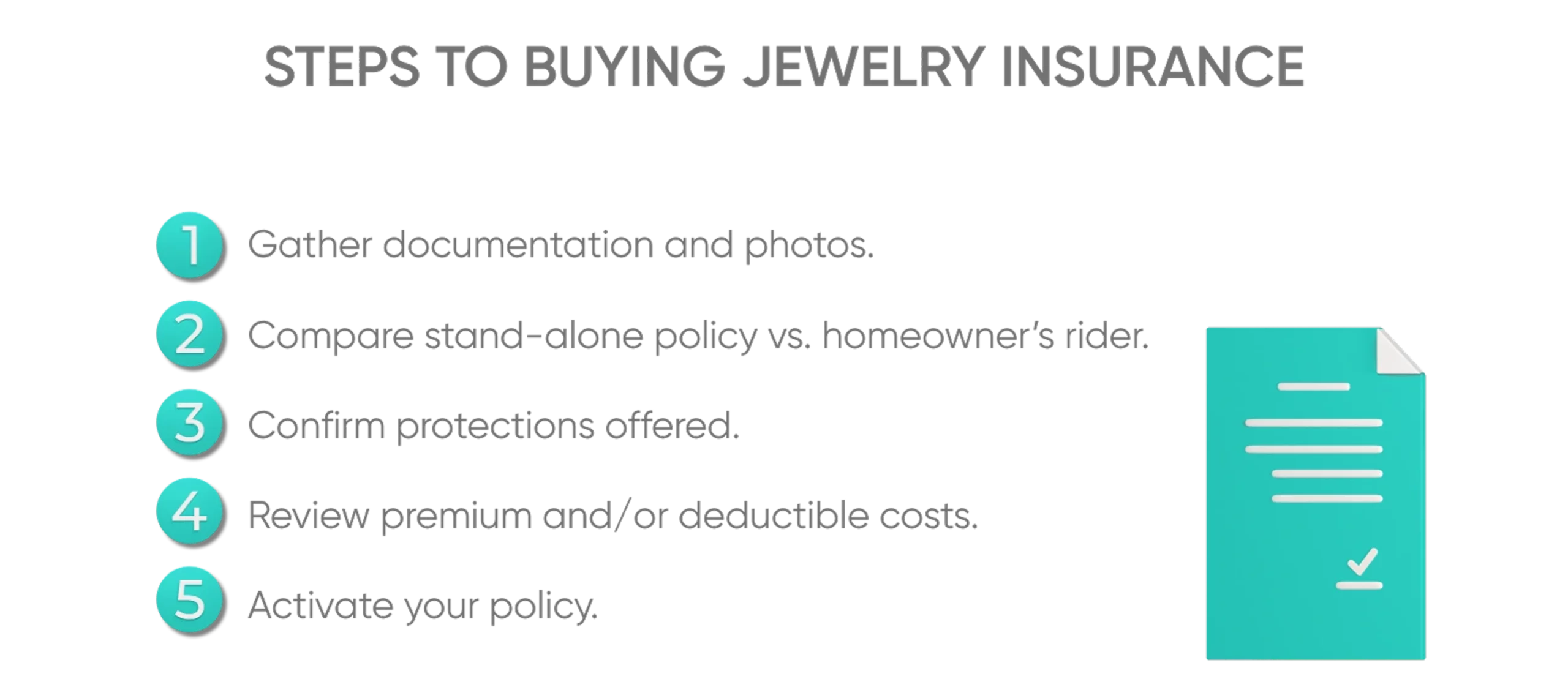
- Gather all your documentation and photos.
- Compare the comprehensive coverage of a stand-alone policy against a homeowners rider.
- Confirm your chosen policy offers the best protection for loss, theft, damage, and mysterious disappearance.
- Review what you’ll pay for a premium and/or deductible.
- Activate your policy and store proof of coverage somewhere safe.
On the BriteCo website, “you’ll be able to get a quote from us in 30 seconds — boom! — and then you’ll be able to get a policy from us in two minutes,” Lemick says. “It’s a comprehensive policy, at pretty much the best price in the market.”
BriteCo jewelry insurance policies generally cost 0.5%-1.5% of your jewelry’s appraised value per year. Check your price now.
What If Something Happens Before You Insure It?
If something happens before your specialized insurance policy is active, your jewelry insurance company usually cannot help with that past issue. The way jewelry insurance works, it protects you from covered events only after coverage begins, not against losses that happened before policy purchase and activation.
As such, document what happened and see if you can possibly make a claim with your existing homeowners or renters insurance. If the piece is damaged rather than lost or stolen, meet with a jeweler to discuss repairs. Then, insure all your valuable pieces immediately, to prevent similar issues in the future.
Claims Process: What Happens If Something Happens After You’re Covered?
Once you’re covered, a jewelry claim starts with reporting the covered loss, submitting proof, and moving toward repair or replacement under your policy terms.
How to file a jewelry insurance claim:
- Begin the claims process online, on your insurer’s website.
- Submit your appraisal, receipt, and photos of the piece.
- Provide incident details or a police report if the claim is theft-related.
- Review your insurer’s policy regarding repairs or replacement.
BriteCo’s claims process requires only a few minutes and can be completed entirely online.
Special Cases: Watches, Loose Stones, Collections, and Repairs
Some jewelry should be insured sooner because it is high-value, hard to replace, or temporarily exposed to extra risk. Such special cases include luxury watches, loose stones that have not yet been set, jewelry that will be repaired or shipped, multiple-piece collections, and antique or vintage jewelry.
While coverage limits in these situations may vary based on several factors (like if your insurer has guidelines on how jewelry should be shipped), make sure that you’re documenting these high-risk items separately, confirming whether they’re covered (particularly loose stones or items to be repaired or shipped), and keeping appraisals current.
FAQs About When to Get Jewelry Insurance
Is homeowners insurance enough for valuable jewelry?
While, yes, homeowners or renters insurance covers jewelry, this coverage comes with sub-limits, often won’t cover the full value of your jewelry, limits covered events, requires a deductible, and can negatively impact future premiums.
When should I insure an engagement ring?
Insure an engagement ring as soon as possible after purchase, before you propose, to protect it from risks such as theft, loss, damage, and mysterious disappearance.
Should I insure an engagement ring before proposing?
Yes, you should always insure an engagement ring, as soon as you buy it, before proposing. After the proposal, you can transfer the policy over to your fiancé.
Can I insure jewelry I already own?
Yes, you can insure jewelry that you already own. The sooner, the better! Make sure you have all necessary documentation and get an updated appraisal to start.
Should I insure jewelry before traveling?
Yes, before traveling, insure any jewelry you’ll take with you. Verify that your chosen policy includes coverage for worldwide travel.
When Should I Get Jewelry Insurance? Final Timeline
Insure jewelry as soon as you own it, if the piece is valuable, sentimental, worn often, or hard to replace. The biggest mistake is waiting until after travel, public wear, an upgrade, or a loss to think about coverage.
Once you purchase or inherit jewelry:
- Gather your receipt, appraisal, and photos.
- Check out your coverage options.
- Choose and activate your policy.
- Keep your policy updated after new appraisals, upgrades, or value changes.
Get your quick online jewelry insurance quote now.
Get a Quote:
The Easy Way to Insure Your Jewelry - and Save Money!
UP NEXT: Why Waiting to Buy Insurance Puts Your Jewelry at Risk

Author