Sufficient jewelry insurance coverage will allow you to repair or replace an insured piece with one of the same kind and quality, at today’s replacement value. Following a claim, there should be no out-of-pocket costs on your end.
For high-value jewelry, engagement rings, wedding bands, heirlooms, watches, and collections, ensuring you have enough coverage usually requires obtaining a current appraisal so you know your items’ current replacement values. Then it’s time to check whether your homeowners or renters coverage will cover those values, and evaluate whether you have coverage for risks such as theft, loss, accidental damage, and mysterious disappearance.
Don’t assume the insurance premium you’re paying is reflective of your coverage amount. One does not always reflect the other and it’s vital to be assured that you have comprehensive protection.
How much jewelry insurance coverage do you need? Let’s take a look. With input from BriteCo founder and CEO Dustin Lemick, we’re going to examine the following:
- Why coverage should reflect your pieces’ current replacement value, not just purchase price
- How homeowners and renters policies may leave gaps
- Why engagement rings and wedding bands often need dedicated coverage
- That jewelry collections should be itemized
- How coverage quality matters as much as coverage amount
- And why you should revisit coverage after jewelry upgrades, appraisals, or major value changes
BriteCo offers coverage for jewelry, watches, and full collections, with no maximum insured value. This includes everything from everyday pieces to million-dollar collections. Coverage is subject to a standard underwriting review process.
What You Will Learn
- How Much Jewelry Insurance Coverage Do You Need?
- Quick Self-Assessment: Do You Need More Jewelry Coverage?
- Start With the Jewelry’s Appraised Value
- Why Homeowners or Renters Insurance May Not Be Enough
- What Should Your Jewelry Coverage Include?
- How Much Coverage Do Engagement Rings and Wedding Bands Need?
- How to Balance Jewelry Coverage and Cost
- What Happens If Your Jewelry Coverage is Too Low?
- What Jewelry Insurance Usually Does Not Cover
- How to Choose the Right Coverage Amount Step by Step
- Jewelry Coverage FAQs
- Conclusion: Choose Coverage Based on Replacement Risk, Not Guesswork
How Much Jewelry Insurance Coverage Do You Need?
You should have enough jewelry insurance to cover the entire replacement cost of all protected pieces, with coverage that applies to all potential risks.
Jewelry coverage needed = Current replacement value of each piece you want protected + Policy terms broad enough to cover realistic loss scenarios
Coverage should always be based on your items’ current replacement value, which can be determined with an appraisal or, if the item was purchased very recently, a detailed receipt. Furthermore, coverage should insure specific jewelry items, vs. general household personal property (and for jewelry collections, coverage should be itemized vs. estimated).
If you truly have enough coverage, you’ll be able to avoid any out-of-pocket expenses in the case you make a claim.
The Replacement-Value Rule
Coverage should always be sufficient to replace a piece of jewelry with one of the same kind and quality, based on the item’s current appraised value.
Let’s look at some potential scenarios, with jewelry items you might have in your dresser right now, their possible replacement values, and the coverage they might need.
| Jewelry Item | Current Replacement Value | Suggested Coverage |
|---|---|---|
| Engagement ring | $8,000 | Coverage should fully support repair or replacement with a comparable ring |
| Wedding band | $1,500 | Coverage depends on the ring’s value, wear, and your loss tolerance, but should still be able to fully repair or replace the ring |
| Diamond earrings | $5,000 | Coverage amount should reflect both stones and setting, allowing for replacement of the earring(s) as a whole or just a stone |
| Heirloom necklace | Appraisal needed to determine an appropriate replacement value | Coverage should be based on documented replacement value, which can get tricky with heirloom or antique pieces |
| Jewelry collection | Current replacement value will be an itemized total of all pieces | Each piece should be documented separately, for coverage that addresses each piece’s unique value |
Single Piece Vs. Whole Collection
If you have only one piece of fine jewelry, you’ll want enough coverage to account for that piece’s current replacement value; however, to insure a collection, you’ll want to make an itemized list and purchase coverage that’s suitable for all pieces.
Avoid relying on a single rough estimate of your collection’s value. Individual documentation is key, as an underwriting review may be necessary, wherein the insurer will evaluate your collection’s size, value, documentation quality, storage location, and security.
Make sure you think of all potentially insured items, too — rings, watches, bracelets, necklaces, earrings, wedding jewelry, heirlooms, and loose stones. They should all be included in your coverage. If the purchase was an emotional or financial investment, you want it protected.
Quick Self-Assessment: Do You Need More Jewelry Coverage?
You likely need dedicated or more jewelry coverage if you answer “yes” to two or more of these questions:
- Would replacing the jewelry out of pocket create financial stress?
- Is any single piece worth more than your homeowners or renters jewelry limit?
- Do you wear the piece daily, or as part of an active lifestyle?
- Do you travel with it?
- Does the piece have sentimental value?
- Is the item inherited, custom, or hard to replace?
- Would you want the same quality of replacement, not a lower-value substitute?
- Is the jewelry part of a collection?
- Has the item increased in value since purchase?
Again, if you answered “yes” to two or more of the above questions, specialized jewelry insurance is worth it for you.
If Replacement Would Hurt Financially
The right coverage should prevent you from paying a major out-of-pocket expense after theft, loss, or damage. For example, if replacing a $7,500 ring would force you to use savings or credit, or delay replacing the ring entirely, the ring likely needs dedicated coverage closer to its current replacement value. Don’t forgot coverage and then pay the cost.
If You Wear the Jewelry Often
Daily-wear pieces like engagement rings or a wedding band face more exposure and risks than jewelry kept in a safe. However, these are some of your most valuable and sentimental pieces. As such, they need full protection.
Start With the Jewelry’s Appraised Value
Having your jewelry appraised is the first step to ensuring you have appropriate coverage, as the appraisal essentially answers, “What would it cost to replace this piece today?”
Accordingly, during an underwriting review, an insurer uses the jewelry appraisal to determine how much coverage you need, as well as the premium you will pay. As such, it’s vital that the appraisal is accurate, up to date, and from a reputable appraiser.
An appraisal should include:
- An item description
- Metal type
- Gemstone details
- Diamond or gemstone grading information
- Photos
- Replacement value
- Appraiser or jeweler details
The appraisal should then be updated after any repairs, upgrades, or jewelry value changes.
What If Your Appraisal is Old?
If your appraisal is more than a few years old, it’s imperative that you get a new one. Jewelry values can vary based on several factors, and they change quickly from year to year.
The changing diamond and gemstone markets, metal prices, brand value, and individual piece condition can all change over time, necessitating a new appraisal. Additionally, if you make any repairs or upgrades, or extend your collection, that also affects the appraisal, as does your location and the local labor and replacement costs.
In short, update your documentation if the piece has materially changed, if the appraisal is several years old, or if the insured value no longer reflects replacement reality.
Receipt Vs. Appraisal
When you purchase coverage, an insurance company may accept a detailed receipt in lieu of an appraisal if you’re buying coverage for a newly purchased item. “At BriteCo, we accept both, as long as the sales receipt is detailed or the appraisal is detailed and there’s enough information,” Lemick says. “Having an accurate appraisal is truly the only way to guarantee that your item will be replaced exactly as it is. It’s important for you as well to have that information for your records so you know what you bought, as far as the center stone or the total carat weight. Any reputable jeweler will provide you with an appraisal. So if you weren’t provided with an appraisal, simply ask your jeweler and they will provide it for you.”
For older, inherited, custom, or high-value jewelry, an appraisal is preferred.
Again, your coverage should always reflect your piece’s current replacement value, not your original purchase price. If an insurer requests an appraisal, it’s because the company needs to confirm that you have the correct amount of coverage.
Why Homeowners or Renters Insurance May Not Be Enough
Often, standard homeowners insurance or renters insurance does not cover the full value of jewelry, leaving you with a gap at claim time and requiring you to pay out of pocket to replace or repair a piece. When comparing stand-alone jewelry insurance vs. a homeowners policy, keep the below limitations in mind.
| Coverage Source | What It May Cover | Where It Can Fall Short |
|---|---|---|
| Standard homeowners policy | Some jewelry as personal property, from theft and possibly natural disasters | Low sub-limits, deductibles, few named perils, future claim impacts |
| Renters policy | Some jewelry as personal property, from theft and possibly natural disasters | Low jewelry limits and covered-peril restrictions |
| Scheduled rider/floater | Some jewelry as personal property, but possibly under more circumstances or to a greater degree | Still tied to home/renters policy terms |
| Specialized jewelry insurance | Jewelry-specific loss, theft, mysterious disappearance, and accidental damage, worldwide | Requires a separate, stand-alone policy |
Homeowners Jewelry Limits
Homeowners policies often come with limited coverage for jewelry, and those coverage limits include:
- Jewelry-specific sub-limits with payouts typically capped around $1,500-$2,000 (well below the value of many pieces)
- Deductibles that you must pay before coverage kicks in
- Fewer named events, so losses like accidental loss or mysterious disappearance are not covered
- Future policy punishments such as higher premiums or non-renewal
Renters Jewelry Limits
While renters insurance covers jewelry to a limited degree, as personal property, the average renters insurance policy doesn’t cover jewelry much differently than homeowners insurance; coverage is limited to listed events (on-property theft, fire, etc.) and payouts can be restricted to less than the actual value of most engagement rings, watches, heirlooms, and collections.
Always compare your policy limits against the replacement value of your pieces.
What Should Your Jewelry Coverage Include?
As you compare your coverage options, look for comprehensive coverage (such as that offered by specialized jewelry insurance) that will protect you in the event of theft, accidental loss, mysterious disappearance, and accidental damage, worldwide.
| Coverage Feature | Why It Matters |
|---|---|
| Theft | Protects against stolen jewelry |
| Accidental loss | Helps when a piece is lost |
| Mysterious disappearance | Helps when jewelry disappears without a clear explanation |
| Accidental damage | Helps with chips, broken settings, bent prongs, or other damage |
| Stone loss | Helps when a diamond or gemstone is lost |
| Worldwide coverage | Helps when jewelry is worn while traveling |
| Preferred jeweler option | Helps preserve quality and relationship |
| Preventive maintenance | Helps reduce avoidable future losses |
Coverage for Loss, Theft, and Mysterious Disappearance
Your coverage should cover the scenarios and risks you’re most worried about. Even if your jewelry’s total value is protected, that policy is worth less if it won’t actually protect you from the covered losses you’re most at risk of encountering. For example, if you travel a lot and wear your jewelry, you want a policy that gives you worldwide travel protection.
Coverage for Damage and Loose Stones
While many policies may cover theft, not all cover damage, including accidental damage and loose stones. But these are very real risks, especially for everyday items like engagement rings or wedding bands.
Ensure your coverage accounts for:
- Chipped stones
- Bent prongs
- Damaged settings
- Lost stones
- Broken clasps
- Damage during daily wear or travel
“We see a lot of this at BriteCo,” Lemick says, “where somebody knocked an engagement ring on a door handle, or dropped it on the floor and a diamond popped out, or the shank of the ring cracked or the center stone chipped. And most jewelry insurance policies should cover that.”
Preventive Maintenance Support
A jewelry insurance policy that includes preventive maintenance is also very valuable, as preventive maintenance can help reduce the chances of future loss or damage, maintaining the piece’s value. Look for a policy that includes stone tightening, clasp replacement, and prong inspections.
How Much Coverage Do Engagement Rings and Wedding Bands Need?
Engagement rings and wedding bands need coverage equal to their current replacement value, not just their original purchase price. Keep the below coverage considerations in mind, to ensure you’re purchasing enough coverage for your bridal jewelry.
| Item | Coverage Considerations |
|---|---|
| Engagement ring | Get an appraisal that lists the diamond/gem details, setting, and current replacement value, before shopping for engagement ring insurance |
| Wedding band | Get an appraisal that counts for the band’s metal, gemstones, engravings, and/or paired-set value |
| Bridal set | Insure the rings together if a future replacement of one ring will depend on getting a matching design |
| Heirloom engagement or wedding ring | A current appraisal and documentation are especially important to ensure enough coverage |
| Custom engagement or wedding ring | Replacement may require you to use the same jeweler or for you to be able to provide custom-work documentation, so have those details on hand for your appraisal and underwriting review |
Engagement Ring Coverage Example
The ideal engagement ring insurance covers the ring’s full replacement value and protects it from loss, theft, mysterious disappearance, and accidental damage.
For example, if a ring’s appraised replacement value is $10,000, coverage should support replacing the ring with one available at a comparable piece. The coverage should not reimburse you for what you originally paid for the ring years ago. Replacement prices have likely changed.
Wedding Band and Stacked Ring Coverage
Wedding bands, anniversary bands, and stacked rings all come with great sentimental value and deserve financial protection in the form of individual documentation and coverage — especially if they incorporate diamonds, gemstones, engraving, and/or custom designs.
How to Balance Jewelry Coverage and Cost
Jewelry coverage can seem like a financial investment. So it’s important to avoid both underinsuring and overpaying for coverage, by ensuring your coverage actually matches your items’ real-world value and by shopping for a policy that comes with no deductible and covers you from your biggest risks.
Let’s take a look at some jewelry values and what kind of coverage might be suitable for your needs.
| Your Jewelry’s Total Value | What Kind of Coverage Do You Need? |
|---|---|
| Under $1,000 | Specialized coverage may be optional if the jewelry is easily replaceable |
| $1,000–$5,000 | Compare your existing homeowners/renters limits vs. dedicated coverage (your homeowners/renters coverage may be enough) |
| $5,000–$10,000 | Dedicated coverage often becomes more practical at this price point |
| $10,000+ | There’s a strong case for itemized specialized jewelry coverage if your jewelry is worth this amount |
| Collection worth more than $10,000 | Itemize each piece and insure it all based on the combined replacement value |
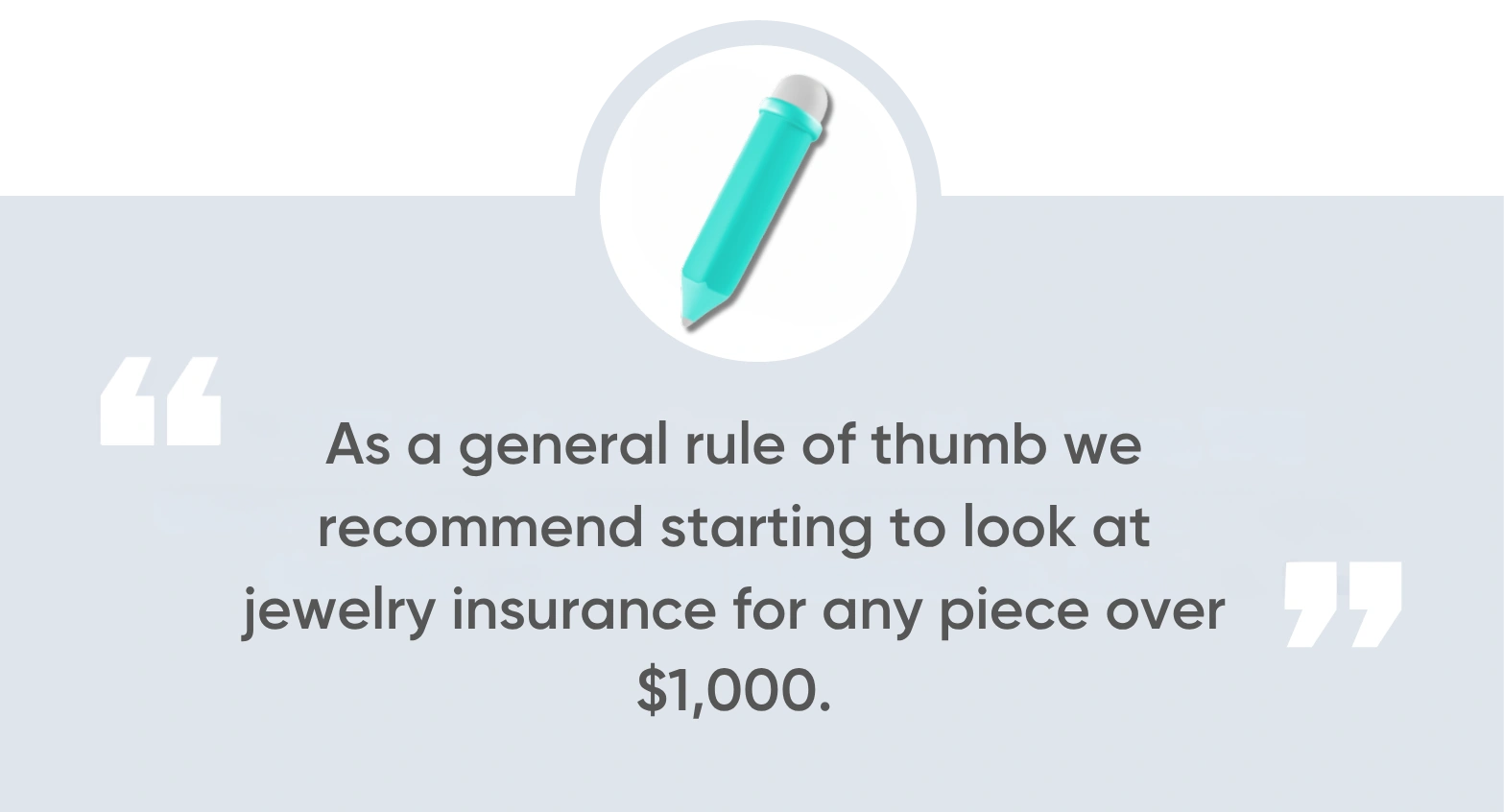
“As a general rule of thumb,” Lemick says, “we recommend starting to look at jewelry insurance for any piece over $1,000.”
What Factors Affect Coverage Price?
While type of coverage and jewelry value affect your coverage price the most, other factors that can impact your premium include:
- Your location
- Chosen deductible
- Security measures, such as if you have a home security system
- Coverage terms
- Policy structure
- Underwriting review
- Number of pieces insured
Do Not Lower Coverage Just to Lower Premium
As you shop for jewelry coverage, just make sure you don’t make the mistake of lowering your coverage just to lower the premium. That could result in unpleasant surprises at claim time, as you have to pay a higher deductible or more out of pocket to replace or repair the piece after a covered loss.
What Happens If Your Jewelry Coverage is Too Low?
If you don’t have enough jewelry coverage and then you try to file a claim with your insurer, you could run into your jewelry claim not being covered at all; your claim being covered but not your piece’s full value, meaning you have to pay out of pocket to fully repair or replace the piece; or annoying stipulations, such as not being able to work with your preferred jeweler.
| Potential Scenario | What Can Go Wrong at Claim Time |
|---|---|
| Your appraisal is outdated so you’re underinsured | Since your insured value is too low, your coverage won’t pay for your replacement or repair’s full cost |
| You have homeowners coverage with a sub-limit | Your claim payout may be capped far below your item’s value |
| You have a policy with a deductible | You have to pay out of pocket before your insurance kicks in |
| You have coverage, but missing documentation | The claims process may be unnecessarily long |
| Your policy excludes the claim event | You’re simply not covered at all |
| Your collection is not itemized | Some of your pieces may not be properly documented, and thus not properly covered, leaving you with coverage gaps |
Claim Documentation Matters
Having enough coverage, in part, relies on having the proper documentation.
For example, if your pieces are covered in the event of loss or damage, then photos, appraisals, and written details may help establish what the piece was and what it was worth, so you can get a proper replacement or repair. Likewise, if you make a claim for stolen pieces, a police report is just one necessary form of documentation that likely will be required by your insurer.
Replacement Quality Matters
Make sure that your specific policy contract spells out how it will replace or repair a covered piece, as “covered” does not always mean “fully protected.”
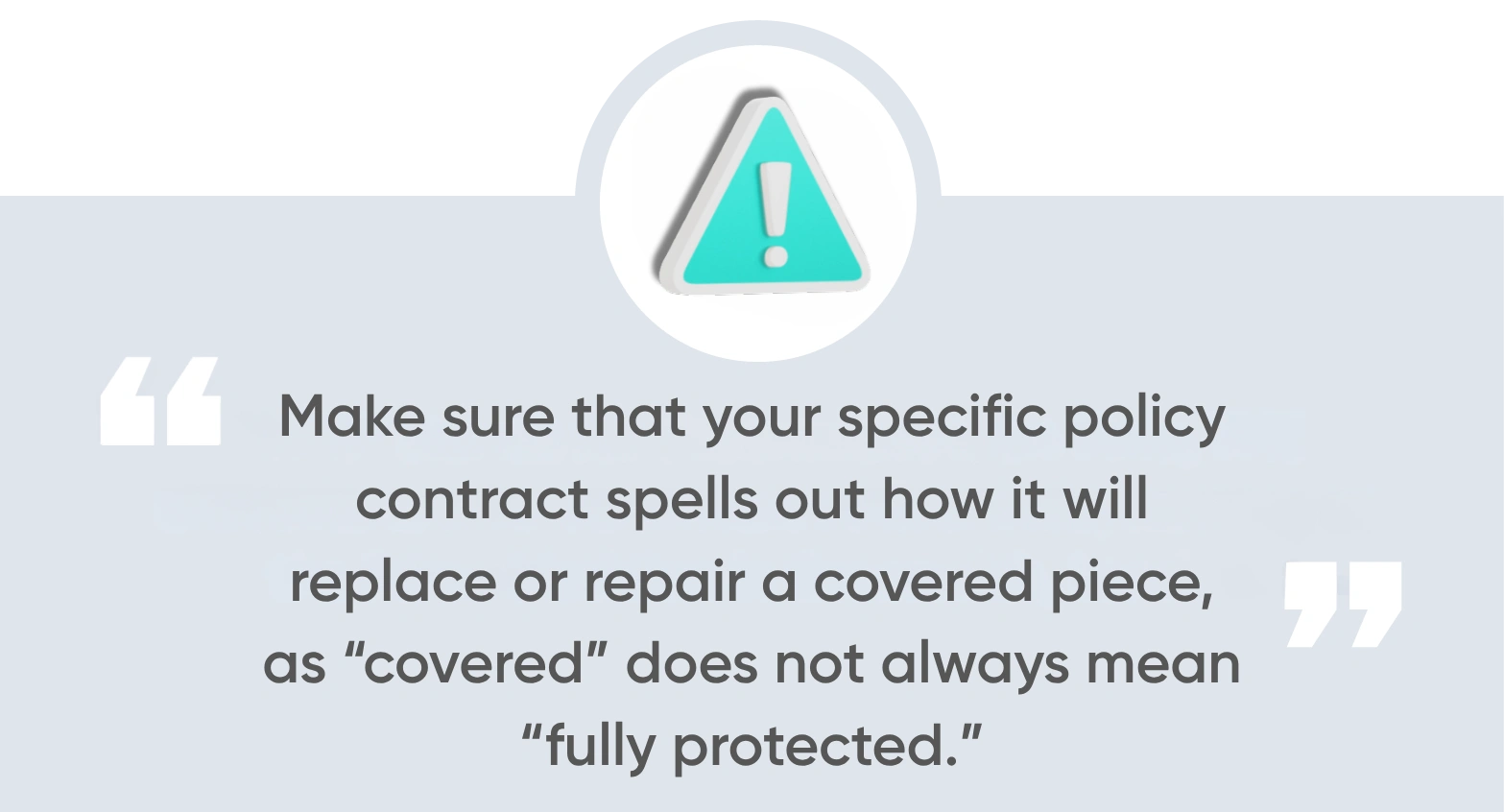
Understand whether your policy supports a replacement of comparable quality, whether a deductible applies, what claim events are included in coverage, and whether your piece’s insured value matches your piece’s documented value.
What Jewelry Insurance Usually Does Not Cover
Even with the most comprehensive coverage, jewelry insurance policies still often exclude:
- Damage or loss from intentional actions
- Damage or loss due to neglect
- Manufacturing defects
- Normal wear and tear
- Policy-specific excluded events
- Damage or loss that occurred before policy activation
- Damage or loss without proper documentation
- Claims outside policy terms
- Loss or damage due to military action or similar excluded events, if named in the policy
Read the Policy Before You Decide Coverage is Enough
Before deciding if a policy contract offers enough protection for your precious pieces, be sure to fully understand the policy’s:
- Declarations page
- Insured value
- Exclusions
- Deductibles
- Coverage limits
- Claim documentation requirements
- Replacement terms
- Preventive maintenance terms
- Policy cancellation rules
Do Not Confuse Insurance with Maintenance or Warranty
Additionally, understand that insurance is not the same as a maintenance plan or warranty, as the former protects you from unforeseen loss and damage, while the latter services protect you from manufacturing defects or provide you with regular care, such as rhodium plating, tightening, and inspections with pre-approved jewelers.
How to Choose the Right Coverage Amount Step by Step

Ask These Questions Before Buying
Ask the insurance representative:
- What is the insured value listed on my policy?
- Does coverage include mysterious disappearance?
- Are loose stones covered?
- Is there a deductible?
- Can I use my preferred jeweler after a claim for repairs or replacement?
- Are appraisals updated automatically?
- What events are excluded from my policy?
- What documents are needed for a claim?
- How does the policy handle coverage changes?
- What are the policy cancellation terms?
When to Update Coverage
Once you’ve secured a jewelry policy, make sure to update it when:
- You get a new appraisal
- A ring is resized or reset
- You replace a stone
- Values increase
- You purchase a new piece for your collection
- You get married or move
- You need to add an additional insured to your policy
- You receive updated documentation from a jeweler
Letting policy details fall out of date can create unnecessary friction at claim time.
Is There a Maximum Amount of Jewelry You Can Insure?
No, BriteCo offers coverage for jewelry, watches, and full collections with no maximum insured value, subject to its standard underwriting review process.
This means you can potentially cover a wide range of jewelry and collections, whether that be everyday jewelry collections, engagement rings and other wedding jewelry, luxury watches, high-value individual pieces, multi-piece jewelry collections, or even million-dollar collections.
Higher-value pieces and collections remain subject to BriteCo’s standard underwriting review process, so documentation such as current appraisals may be important when establishing the appropriate insured value.
Jewelry Coverage FAQs
How Much Jewelry Insurance Coverage Do You Need?
You generally need enough coverage to repair or replace each insured piece with one of the same kind and quality at its current replacement value, supported by an appraisal or detailed documentation.
Should Jewelry Insurance Equal Appraised Value?
Yes, your jewelry insurance should always cover your pieces’ appraised value, vs. their actual cash value or original purchase price. Otherwise, you’re underinsured and likely will end up paying out of pocket for a repair or replacement come claim time.
How Much Coverage Do I Need for an Engagement Ring?
You should have enough coverage so that if the engagement ring needs to be fully replaced or repaired, you can do so and have a ring that’s as similar to the original as possible, at no cost to you.
Do I Need Coverage for Mysterious Disappearance?
Yes, it can be smart to have jewelry insurance coverage for mysterious disappearance, as this is often not a covered event per many homeowners or renters insurance policies. Mysterious disappearance is basically when your jewelry disappears and you have literally no idea where it went.
How Often Should I Update My Jewelry Coverage?
Update your jewelry coverage with a new appraisal every few years, or any time that the jewelry market shifts, you change the piece in some way, or the piece’s value otherwise changes.
Conclusion: Choose Coverage Based on Replacement Risk, Not Guesswork
“The right amount of jewelry insurance coverage,” Lemick says, “is the amount that keeps a covered loss from becoming a financial loss.”
Coverage is not a guess and should not just match the amount you paid for a piece of jewelry years ago. It should reflect what the jewelry would cost to repair or replace today, whether your homeowners or renters insurance leaves a gap, and the events you actually need protection from.
What’s next? Find the best protection for your pieces.
- Gather your appraisal and receipts (you can get an online jewelry appraisal now)
- Check your home or renters policy limits for gaps.
- Decide which pieces need full protection.
Get a BriteCo quote to compare coverage for your jewelry, engagement ring, wedding band, watch, or full collection.
Get a Quote:
The Easy Way to Insure Your Jewelry - and Save Money!
UP NEXT: What are the Odds of Losing or Damaging Jewelry?

Author