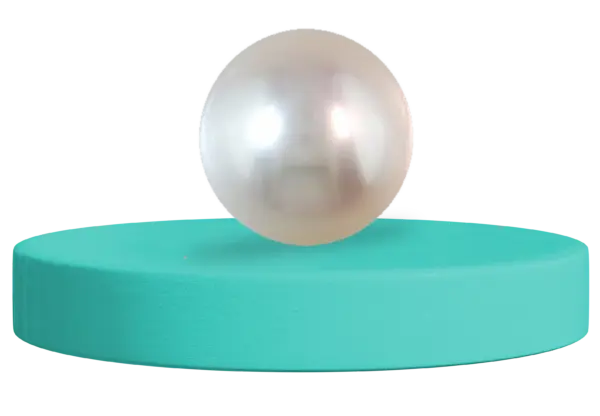
What are cultured pearls, and how do they differ from natural pearls? Here’s everything you need to know.
The main difference between a cultured pearl and its natural counterparts? A cultured pearl is formed via human intervention.
Here’s how it works.
A mantle tissue fragment is placed within a saltwater mollusk or freshwater mollusk. Over time, typically two to three years, successive layers of nacre form over the tissue; this nacre forms the pearl and gives the pearl its characteristic iridescent or lustrous appearance. Once mature, the pearl is carefully extracted, and the inserted tissue is removed.
In contrast, natural pearls form spontaneously within oysters in aquatic settings when a foreign substance enters the oyster. The oyster secretes nacre as a defense, enveloping the irritant. Over half a year to three years, the nacre forms a natural pearl.
What You Will Learn
The History of Cultured Pearls
Artificial pearls date back to the Sung Dynasty in ancient China, where the earliest pearl cultivation method was documented. The ancient technique involved inserting an object, often a Buddhist figurine crafted from lead, into a freshwater mussel shell, mirroring the process used by contemporary pearl farms.

By 1637, cultivated pearls found their way to Europe via the Silk Road, quickly becoming a symbol of affluence among the European elite. This popularity led European scientists on a two-century quest to unravel the secrets of pearl formation, significantly advancing pearl cultivation technology.
In 1916, Mikimoto Kōkichi, an innovative Japanese businessman, secured a patent for a refined method of cultured pearl production. The method was swiftly adopted for commercial use, leading to the rise of Japan’s renowned Akoya cultured pearls. Celebrated for their beauty, Akoya pearls are now a staple in jewelry collections around the globe.
Types of Cultured Pearls
-
Akoya Cultured Pearls
Renowned in the Western jewelry market, Akoya pearls are the most sought-after saltwater pearls. They boast a classic palette of white and cream hues and a uniform shape, making them the go-to choice for crafting elegant strand necklaces.
-
South Sea Pearls
Harvested primarily in Australia, Indonesia, and the Philippines, cultured South Sea pearls are known for their impressive size and warm spectrum of colors, ranging from pristine white to deep gold and sleek silver. The painstakingly long cultivation period and specific conditions required for the growth of South Sea cultured pearls render them among the most luxurious and expensive.
-
Tahitian Cultured Pearls
Originating in French Polynesia, Tahitian pearls display an exotic array of colors. These pearls can vary from deep gray to black but also come in blue, green, purple, or pink.
-
Cultured Freshwater Pearls
The most widely available pearls, cultured freshwater pearls, are a staple in jewelry. Cultivated in lakes and ponds, they are versatile in shape, size, and color. The wide accessibility and affordability of freshwater cultured pearls make them a favored choice for both jewelers and consumers.
The Key Difference Between Natural Pearls vs. Cultured Pearls
The key difference between natural and cultured pearls comes down to formation.
Real pearls form naturally when saltwater mollusks respond to foreign objects lodged within their shells. In contrast, cultured pearls form through human intervention when an irritant is placed inside the mollusk’s soft inner tissue.
These differing formation processes result in other characteristics that set cultured vs natural pearls apart, such as:
-
Shape Variations
Natural pearls display an array of shapes, from spherical to teardrop to even conical. Cultured pearls, however, are typically crafted to achieve a perfectly round or semi-spherical shape.
-
Color Varieties
Cultured pearls’ color can be manipulated during production. Cultured pearls come in virtually any color. Natural pearls, constrained by organic origins, offer a limited range of hues.
-
Luster
The luster, or brilliance and reflectivity, of a natural pearl and cultured pearls are both determined by the quality of the nacre. Pearls can differ in luster depending on the type of pearl, variations of mollusks, and the thickness of the nacre.
-
Price Difference
Most pearls that have been cultured are less expensive than natural pearls, as natural pearls are extremely rare.
While both natural and cultured pearls possess their own unique allure and beauty, they differ in creation, appearance, and cost, offering options for varying preferences and budgets.
How to Tell Cultured and Natural Pearls Apart
There are a few ways to determine whether a pearl is cultured or natural:
- Surface Quality: Cultured pearls have a higher likelihood to be enhanced to achieve unnatural colors compared to natural pearls. For example, a pearl that is unnaturally bright is most likely a dyed pearl.
- UV Light Response: Observing a pearl’s reaction under ultraviolet (UV) light offers another clue. Cultured pearls exhibit a fluorescent glow due to the materials used in their creation, while natural pearls generally show no reaction under UV light.
- Purity Testing: Cultured pearls, due to their controlled formation process, often have different impurity levels compared to natural pearls.
Cultured Pearls: Pros and Cons
Should you choose cultured pearls for your jewelry collection?
Pros of Cultured Pearls:
- A cost-effective, genuine alternative to natural pearls
- One-of-a-kind piece of jewelry
Cons of Cultured Pearls:
- Hold less monetary value
- Prone to wear and tear, such as scratches, chips, and peeling – similar to natural pearls, which is why proper maintenanceis important
FAQs
What are cultured pearls worth?
Cultured pearls’ worth can vary widely based on factors such as size, shape, luster, and color. Generally, cultured pearls’ worth is determined by quality and type, with high-quality pearls fetching higher prices.
Are cultured pearls real?
Yes, cultured pearls are real pearls, created through human intervention.
What are cultured freshwater pearls?
Cultured freshwater pearls are pearls cultivated in freshwater environments, as opposed to saltwater settings.
What is a pearl farm?
A pearl farm is a specialized aquaculture facility where pearl farmers carefully cultivate pearls by inserting irritants into mollusks to initiate the pearl-creating process. These farms can be found in both freshwater and saltwater environments.
Where are saltwater pearls grown?
Saltwater pearls are grown in oceans and seas, primarily in Japan, Australia, Indonesia, and the Philippines.
What is cultured pearl?
Cultured pearl is created through human intervention, by inserting a mantle tissue fragment into a mollusk, which then secretes layers of nacre around the fragment, forming the pearl over time.
Protect Your Investment
Understanding the nuanced differences between cultured and natural pearls enriches your appreciation for these treasures and allows you to make more informed purchasing decisions.
At BriteCo, we help you safeguard your investments, including pearl jewelry, with our comprehensive coverage against loss, theft, and damage. For more information, connect with us directly or use our user-friendly online tool to get a personalized insurance quote.
Related Articles:
How Much Are Real Pearls Worth?
Men’s Pearl Necklace: Everything You Need To Know
Largest Pearl in the World and 9 Other Largest Pearls Ever Found
What Are Cultured Pearls?
The Rise of Pearl Jewelry Trends in Fashion
Appraisal Tool:
The Easiest Way to Get a Professional Jewelry Appraisal Valuation!

UP NEXT: What are the Odds of Losing or Damaging Jewelry?

Author