Most jewelry insurance companies require a formal appraisal for items above a carrier-set threshold, though BriteCo also accepts a detailed receipt. This requirement applies to all items, including fine jewelry, lab-grown diamonds, and any pieces with gemstones.
What You Will Learn
- When an Appraisal is Required vs. When a Receipt is Enough
- What Makes Someone a Qualified Jewelry Appraiser?
- Types of Jewelry Appraisals (and When Each is Required)
- What a Valid Jewelry Appraisal Report Must Contain
- How to Get Your Jewelry Appraised
- How Often Should You Update a Jewelry Appraisal?
- Jewelry Appraisal Requirements | FAQs
- How Insurance Value Adjustment Handles the Gap Automatically
When an Appraisal is Required vs. When a Receipt is Enough
Many specialty insurers have a jewelry appraisal requirement for items above a certain value, though a detailed purchase receipt listing the metal type, gemstone identification, and carat weight can serve as a substitute. BriteCo typically accepts both types of documentation for high-value items, while Progressive requires appraisals for items valued at >$5,000.
An insurance appraisal verifies the insurer’s estimate of your item’s retail replacement value, ensuring you have adequate insurance coverage.
“At BriteCo, the issue we sometimes run into with a receipt is it might not have enough detailed information,” says the company’s founder and CEO, Dustin Lemick.
“We need some documentation that says the center stone is, for example, a 2.5-carat of G color, VSI clarity, with a GIA certificate number. A good receipt will have that required information.”
What Happens if You Skip the Appraisal?
A missing appraisal results in underinsurance risk. When you make a claim for any insured, high-value items, the claim payout is based on documentation, not what a piece is actually worth. As such, if you purchased a piece years ago, lost the receipt, and skipped the appraisal, you have no proof of replacement value for a claim, leaving you without adequate insurance coverage.
Even when optional, an appraisal is helpful during a claim. Just note that an appraisal is only useful when coming from a qualified appraiser.
What Makes Someone a Qualified Jewelry Appraiser?

There’s no government regulation determining who is or isn’t a qualified jewelry appraiser, but strict standards still exist, established by industry organizations.
When evaluating an appraiser’s credentials, look for:
- Graduate Gemologist diploma
- USPAP adherence
- Membership in NAJA
Note that a self-applied “GIA-certified” label does NOT make a qualified appraiser.
The Credential Floor: Graduate Gemologists and Nationally Recognized Organizations
Look for these appraiser’s qualifications:
- Graduate Gemologist (GIA) diploma or equivalent gemological credentials
- Active membership in nationally recognized appraisal organizations
- Adherence to USPAP
- Ongoing continuing education
Being a Graduate Gemologist with a GIA diploma is the minimum gemological training a certified professional appraiser should possess. Active participation in nationally recognized appraisal organizations (NAJA, ASA, AGS, ISA, AGA) is necessary for professional appraisal practice credibility, and USPAP standards increase the likelihood of a valid appraisal report.
BriteCo’s Lemick, a Graduate Gemologist, third-generation jeweler with 13+ years in retail jewelry, is an example of the acceptable standard. To find a good appraiser, he suggests researching your local network.
“Definitely look at reviews online. A lot of times, you can ask a jeweler you go to, and they will tell you who is good or bad in your area.”
What USPAP Compliance Actually Means
The Uniform Standards of Professional Appraisal Practice (USPAP), published by the Appraisal Foundation, sets the ethical, performance, and educational standards that members of nationally recognized organizations must follow, though it cannot legally require certifications or similar requirements for appraisers. It follows, then, that other markers of appraiser qualification remain important.
USPAP governs report content, scope of work, and limiting conditions, so a USPAP-compliant appraisal contains specific elements an insurer expects and wants to see.
A USPAP-compliant appraisal will reflect the requirements listed in our appraisal report checklist below.
Red Flags: “GIA Certified,” Percentage-of-Value Fees, and FTC-Defined Ethics Breaches
There are three red flags to look for when examining an appraiser’s credentials.
- Red flag 1: Using “GIA certified,” because GIA awards the Graduate Gemologist diploma, but does not certify appraisers
- Red flag 2: Charging a percentage of your item’s appraised value; the industry finds this unethical, preferring hourly or flat fees
- Red flag 3: Intentionally over-valuing items, which stands in the way of a credible appraisal (and is considered illegal under FTC guidelines); not following these legal guidelines regarding intentionally over-valuing items can result in appraisal organization expulsion
Types of Jewelry Appraisals (and When Each is Required)
A retail replacement value appraisal determines how much it would cost to replace an item with its exact match if you were to go to the store today. A fair market value appraisal, meanwhile, determines how much the item could sell for based on factors such as demand, condition, and age.
| Difference | Retail Replacement Value | Fair Market Value |
|---|---|---|
| Definition | The cost to replace an item with its exact match in a retail setting | The price the item would likely sell for on the current market |
| Use | Insurance purposes | Estate tax filings, charitable donations, and divorce settlements |
| Valuation methodology | Appraisal based on market research and full retail pricing from jewelry retailers | Appraisal based on current secondary market prices, comparable sales, and expert analysis |
| Value level | Typically higher | Typically lower |
Retail Replacement Value — for Insurance
Retail replacement value is the cost to replace a piece at a jewelry store that regularly sells the type of item being appraised. The appraiser’s valuation methodology incorporates the current fair retail selling price of similar pieces and current retail market research.
Retail replacement value is required for insurance appraisals. It ensures that, if you ever need to make a claim, you have adequate insurance coverage and can purchase a new piece of the same value, with no out-of-pocket costs on your end.
Fair Market Value — for Estate, Donation, and Divorce
Fair market value is the fair price a willing buyer would pay, without the influence of time or need. It’s the item’s true resale value on the common market.
Fair market value serves tax purposes and legal purposes related to:
- Estate tax filings
- Charitable donations (for fair market value appraisals for donations over $5,000, and tax deductions, see IRS Publication 561)
- Divorce settlements
Market fluctuations cause changes in both values over time. For example, the fair market and retail replacement values of lab-grown diamonds have shifted significantly recently as pricing and demand have changed. However, regardless of the value type your appraiser uses, the appraisal itself must meet specific requirements.
What a Valid Jewelry Appraisal Report Must Contain

Insurance companies will reject your appraisal if it doesn’t meet industry-established criteria. A professional appraisal report must contain a defined set of elements and meet certain uniform standards. If the report does not, the underwriter cannot accept it. Here’s what you need and why.
The 10-item Checklist Insurers Verify
When an appraiser makes their objective assessment, their professional appraisal report should contain:
- Their name, credentials, and signature on letterhead
- Date of the formal evaluation
- Detailed descriptions (precious metal type, gemstone quality, carat weight, mounting)
- Photograph(s)
- Statement of value and value type (retail replacement value for insurance)
- Valuation methodology + summary of market research used to compare similar pieces of a relative quality
- Limiting conditions/scope of work
- Distinction between analyzable facts and subjective features
- USPAP-compliance statement
- Organizational affiliation (NAJA, ASA, AGS, ISA, or AGA)
The ACORD/JISO 78 and JISO 79 forms provide the uniform standards that most insurers prefer for a proper appraisal.
Even with all this, though, a seemingly accurate appraisal can still be rejected for other reasons.
Why Insurers Reject Appraisals (and How to Avoid It)
To ensure adequate insurance coverage, a provider can reject appraisals due to:
- Missing appraiser’s credentials/letterhead
- Missing photographs
- Expired dates on appraisals more than 12 months old
- Unclear value statements
- Percentage-of-value fee structures signaling an unethical appraiser
Again, the appraisal report is part of your insurance application and should be taken seriously, since you risk being underinsured if you don’t have a proper appraisal. A detailed description, an objective assessment, and a valuation methodology that meets USPAP standards are required for a valid appraisal report.
Now that you know what a valid appraisal looks like, here’s how to get one.
How to Get Your Jewelry Appraised
There are three ways to have your jewelry appraised:
- Go to a local jeweler or jewelry store
- Use an independent appraiser
- Get an online jewelry appraisal valuation from BriteCo
Path 1: A Local Independent Jeweler or Appraiser
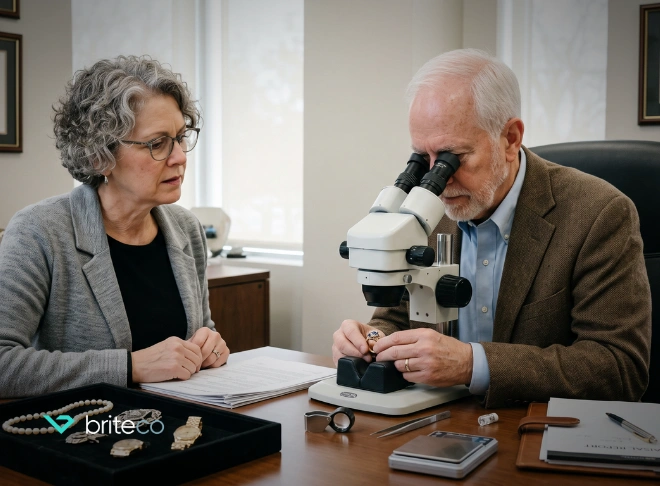
You can find a local jeweler or independent appraiser through the NAJA member directory, GIA appraiser-finding resources, or simply by going to your local jewelry store. Confirm the appraiser is a Graduate Gemologist and a member of a nationally recognized appraisal organization before you schedule your appraisal. The process takes a few days to a few weeks, and your realistic cost will be $50–$150/hour or a $75–$150 flat fee.
Path 2: A BriteCo Partner Jeweler (Integrated Appraisal-to-Quote)
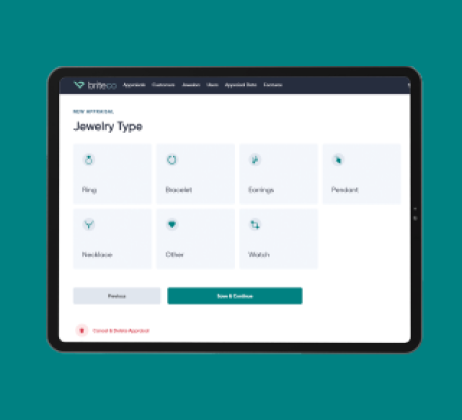
You can also get insurance appraisals from any one of the 3,500+ retail jewelry partners that use BriteCo’s Appraisal Management System. They can complete the appraisal in-store, and then the credentialed appraisal flows directly from the jewelry store to BriteCo for a quick insurance quote.
You’ll have peace of mind knowing the partner is properly accredited, and the convenience of not needing to submit your appraisal for an insurance quote separately. The process takes only 1-2 days.
Path 3: BriteCo’s $26 Online Jewelry Appraisal Valuation
BriteCo’s online jewelry insurance appraisals are available for a $26 flat fee for the first item and $13 for each additional item.
How it works:
- Complete a 5-minute questionnaire
- Meet with a credentialed appraiser partner via video conference
- Receive a digital PDF appraisal via email
BriteCo’s appraisal valuations are true, credentialed appraisals, giving you the peace of mind that you can’t find with instant online appraisals that merely produce algorithmic estimates, unsuitable for insurance purposes.
How Often Should You Update a Jewelry Appraisal?
You should update your jewelry appraisal every 2-3 years to account for market fluctuations and ensure adequate insurance coverage. Appraisals conducted through BriteCo are automatically updated annually, saving you the hassle.
Here’s why these updates matter and how BriteCo’s Insurance Value Adjustment perk makes it simple to keep your appraisal relevant.
The 2- to 3-Year Cadence (and What Drives It)
The GIA recommends updating your jewelry appraisal every 2-3 years due to changes in precious metal and gemstone prices, market fluctuations, and current trends that affect retail prices. What you paid years ago for a piece no longer reflects its replacement cost, and failing to update your appraisal means older pieces are underinsured.
To further ensure adequate insurance coverage, also update your appraisal for:
- Significant piece modifications
- Sudden and major market changes (like a gold or diamond price shock)
Jewelry Appraisal Requirements | FAQs
Do I need an appraisal for jewelry insurance?
Most jewelry insurance companies require a formal appraisal for items above a carrier-set threshold in order to confirm their true value. Some insurers accept a detailed receipt as a substitute.
What is a jewelry appraisal for insurance?
An insurance appraisal verifies the insurer’s estimate of an item’s retail replacement value, helping ensure you have adequate insurance coverage.
How do I get jewelry appraised for insurance?
You can have your jewelry appraised by a local jeweler or independent appraiser, through a partner jeweler, or through an online jewelry appraisal valuation service.
What should be included in a jewelry appraisal?
A professional appraisal report should include the appraiser’s credentials and signature, the evaluation date, a detailed description, photographs, a statement of value and value type, the valuation methodology, limiting conditions, a distinction between analyzable facts and subjective features, a USPAP-compliance statement, and organizational affiliation.
How much does a jewelry appraisal cost?
A local jeweler or independent appraiser may charge $50-$150 per hour or a flat fee of $75-$150. BriteCo’s online jewelry appraisal costs $26 for the first item and $13 for each additional item.
How often should jewelry be appraised?
You should update your jewelry appraisal every 2-3 years to account for market fluctuations and ensure adequate insurance coverage. You should also update it after significant modifications or sudden, major market changes.
Is a jewelry appraisal the same as a receipt?
No. A detailed receipt can serve as a substitute for an appraisal with some insurers, but it must include information such as the metal type, gemstone identification, and carat weight.
Is a diamond certificate the same as an appraisal?
No. An appraisal determines an item’s value, while a diamond certificate documents a diamond’s characteristics, such as its carat weight, color, clarity, and certificate number.
Can I insure jewelry without an appraisal?
Yes, some insurers accept a detailed receipt instead of an appraisal, and BriteCo typically accepts both types of documentation for high-value items. You must have one or the other, though; this is non-negotiable.
Why do insurance companies require jewelry appraisals?
An appraisal verifies an item’s retail replacement value to help ensure adequate insurance coverage. Without sufficient documentation, you risk being underinsured because a claim payout is based on documentation.
How Insurance Value Adjustment Handles the Gap Automatically
Through its Insurance Value Adjustment (IVA) offering, BriteCo automatically adjusts annual coverage based on market data for metal and gemstones. BriteCo IVA prevents any coverage gap from appraisal lag, so that an outdated appraisal doesn’t put you at an underinsurance risk. Even if there are market fluctuations that require updating appraisal documents, thanks to IVA, it’s done for you.
“We don’t need updated values every two years, because we have algorithms that determine that,” Lemick says.
“Our systems know that the values are correct, where other insurance companies have no clue. With other companies, if you don’t get your items reappraised in 10 years, your values are going to be completely out of whack. We don’t require a new appraisal every X number of years, unlike most other insurance providers. It’s a big hassle for consumers.”
Note: The IVA focuses on adequate insurance coverage, giving you peace of mind that you’re not underinsured. This does not replace the need for a fresh appraisal after significant modifications or major market events.
Inherited a valuable piece, or just made a new purchase?
Get a BriteCo quote, or find a partner jeweler to start an appraisal.
Related Articles:
Bvlgari Jewelry Insurance
Appraised Value Vs. Replacement Value Vs. Market Value for Jewelry Insurance
Appraisal Tool:
Sign Up for FREE Jewelry Appraisal Software for Jewelers
UP NEXT: What are the Odds of Losing or Damaging Jewelry?

Author