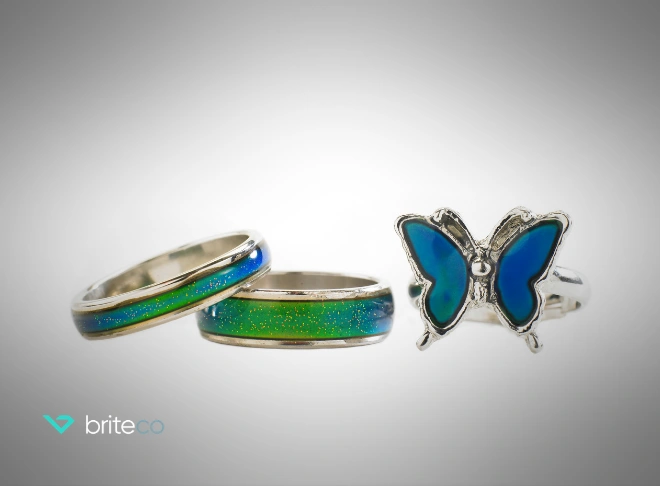

Mood jewelry works as a fun accessory that changes color, but it doesn’t really read your emotional state. The color changes in mood rings and similar jewelry result from shifts in your skin temperature (for example, if you go outdoors and have cold hands, or you exercise and get warm) as well as the ambient temperature in your environment.
Keep reading to learn from jewelry expert and BriteCo gemologist Kaitlyn Rigdon about…
- Does mood jewelry really work?
- How do mood rings work?
- The science behind mood rings
Then, if you’re busy building your overall jewelry collection, with pieces you wear on a daily or regular basis, protect them with comprehensive jewelry insurance. Get a jewelry insurance quote now, with plans ranging from 0.5% to 1.5% of an item’s appraised value.
What You Will Learn
- What is a Mood Ring and How Does it Work?
- Should You Buy Modern Mood Jewelry?
- How Much Should You Spend on Mood Jewelry?
- Does a Mood Ring Actually Work? How to Test Its Effectiveness
- Mood Ring Do’s and Don’ts
- FAQs: How Do Mood Rings Really Work?
- Enjoy Mood Jewelry as a Fun Accessory — And Then Protect All Your Daily-Wear Pieces
What is a Mood Ring and How Does it Work?
Typically, the color-changing portion of a mood ring consists of thermotropic liquid crystals housed within a hollow glass shell, which change their molecular structure in response to temperature, resulting in the characteristic visible color shift.
Thermochromic materials: Materials that change their physical or optical properties based on temperature.
Popularized in the 1970s, mood rings can display a range of colors, including blue, green, yellow, black, and gray. Some mood rings even feature thermochromic pigments that flip between fewer colors.
“These days, mood jewelry is typically worn by kids or adults feeling nostalgic,” Rigdon says. Mood rings are the most popular type of mood jewelry, but you can also find mood bracelets, necklaces, and beads.
While it is true that skin temperature may correlate with shifts in mood, a mood ring (or any mood jewelry for that matter) is not an accurate or reliable way to gauge someone’s true emotions.
So, does mood jewelry really work? Yes, just not in the way people typically assume. Think of mood rings as a fun piece of affordable jewelry, rather than placing any confidence in mood ring color meanings.
Should You Buy Modern Mood Jewelry?
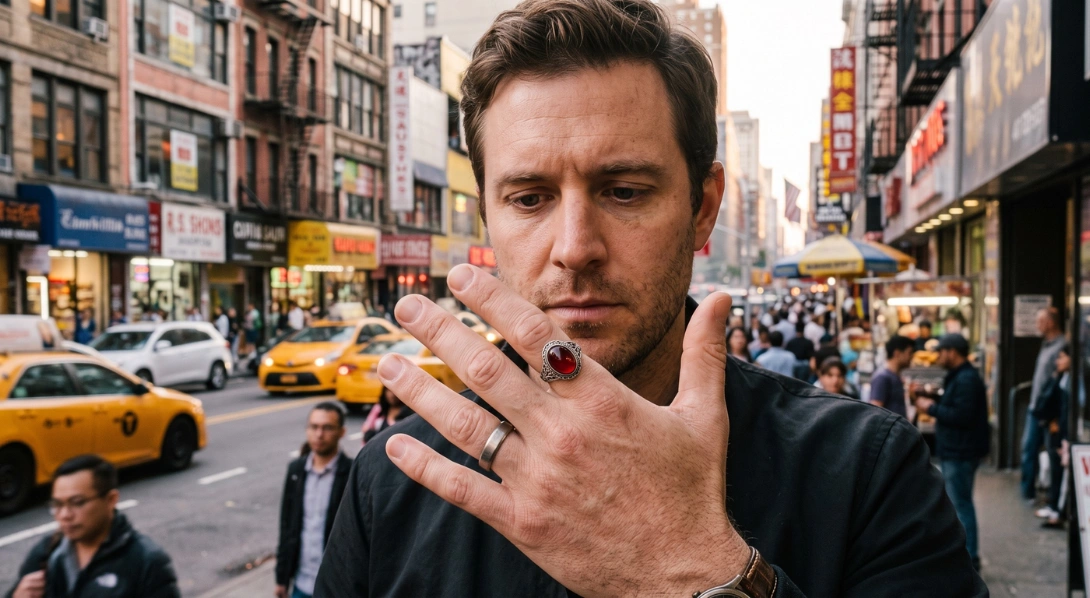
Modern mood jewelry may be of interest if you’re looking for a fun accessory that changes colors. It’s less of a good fit if you’re looking for a piece of jewelry to reliably interpret emotional indicators or confirm your nervous and calm states.
Ask yourself the following questions.
- Are You Buying This Mainly as a Fun, Color-Changing Accessory?
If this is the case, mood jewelry could be a unique addition to your wardrobe. - Do Your Hands Run Cold Most of the Day, Such as If You Work in a Chilly Office or Live in a Winter Climate?
Because of the way the liquid crystal substance within the ring responds to body temperature, if you have cold hands, your ring may be stuck in gray or black most of the time. - Do You Want Consistent Colors from a Piece of Jewelry?
Due to mood jewelry’s thermal response, you may be in for some surprises as the ring shifts colors based on ambient and skin temperature. - Are You Sensitive to Plated Metals or Nickel?
These materials are used frequently in mood jewelry, so you may want to avoid it, particularly if you’ve ever experienced an allergic reaction to jewelry in the past. - Do You Want to Use Mood Ring Colors and Color Interpretation to Diagnose Your Stress or Moods?
Keep in mind that mood jewelry is really just responding to your finger temperature and peripheral blood flow, rather than actual emotions. While blood flow and body temperature may change based on emotion, mood jewelry isn’t a reliable indicator of any particular emotional state.
How Much Should You Spend on Mood Jewelry?
If you’ve decided that mood jewelry is a good fit for your aesthetic, and if you want to wear it regularly, pick a piece that maybe costs a little more, in order for it to last longer before the protective coating on the jewelry band scratches or the ring’s liquid crystal molecules stop responding to heat transfer. Otherwise, if you plan on wearing it infrequently, go the budget route.
| What are you buying the piece for? | How often will it be worn? | What qualities are you looking for? | What you should buy: |
|---|---|---|---|
| Simple nostalgia or to wear to a party | 1-3x/month, if that | Any color-changing properties are fine | An inexpensive mood ring; think costume jewelry |
| Daily wear | 3-7x/week | A sealed dome and sturdier metal | A durable, modern piece of mood jewelry made with precious metals rather than nickel |
| As a gift | Occasionally | Predictable color changes | A piece from a reputable seller with a good return policy |
Remember, if you want to wear the piece daily, durability matters more than how many colors the clear glass stone can display or how “accurate” the ring’s liquid crystals are at picking up on temperature changes.
What Affects Mood Jewelry Cost?
The materials used in the piece — typically “a base metal, stainless steel or sterling silver,” Rigdon says — are one factor. Also affecting the cost:
- Adjustability
- Hypoallergenic claims
- Whether there’s a protective dome or seal over the thermochromic layer
- Color range and responsiveness
- Finish quality
Then, if you’re insuring jewelry you wear often, plans will range from 0.5% to 1.5% of an item’s appraised value
Does a Mood Ring Actually Work? How to Test Its Effectiveness
You can test how well a mood ring actually responds to temperature changes by following the steps below:
- Stabilize your skin’s temperature by sitting indoors for five minutes, keeping your hands away from any hot or cold items (like beverages) that would impact the ring.
- Put on the mood ring and ensure the stone touches your skin.
- Observe the ring’s color and how it changes when exposed to your warm hands vs. cool air vs. neutral room temperatures.
- Most rings will exhibit a violet or purple when warm and a black or gray when cold, with a green or blue color meaning neutral.
Mood Ring Troubleshooting
| If you’re worried about… | Then you need… | Why? |
|---|---|---|
| Your mood ring never changing color | A piece with better skin contact and a sealed surface | Pieces that constantly sit against your skin — like rings vs. loose bracelets — change color more often and more quickly |
| Incorrect color interpretation | To interpret the colors based on temperature, not “mood” | Color changes based on heat conduction, not mood, and any color interpretation chart that claims differently is just marketing content |
| The ring turning gray or black | To warm up your hands or the environment | While some may worry about an “anxious black” reading, gray and black mood jewelry is just a sign of a cold environment |
| Skin irritation | A nickel-free piece made of a higher-quality metal | Even if a ring is plated, that plating can wear away, exposing the nickel and irritating your skin |
| Falling for a gimmicky mood ring | To worry only about the look and aesthetic you want, not so-called mood interpretations | Mood rings are a unique design and there’s nothing wrong with wearing them; you don’t have to put any stock in color interpretation |
Mood Ring Do’s and Don’ts
Do buy a mood ring for the nostalgia or as a playful, fun gift (for yourself or someone else!), but don’t treat it as a medical or psychological tool.
If you’re looking for a piece of jewelry that can help you meet your physical or mental health goals, consider buying a smart piece of jewelry or a similar wearable that tracks your biometrics and data regarding your movement, sleep, heart rate, and more. Also, “a lot of crystals are seen as having therapeutic value,” Rigdon says. “Many people wear amethyst for calm and inner peace, and rose quartz for love of themselves and others.”
If you’re simply looking for a piece of jewelry with color-changing properties, and you want something maybe a little more upscale than a piece of mood jewelry, look for color-changing gemstones. “For example,” Rigdon says, “alexandrite is a rare color-changing gemstone that appears green in one light and red in another.”
If you do choose to clean mood jewelry, always avoid soaking, harsh cleaners, and extreme heat. These can all damage the protective layer on the ring’s exterior.
FAQs: How Do Mood Rings Really Work?
How do mood rings actually work?
Mood jewelry works by changing color with the temperature, and does not actually change color in response to the wearer’s mood or emotions.
Do mood rings detect your mood?
Mood rings do not directly detect your mood, but instead react to temperature changes related to your physiological response to activity. Your mood can influence your skin temperature and circulation, which may influence the ring’s color; however, it’s not a foolproof tactic of interpreting mood.
What are mood rings made of?
Typically, mood rings consist of a hollow glass shell filled with thermochromic liquid crystals that change color in response to temperature.
Why is my mood ring always black?
If your mood ring is black, it’s likely because it’s always cold (which is possible if you have cold hands, or work or live in a cold environment). Otherwise, the coating may be damaged.
Can mood jewelry stop working?
Yes, mood jewelry can stop working if it’s damaged, such as by scratching, excess moisture, exposure to harsh chemicals, high heat, or UV rays. All of these can degrade the piece’s layers and cause it to stop changing color.
Enjoy Mood Jewelry as a Fun Accessory — And Then Protect All Your Daily-Wear Pieces
A mood ring is a temperature-reactive accessory that’s fun, usually inexpensive, and sometimes eerily accurate, but not a lie detector for feelings. Any pricier jewelry you wear daily deserves comprehensive coverage, whether or not it lives up to the hype.
For your daily-wear pieces, specialized jewelry insurance offers protection from damage, theft, and loss.
Get your online jewelry insurance quote now, with plans ranging from 0.5% to 1.5% of an item’s appraised value.
Related Article:
What Color Jewelry Should I Wear?
Birthstone Guide:
Curious About Your Birthstone? Discover All The Details In Our FREE Guide!
UP NEXT: What are the Odds of Losing or Damaging Jewelry?

Author