When an engagement doesn’t lead to a final “I do,” the question of who keeps the ring can often spark a debate and a dispute. The answer will actually depend on where you live, since engagement ring laws vary by state. While no one enters an engagement expecting it to end, knowing how your state views ownership of the ring can help you avoid costly legal battles and protect your rights if the marriage doesn’t work out.
An engagement ring holds sentimental value, whether it was specially purchased with the recipient in mind or is a family heirloom gifted to the next generation. However, they also typically hold significant financial value, with the average engagement ring cost hovering around $6,504 in 2025.
This article offers a look at specific engagement ring laws by state so you know if you’re legally required to return it and reviews how your engagement ring insurance policy may need to change so your valuables are covered.
Engagement Ring Laws: The 3 Gift Categories
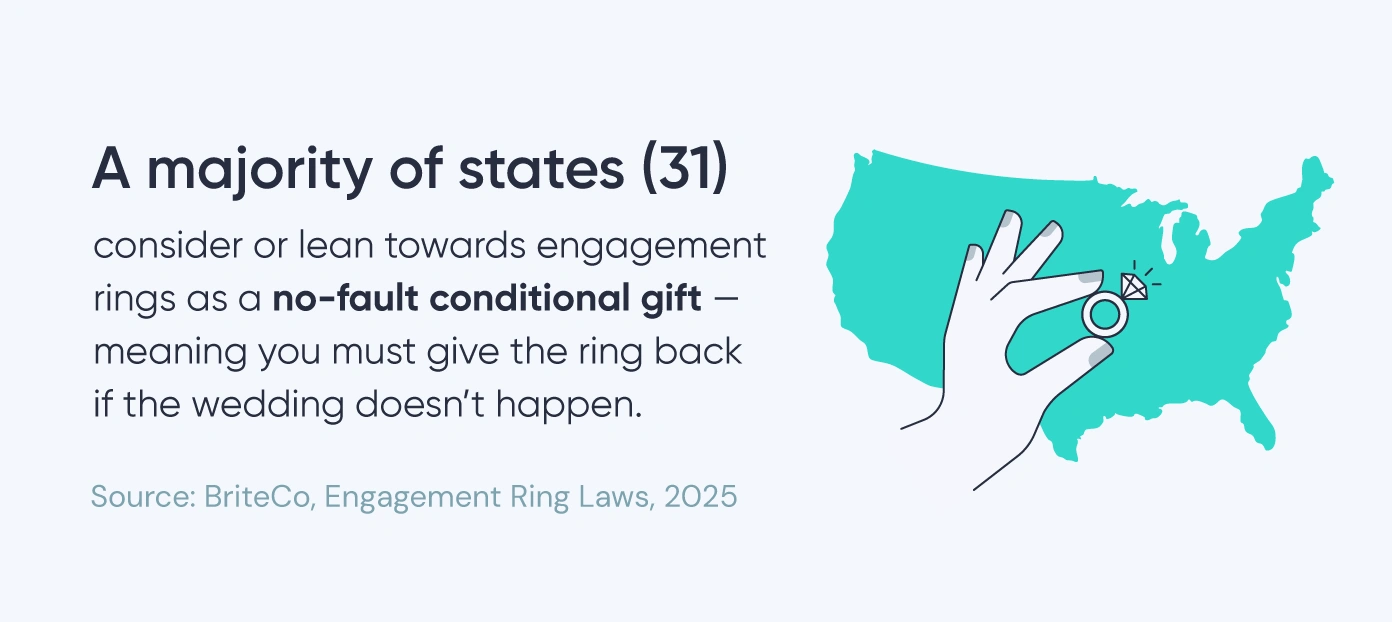
Who keeps the engagement ring after a breakup is dependent on how the law in your state views the item. Most states fall into one of three main gift categories: no-fault conditional gift, fault-based conditional gift, or unconditional gift.
Each approach treats an engagement ring differently if a relationship ends. Here’s a simple breakdown of these three main gift categories:
| Gift Category | Definition | Who Keeps the Ring |
| No-Fault Conditional Gift | The ring is a gift contingent on whether the marriage happens, no matter who ends the engagement or why. | The giver always gets the ring back. |
| Fault-Based Conditional Gift | The ring is a gift contingent on whether the marriage happens, but who ended the engagement and why matters. | The recipient keeps it if the giver broke it off. The giver gets it back if the recipient broke it off. |
| Unconditional Gift | The engagement ring is considered a permanent gift that is given freely and without conditions. | The recipient always keeps the ring. |
For example, most states view an engagement ring as a no-fault conditional gift, meaning it doesn’t matter who ended the engagement — the ring always returns to the giver.
Who Keeps the Ring: A State-By-State Breakdown
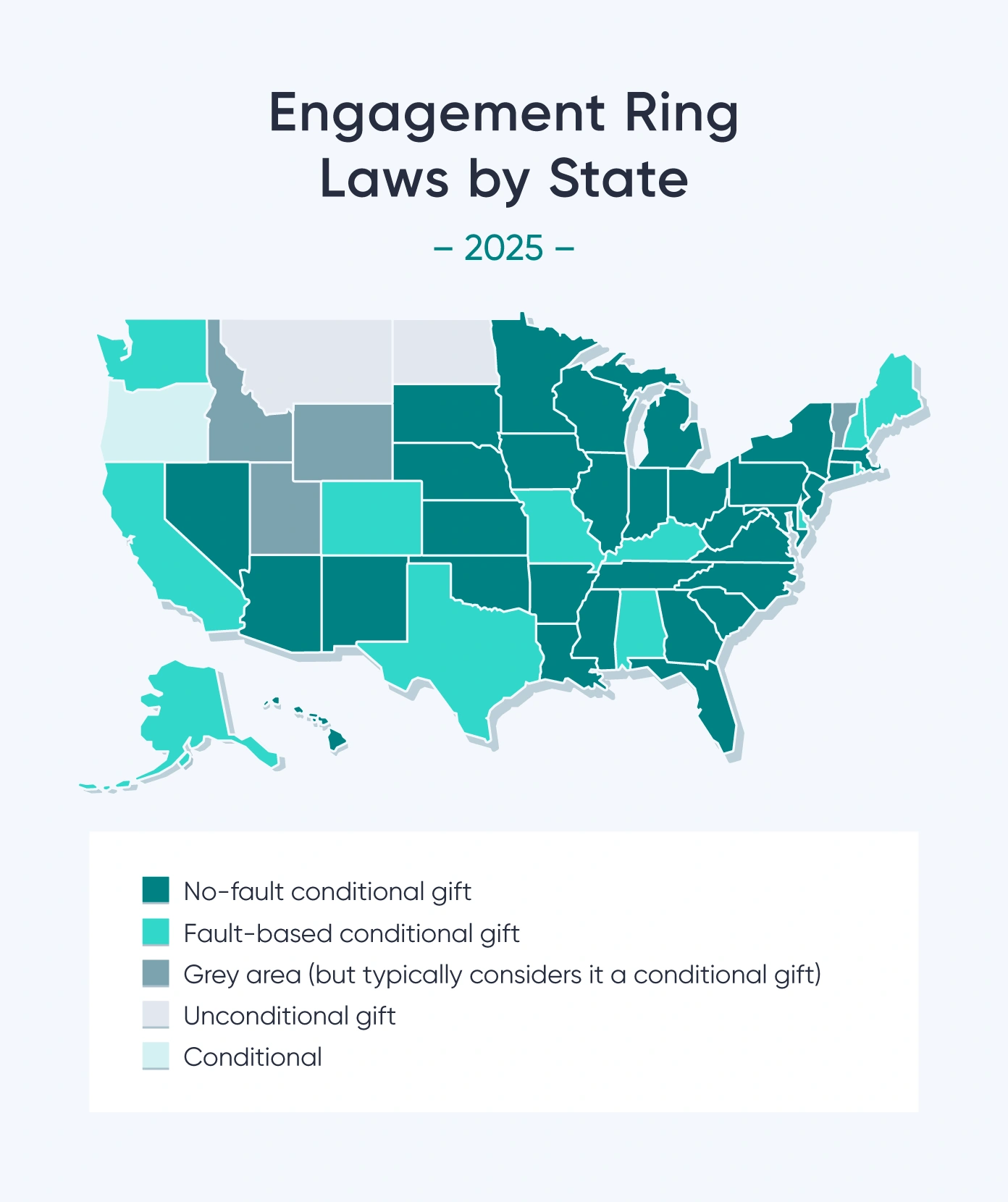
As previously mentioned, engagement ring laws vary by state, and the rules of who keeps the ring where you live may surprise you, especially if you live in the 38% of the country that doesn’t view a ring as a no-fault conditional gift. For example, if you live in Maine, the law views an engagement ring as a fault-based conditional gift. However, the law adds that if a breakup is mutual, the recipient can keep the ring.
The map and table below offer an easy-to-understand look at how each state views engagement rings as gifts, so you can see how the law applies where you live.
| State | Type of Gift | Who Keeps the Ring |
| Alabama | Fault-based conditional | Whoever didn’t end the engagement |
| Alaska | Fault-based conditional | Whoever didn’t end the engagement |
| Arizona | No-fault conditional | The giver of the ring |
| Arkansas | No-fault conditional | The giver of the ring |
| California | Fault-based conditional | Whoever didn’t end the engagement |
| Colorado | Fault-based conditional | Whoever didn’t end the engagement |
| Connecticut | No-fault conditional | The giver of the ring |
| Delaware | Fault-based conditional | Whoever didn’t end the engagement |
| Florida | No-fault conditional | The giver of the ring |
| Georgia | No-fault conditional | The giver of the ring |
| Hawaii | No-fault conditional | The giver of the ring |
| Idaho | Grey area (leans toward no-fault conditional) | Unclear: A lack of precedent means a judge can rule either way |
| Illinois | No-fault conditional | The giver of the ring |
| Indiana | No-fault conditional | The giver of the ring |
| Iowa | No-fault conditional | The giver of the ring |
| Kansas | No-fault conditional | The giver of the ring |
| Kentucky | Fault-based conditional | Whoever didn’t end the engagement |
| Louisiana | No-fault conditional | The giver of the ring |
| Maine | Fault-based conditional | Whoever didn’t end the engagement *but if the breakup is mutual, the recipient can keep the ring |
| Maryland | No-fault conditional | The giver of the ring |
| Massachusetts | No-fault conditional | The giver of the ring |
| Michigan | No-fault conditional | The giver of the ring |
| Minnesota | No-fault conditional | The giver of the ring |
| Mississippi | No-fault conditional | The giver of the ring |
| Missouri | Fault-based conditional | Whoever didn’t end the engagement |
| Montana | Unconditional | The recipient of the ring |
| Nebraska | No-fault conditional | The giver of the ring |
| Nevada | No-fault conditional | The giver of the ring |
| New Hampshire | Fault-based conditional | Whoever didn’t end the engagement |
| New Jersey | No-fault conditional | The giver of the ring |
| New Mexico | No-fault conditional | The giver of the ring |
| New York | No-fault conditional | The giver of the ring |
| North Carolina | No-fault conditional | The giver of the ring |
| North Dakota | Unconditional | The recipient of the ring |
| Ohio | No-fault conditional | The giver of the ring |
| Oklahoma | No-fault conditional | The giver of the ring |
| Oregon | Conditional | Depends on circumstances |
| Pennsylvania | No-fault conditional | The giver of the ring |
| Rhode Island | Fault-based conditional | Whoever didn’t end the engagement |
| South Carolina | No-fault conditional | The giver of the ring |
| South Dakota | No-fault conditional | The giver of the ring |
| Tennessee | No-fault conditional | The giver of the ring |
| Texas | Fault-based conditional | Whoever didn’t end the engagement |
| Utah | Grey area (typically considered a conditional gift) | Unclear: A lack of precedent means a judge can rule either way |
| Vermont | Grey area (typically considered a conditional gift) | Unclear: A lack of precedent means a judge can rule either way |
| Virginia | No-fault conditional | The giver of the ring |
| Washington | Fault-based conditional | Whoever didn’t end the engagement |
| West Virginia | No-fault conditional | The giver of the ring |
| Wisconsin | No-fault conditional | The giver of the ring |
| Wyoming | Grey area (leans toward no-fault conditional) | Unclear |
What Engagement Ring Laws Mean for Couples
When engagements end, couples face many logistical hurdles that come with cancelling a wedding, such as figuring out living arrangements and the legal details about their possessions, including the engagement ring. But protecting wedding-related investments with change of heart insurance coverage can help alleviate a lot of the burden and provide peace of mind in the aftermath of a canceled wedding.
Returning the engagement ring is only one part of the emotional and financial aftermath when an engagement or wedding is called off.
Here are a few reasons why understanding engagement ring laws matters:
- Protecting family heirlooms: If the ring has sentimental value as an item passed down through generations, knowing the law helps set expectations about whether it should return to the original family.
- Avoiding legal disputes: Understanding your state’s laws upfront can prevent costly legal fees or stressful arguments if an engagement ends.
- Planning finances: Engagement rings are often one of the most expensive purchases before a wedding, so knowing the potential outcomes can help couples plan more responsibly.
- Considering a need for insurance coverage: In addition to jewelry insurance to protect the investment in the ring, change-of-heart insurance can help cover nonrefundable wedding expenses if plans fall through.
- Managing the breakup aftermath: Returning the ring is just one item to check off your list if your engagement ends; couples also need to know how to cancel a wedding properly to handle contracts, deposits, and societal obligations (i.e., informing guests about the cancellation and what to do for future events you’re both invited to).
- Having peace of mind: Even if you never need this knowledge, having clarity about the law and your options can reduce uncertainty and stress.
Why Jewelry Insurance Matters
Knowing the law helps with ownership questions, but only jewelry insurance ensures an engagement ring is financially protected, no matter what the future holds. Even if the law states that you get the ring in the event of a breakup, it doesn’t guarantee that the ring will be safely returned to you. A stolen, damaged, or lost engagement ring can cause financial and sentimental loss.
Jewelry insurance helps protect against these risks and ensures your investment is covered for repair or replacement based on its appraised value.
To help you prepare for the unexpected, here is what’s important to know about an engagement ring’s insurance coverage in the event of a breakup:
The Policy Still Exists
Jewelry insurance coverage for an engagement ring covers the ring itself, not the wedding. Even if the engagement ends or the wedding is cancelled, the insurance policy doesn’t just disappear. As long as you continue to pay the monthly premiums, the insurance coverage remains active.
The Person Who Owns the Policy Controls Coverage
If the person who gave the ring also purchased the insurance policy, they will remain the policyholder until they choose to retain, cancel, or transfer the coverage. On the other hand, if the recipient purchased the insurance policy, they will control the insurance coverage.
Knowing who controls the policy is key to protection and any potential reimbursement. However, things can get complicated if the ring becomes subject to a court dispute. During this period, the ownership of the physical ring and the ownership of the insurance policy may not match, creating a situation where the coverage protects the policyholder but not necessarily the person who physically has the ring.
In this case, if anything happens to the ring while in the uninsured person’s possession, the insurer may refuse a claim or make a payment to the insured.
Deciding to Transfer Coverage
Insurance companies typically cover only the person listed as the policyholder until ownership of the ring is legally resolved. This is why it’s crucial for couples to immediately update or transfer the policy when the ring changes hands.
BriteCo allows you to insure yourself and name one additional person to the coverage — like a fiancé or partner. This added benefit from BriteCo means both the person who bought the engagement ring and the person who received it should be added to the policy for maximum protection of the ring.
Doing so ensures that the right person is protected from loss, theft, or damage while legal matters are settled in situations such as:
- The recipient is the policyholder and gives the ring back: They can cancel or transfer coverage to the giver, who can maintain the existing coverage or obtain new insurance.
- The recipient is the policyholder and keeps the ring: They can ensure the policy is only in their name.
- The giver is the policyholder and the recipient keeps the ring: They can cancel or transfer coverage to the recipient, who can maintain the existing coverage or obtain new insurance.
- The giver is the policyholder and keeps the ring: They can ensure the policy is only in their name.
FAQs About Engagement Ring Laws
Is an Engagement Ring a Gift?
Yes, an engagement ring is considered a gift. However, most states legally view it as a conditional gift with the expectation that a marriage will occur. There are some exceptions where states view engagement rings as unconditional gifts that are accepted and kept out of love. In those cases, many people utilize the divorce ring trend, creating a new piece to wear from the ring.
Do You Have to Give an Engagement Ring Back?
Whether or not you legally have to give an engagement ring back depends on where you live. Engagement ring laws vary by state and how the state classifies the ring as a gift.
Most states deem engagement rings as no-fault conditional gifts, meaning the ring must be returned to the person who gave it. Other states view them as fault-based conditional gifts, meaning that the person not at fault for the engagement ending gets to keep the ring. A few states see engagement rings as unconditional gifts, meaning that the ring’s recipient can keep it.
Can You Return an Engagement Ring?
Yes, if you’re the recipient of an engagement ring and your state law mandates it, you can and should return the ring to the person who gave it to you. Socially, there are mixed opinions; some believe returning the ring is the right thing to do, while others believe it’s a gift that can be kept. However, it’s best to follow state laws to avoid legal ramifications.
If you’re looking to return an engagement ring to the store where you purchased it, the outcome will be dependent on the store’s policy. Some jewelers allow returns or exchanges within a set window (often 30 days), especially if the ring hasn’t been resized or customized (which typically is a final sale). Others only offer store credit. Check your receipt and warranty for specific policies.
No Matter the Engagement Ring Law, Insurance Protects Your Investment
While engagement ring laws by state determine who keeps the ring after a breakup, they don’t help protect the value of your ring. Jewelry insurance ensures that your investment is safe, no matter what happens in your relationship or in everyday life.
Ready to take the next step in protecting your ring? Get a free quote from BriteCo today to see how easy it is to protect the financial and sentimental value..

Author