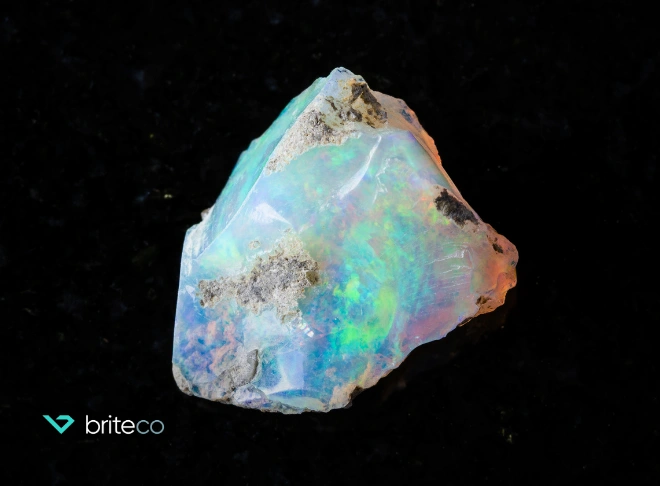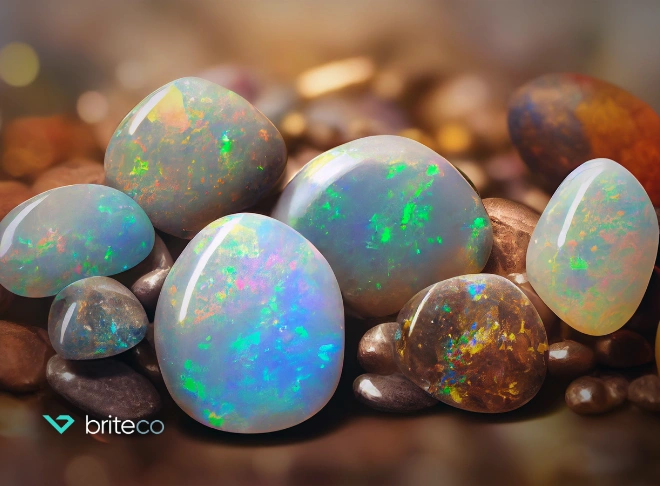
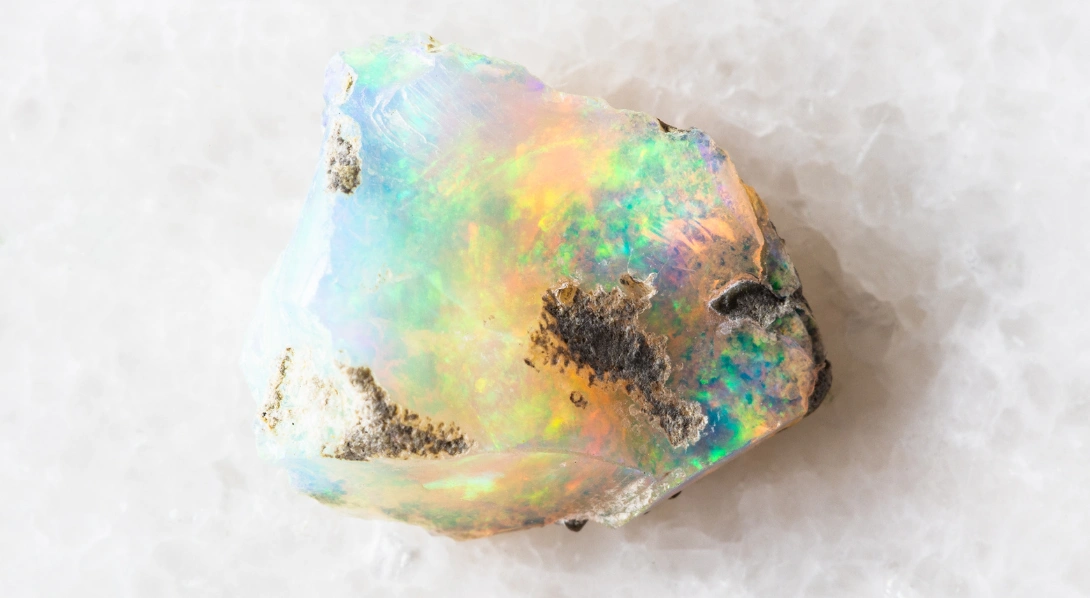
When silica‑rich water seeps into rock voids and deposits a silica gel, which slowly hardens, opal forms. The manner in which the silica hardens impacts the gem’s final appearance. In precious opal, uniform silica spheres diffract light, creating a vivid play of color.
In common opal, disordered spheres result in an opaque or translucent appearance with no play of color. Unlike crystalline gemstones such as diamond or sapphire, opal has no repeating crystal lattice, which distinguishes it from most other gemstones used in jewelry.
Keep reading to learn more about:
- How opal is formed
- What affects an opal’s appearance
- What affects an opal’s price and quality
If you love your opal pieces and want to protect them from potential damage, loss, and theft, you can do so with specialized insurance. Get your online jewelry insurance quote here.
What You Will Learn
How is an Opal Formed? Geological Formation in 5 Steps
Opal formation happens when all the right conditions come together, and the following processes occur:
- Weather or hydrothermal fluids free silica from sandstone or volcanic rocks, and the silica then dissolves into the groundwater.
- The water and dissolved silica mixture percolates into cracks or voids, making its way underground.
- The water evaporates over many, many, many years, leaving behind silica deposits.
- The silica forms sub-microscopic spheres; if the spheres are uniform and stacked, they create play of color and, thus, precious opal (as opposed to common opal — more on that in a bit).
- Opal deposits are mined and then cut, revealing iridescent color patterns that reflect off the final polished surface.
How Opal is Formed Affects Its Appearance
Unlike many gemstone minerals, opal contains microscopic silica spheres rather than crystal structures, which give it its unique appearance. As you probably know, though, not all opal looks the same; opal can take on various different appearances and colors based on minute differences in the above geological formation.
For example, if the silica spheres are larger or more ordered, the play of color is more likely to trend red. Smaller spheres are more likely to trend green or blue. If the spheres aren’t ordered at all, you get a common opal that’s either opaque or transparent, with no play of color.
Geography also matters. The Cretaceous sediments found in Australian opal fields are more likely to produce black or boulder opal, whereas volcanic settings, such as those in Ethiopia or Mexico, are more likely to produce hydrophane or fire opal.
Fun fact: Australia is a major producer of opal, accounting for 90-95% of the world’s supply.
How Opal is Formed Affects Price
Certain aspects of opal formation and the resulting appearance — including body tone and contrast, brightness, and patterns — also impact opal quality and rarity, and thus value and price.
- Body tone and contrast: Black opal is widely considered one of the rarest gemstones, since it’s formed under very specific conditions. It follows, then, that it’ll cost you quite a bit more.
- Brightness and pattern: As discussed, silica sphere size and order uniformity affect opal color, which, in turn, influences price, with large spheres that produce red hues being more prized overall.
- Thickness of color bars and stability: A thicker color bar with a distinct pattern is most desirable; the thicker the bar, the easier it is to separate the precious opal from its colorless base, known as potch.
Types of Opal
Opal can be divided into many categories, including precious opal, common opal, sedimentary opal, and volcanic opal. There are also categories of opal that are named for their distinct qualities (hydrophane opal), geographic origin (Mexican opal, also known as fire opal), or their appearance (black opal versus white opals, for instance).
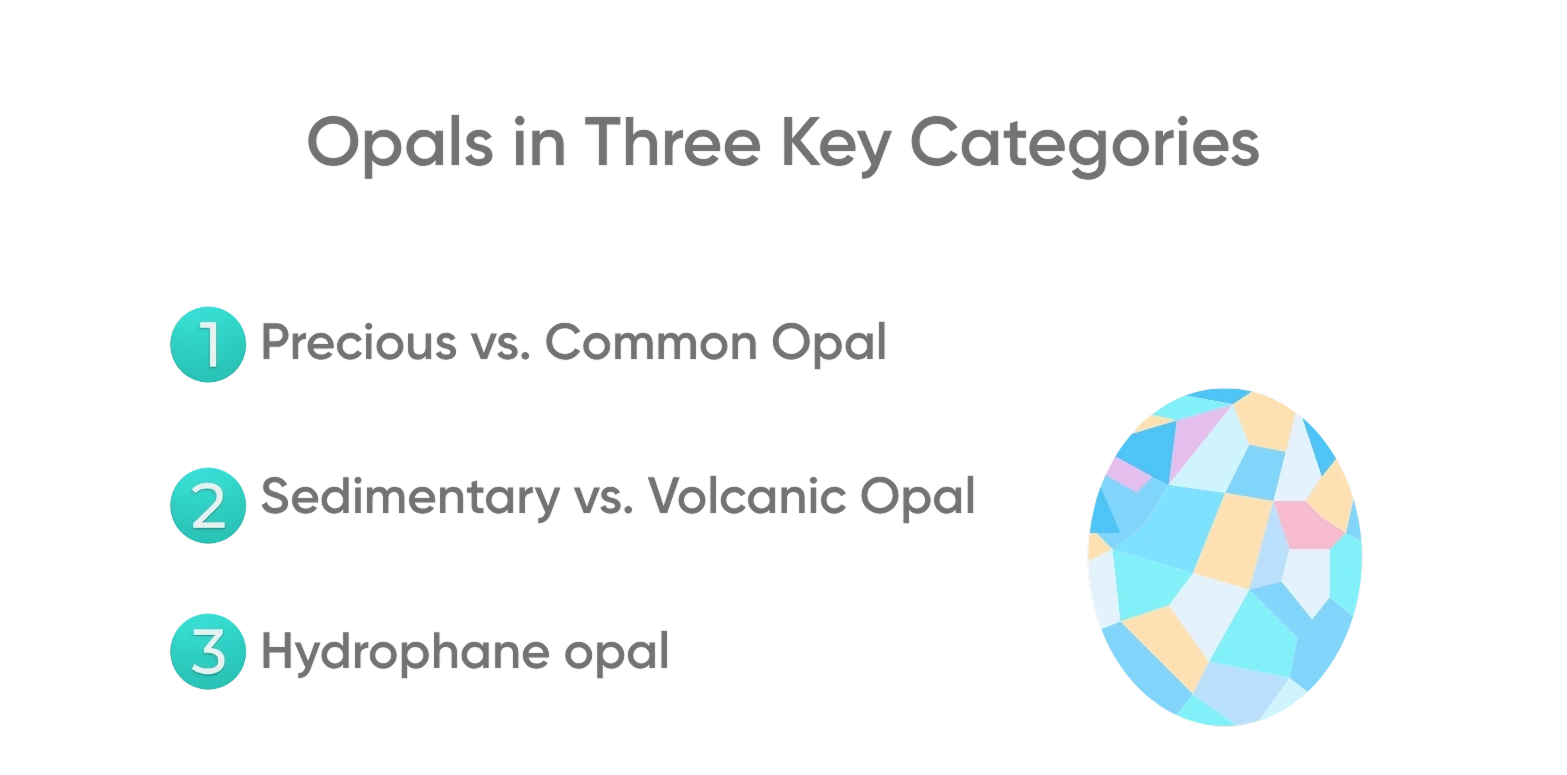
If you’re just starting to shop for opal, it can be helpful to focus on a few key categories and their definitions:
- Precious vs. Common Opal: Precious opal exhibits play of color, whereas common opal does not and has uniform opaque or translucent Common opal is “commonly” available and more affordable, whereas precious opal is rarer and more expensive.
- Sedimentary vs. Volcanic Opal: Sedimentary opal forms via silica derived from sedimentary rocks, while volcanic opal forms via silica derived from volcanic rocks or ash.
- Hydrophane opal: This is a specific type of porous opal, commonly sourced from Ethiopia, that can literally absorb water, changing its appearance. Hydrophane opal is sometimes called water opal.
Solid Opal vs. Opal Doublets and Opal Triplets
It’s important to note that there’s also solid opal versus opal doublets or an opal triplet.
Solid opal is exactly what it sounds like: solid pieces of natural opal. However, doublets and triplets are assembled pieces of layers of opal and/or synthetic materials (with either two or three layers, as the names suggest). Doublets and triplets are more affordable.
What About Opalized Fossils?
Opalized fossils form when the silica and groundwater seep into underground cavities left behind by long-buried plants or animals, replacing the original organic material. The result is an opal formed in the exact shape of a fossil, giving you anything from opalized wood to an opalized skeleton, opalized sea creatures, or opalized teeth. Even opalized dinosaur bones have been unearthed in the past!
Opalized fossils are exceptionally rare, and you’re not going to find them for sale just anywhere. If you do come across a few, they’ll likely come at a high price. According to The National Opal Collection of Australia, the continent is the only source of opalized animal fossils, with famous sources including Lightning Ridge and Coober Pedy.
What Kind of Opal Should You Buy?
When shopping around, consider your style and color preferences. If you want a fiery red opal, look for one with larger silica spheres and an ordered structure. If you want a rare, geologically unique opal, pick a black opal formed in ancient Australian sediments.
Be mindful of your lifestyle and care practices, though, so you don’t accidentally damage a high-quality opal you’ve invested in.
Best Opals for Easiest Care
For the easiest care and greatest durability, avoid hydrophane opals and choose a boulder opal or an opal in a protective setting.
Here’s why:
- If you wear hydrophane opal, you’ll need to take care not to expose it to water, cosmetics, perfumes, or other liquids. Otherwise, you’ll notice that, every time you wash your hands, spritz on lotion, sweat, etc., the opal begins to turn translucent, only reverting back to its normal appearance after drying.

- Boulder opals and opals in protective ring settings can be worn daily with fewer worries regarding accidental damage, making at-home opal care and cleaning easier.
Overall, be mindful of temperature swings (opals don’t like them) and potential damage from accidental impacts. Doublets and triplets will need even gentler care, as they’re more delicate.
Do: Treat opals gently and always check if a stone is solid versus assembled before purchase.
Don’t: Assume opal behaves like quartz or diamond, and never soak hydrophane opals.
How is Opal Stone Formed? | FAQs
What is opal made of?
Opal is composed of hydrated silica and can contain 3-21% water.
What causes play of color?
Play of color in precious opal is the result of uniformly sized and ordered silica microspheres. When the microspheres are not uniformly sized and ordered, you get common opal, which has no play of color.
Do opals come from volcanoes or sediments?
Opals can be formed from both volcanic and sedimentary rocks. Volcanic opals can be found in Ethiopia and Mexico, for example, while sedimentary opals are mainly mined in South Australia, New South Wales, and Queensland.
What is hydrophane opal?
Hydrophane opal is a type of porous opal that absorbs water and changes appearance when wet. It’s mostly found in Ethiopia.
Why do some opals crack (crazing)?
Opal crazing or cracking occurs when opals are exposed to rapid moisture or temperature changes. This is particularly an issue with hydrophane opal.
Protect Your Opal
Opal is silica‑rich water made visible, and its microscopic order turns light into color. Read our opal care guide for more details.
If you’ve found yourself in possession of a beautiful opal, make sure you keep it safe. With BriteCo, your jewelry is insured anywhere in the world, 365 days a year, 7 days a week.
You won’t ever have to worry about coverage when traveling, and you’re covered in the event of accidental damage, loss, mysterious disappearance, and theft. Standard policies have a zero deductible, so you won’t have to pay extra out-of-pocket costs in the event of a claim.
Get your jewelry insurance quote now.
Buying Guide:
The Secret to Diamond Buying: Natural vs Lab Grown

UP NEXT: What are the Odds of Losing or Damaging Jewelry?

Author