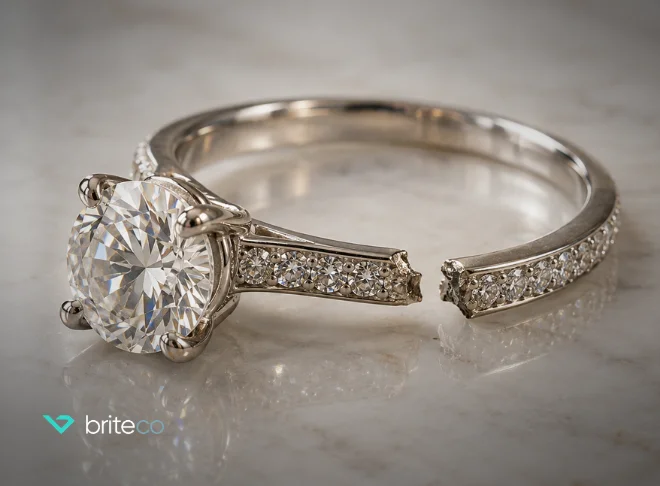
From the moment a rough diamond is pulled from the earth to the final polish on a gold band and setting, each step in making a diamond engagement ring has a process and a cost that add value to the finished product. A diamond ring may be a symbol of love, but behind its sparkle lies a surprisingly complex global journey—and a price tag shaped by far more than just the size of the stone.
At BriteCo, we specialize in insuring jewelry, but our team got curious about exactly what goes into the value of the engagement rings we insure. That’s why we put together this infographic, digging into all of the costs that make up the final price you see at the jewelry store.
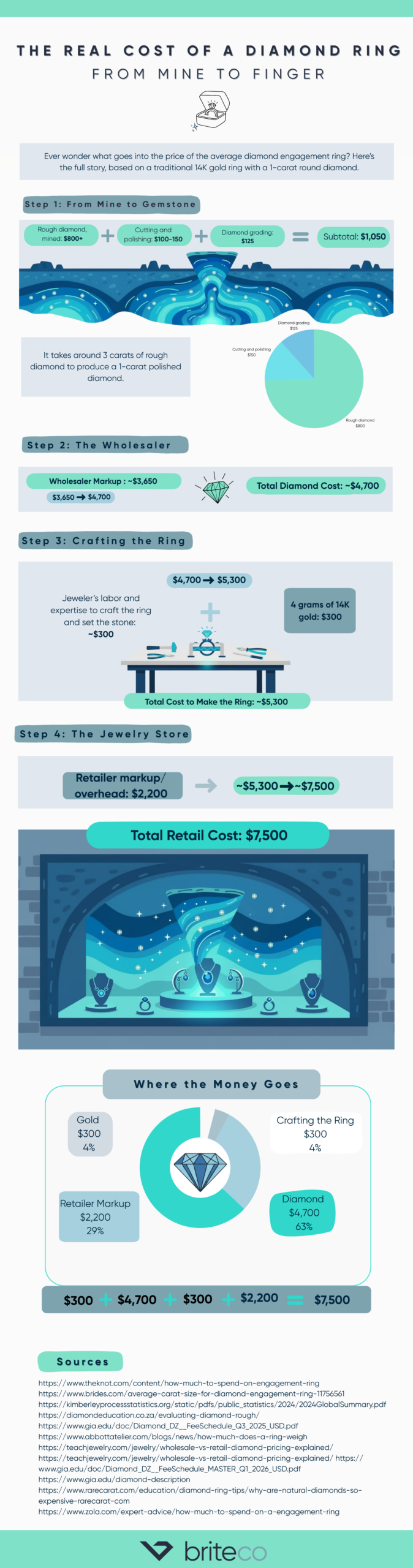
We took an average diamond engagement ring, a traditional-style 1-carat round stone with a yellow gold band, priced at $7,500, and broke down everything that contributes to its final retail cost.
How Much Does a 1-Carat Diamond Ring Cost?
The average price for a high-quality one-carat diamond engagement ring ranges between $6,800 and $8,500. And while diamond jewelry can seem pricey, there’s a lot that goes into that price tag between the mine and the proposal.
Step 1: From Mine to Gemstone
Every natural diamond begins as raw carbon buried deep within the earth, where it undergoes intense heat and pressure over time until the crystalline structure of a rough diamond is formed. Extracting these rough diamonds requires extensive geological surveys to locate the deposits, expensive heavy machinery and infrastructure to access the stones, and labor-intensive mining operations to extract them from the ground.
Only about 20% of the diamonds mined are used for jewelry; the rest are used to manufacture cutting tools, scientific instruments, and electronics. And of that 20%, more than half of the diamond weight is lost during the cutting process. On average, you’ll need 2.5 carats of diamond in the rough to get a nicely shaped, multi-faceted 1-carat diamond for your ring.
- Mining the rough diamond ($800+): To produce a 1-carat polished diamond, miners must extract the rough material, which requires moving an average of 250 tons of earth just to find. Between heavy machinery, labor-intensive operations, and the scarcity of gemstone-quality stones, this initial stage is the foundation of the ring’s value.
- Cutting/polishing ($100 – $150): A raw diamond has little sparkle. Transforming it into a faceted gem requires specialized labor and precision, as even a small mistake can significantly devalue the stone.
- GIA certification ($125): Once cut, the diamond is sent to a gemological lab. A professional grading report from the GIA is the industry standard, providing assurance of the stone’s quality and authenticity.
By the end of this stage, the diamond’s transformation from a piece of rock into a brilliant, certified gemstone has brought its total cost to around $1,050.
Step 2: The Wholesaler
After grading, the polished diamond enters the wholesale market. Wholesalers act as the bridge between cutters and jewelry retailers. They buy loose diamonds in bulk, manage distribution networks across international borders, and take on the financial risk of holding large inventories of high-value stones.
The markup at this stage covers a wide variety of fluctuating costs, such as:
- Scarcity premium: The additional cost driven by the limited global supply of high-quality, investment-grade natural stones.
- Expertise: The specialized knowledge required to inspect, grade, and pair diamonds to meet a retailer’s exacting quality standards.
- Transportation: High-security armored transport and courier services required for moving gemstones across borders.
- Insurance: Comprehensive policies that protect the high value of the stones against loss or theft during transit and storage.
- Financing: The cost of the immense capital required to purchase and hold millions of dollars in inventory before it is sold.
- Global logistics: The cost of navigating international trade laws, customs duties, and the complex track and trace systems that ensure ethical diamond sourcing.
For a high-quality diamond (G-VS2 or better), a jeweler may pay a wholesale price between $4,500 and $5,000.
Step 3: Crafting the Ring
A diamond alone does not make a ring. Once the jeweler has purchased the cut and polished stone, this is where artistry meets metallurgy, and other precious materials are introduced to craft the final piece.
- 14k Gold ($200-$300): With gold spot prices reaching historic highs (approximately $4,628.68 per ounce in early 2026), the “casting” cost of a ring has also risen. A standard 4-gram 14k gold setting contains about $300 in raw gold. Turning that raw gold into a finished ring involves multiple stages of craftsmanship: melting and alloying the metal, shaping the band, casting or fabricating the design, and setting the stone securely, which will increase the cost.
- Labor/setting ($200 – $400): This covers the jeweler’s “bench” time needed to cast the metal and seat the diamond safely.
This step is often the most personal part of the process, where technical precision meets emotional significance. The design choices, setting style, and fine details are what make each diamond engagement ring unique. The jeweler’s process is delicate and requires a balance of beauty and durability to ensure the stone remains secure for a lifetime, raising the cost of the now-finished diamond ring to $5,300.
Step 4: The Jewelry Store
The final stage is the retail store. Whether you shop at a digital-first retailer or a luxury boutique, the store must cover significant overhead, including high rent, specialized jewelry insurance, sales commissions, and marketing.
While online retailers may operate on slimmer margins (25–50%), a physical boutique typically adds a markup of 100% or more to the wholesale cost to provide the traditional “white-glove” experience—allowing you to see, touch, and compare stones in person. That brings us to the final retail cost of the ring, around $7,500.
Where the Money Goes
The price of a diamond ring reflects much more than the sum of its materials. Every sparkle represents a global chain of effort, from miners and cutters to wholesalers, jewelers, and retailers, each adding skill, care, and value along the way. What begins as a raw stone buried in the earth ends as a handcrafted piece designed to last a lifetime.
When you finally hold this masterpiece in your hands, the focus shifts from the cost of the journey to its value. Protect your investment with specialized jewelry insurance. Start by securing an independent appraisal to verify the current market value, then choose a dedicated engagement ring insurance policy that covers loss, theft, and damage. By taking these final steps, you ensure your diamond’s story remains uninterrupted and its brilliance remains protected for a lifetime.
SOURCES:
https://www.theknot.com/content/how-much-to-spend-on-engagement-ring
https://www.brides.com/average-carat-size-for-diamond-engagement-ring-11756561
https://kimberleyprocessstatistics.org/static/pdfs/public_statistics/2024/2024GlobalSummary.pdf
https://diamondeducation.co.za/evaluating-diamond-rough/
https://www.gia.edu/doc/Diamond_DZ__FeeSchedule_Q3_2025_USD.pdf
https://www.abbottatelier.com/blogs/news/how-much-does-a-ring-weigh
https://teachjewelry.com/jewelry/wholesale-vs-retail-diamond-pricing-explained/ https://www.gia.edu/doc/Diamond_DZ__FeeSchedule_MASTER_Q1_2026_USD.pdf
https://www.gia.edu/diamond-description
https://www.rarecarat.com/education/diamond-ring-tips/why-are-natural-diamonds-so-expensive-rarecarat-com
https://www.zola.com/expert-advice/how-much-to-spend-on-a-engagement-ring

Author