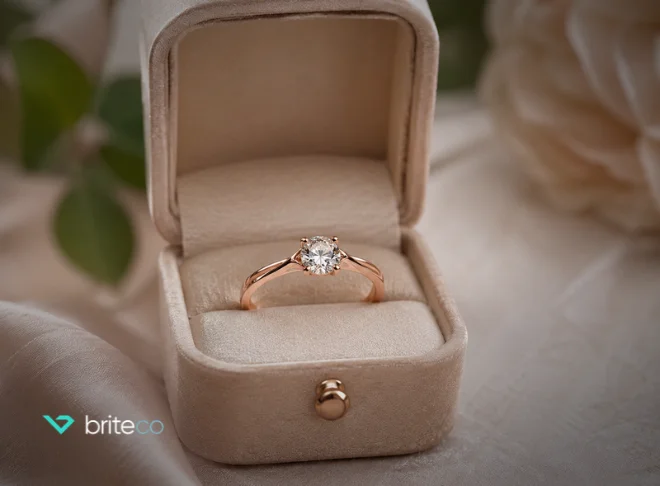
Rose gold is becoming less common, but it’s not necessarily “out of style,” according to BriteCo’s data. Our research found that rose gold was featured in 4.8% of jewelry settings in 2019 and that declined to 3.3% in 2025, with the number declining further January-June 2026, to 3.2%. While that is a noticeable multi-year decline, rose gold still remains present across multiple jewelry categories.
With some guidance from BriteCo jewelry expert Rachel Akmakjian, let’s look at the data further, what you can expect from other precious metals as a result, and how to decide if this once-popular gold is still a good choice for you.
What You Will Learn
- Is Rose Gold Going Out of Style? The Short Answer
- What BriteCo Data Shows About Rose Gold
- When Did Rose Gold Start Losing Popularity?
- Rose Gold Isn’t Declining Equally Across Every Jewelry Category
- Rose Gold Engagement Rings Show an Even Clearer Shift
- What Yellow Gold, White Gold, and Platinum Tell Us About the Shift
- Why Might Rose Gold Be Cooling Off?
- Does Lower Popularity Mean Rose Gold Looks Dated?
- Should You Still Buy Rose Gold?
- FAQs About Whether Rose Gold Is Going Out of Style
- Rose Gold Is More Niche, Not Gone
Is Rose Gold Going Out of Style? The Short Answer
Yes, rose gold items have declined in popularity in recent years, but there’s still a market for them and just because a jewelry style is becoming less common, that doesn’t make it obsolete.
Rose gold — which is technically a yellow gold alloy mixed with copper for a pink-ish hue — may hold less of the market share today, according to BriteCo’s appraisal data, but it’s still a great pick for some shoppers. The color looks great on many individuals and you can easily find rose gold pieces that will remain staples in your collection for years to come.
“There are always going to be people who gravitate towards rose gold,” Akmakjian says, “but it is a very small niche group.”
What BriteCo Data Shows About Rose Gold
According to BriteCo data, rose gold accounted for 4.8% of jewelry settings in 2019; that number then grew to 4.9% in 2021 before declining to 3.3% in 2025, with January-June 2026 numbers coming in at 3.2%. That’s a decline of 1.5 percentage points between 2019 and 2025.
| Year | Rose Gold Settings Market Share |
| 2019 | 4.8% |
| 2020 | 4.7% |
| 2021 | 4.9% |
| 2022 | 4.5% |
| 2023 | 4.1% |
| 2024 | 3.8% |
| 2025 | 3.3% |
| Jan-June 2026 | 3.2% |
BriteCo’s data supports the fact that rose gold is losing market share, especially over the past few years. The data does not find, however, that rose gold has disappeared altogether or is no longer wearable.
“Once in a blue moon, a jeweler will get a rose gold request,” Akmakjian says. “But I do feel it’s declining compared to those years where it was much higher.”
When Did Rose Gold Start Losing Popularity?
Rather than a sudden collapse in popularity, the data shows that the use of rose gold in trendy pieces really started to dip slowly, over time, beginning after 2021. BriteCo data found that rose gold accounted for nearly 5% of jewelry settings from 2019 through 2021, then its popularity declined each subsequent year through January-June 2026.
2019-2021: Market share remained relatively stable
4.8% → 4.7% → 4.9%
2022 onward: A consistent annual decline in this style
4.5% → 4.1% → 3.8% → 3.3% → 3.2% H1 2026
Rose Gold Isn’t Declining Equally Across Every Jewelry Category
Rose gold appears to be becoming more niche rather than disappearing evenly across every type of jewelry, with the metal retaining its popularity best in certain categories, such as bridal jewelry and bracelets.
According to BriteCo, rose gold was used in approximately 4.4% of wedding bands in 2025 and 2.0% of anniversary bands. Meanwhile, the data found that rose gold appeared in 3.5% of other rings, 3.4% of bracelets, 2.8% of necklaces, and 2.2% of earrings in 2025.
| Jewelry Category | Rose Gold Share, 2025 |
| Wedding bands | 4.4% |
| Other rings | 3.5% |
| Bracelets | 3.4% |
| Engagement rings | 3.2% |
| Necklaces | 2.8% |
| Eternity bands | 2.5% |
| Pendants | 2.5% |
| Earrings | 2.2% |
| Anniversary bands | 2.0% |
Wedding Bands and Rings Still Show Meaningful Rose-Gold Use
BriteCo’s data discovered that wedding bands were the most popular use for rose gold among listed 2025 jewelry categories, at 4.4% of market share.
Rose gold rings in general, though, were likewise popular, as were bracelets, all utilizing rose gold at higher rates than earrings, anniversary bands, and pendants.
Earrings and Necklaces Show a Smaller Rose-Gold Share
According to BriteCo, rose gold accounted for 2.2% of earrings and 2.8% of necklaces in 2025.
Rose Gold Engagement Rings Show an Even Clearer Shift
Rose gold has lost substantial share among engagement ring styles since its 2020-2021 high. Rose gold engagement rings have not disappeared, but they do represent a smaller portion of BriteCo’s data set.
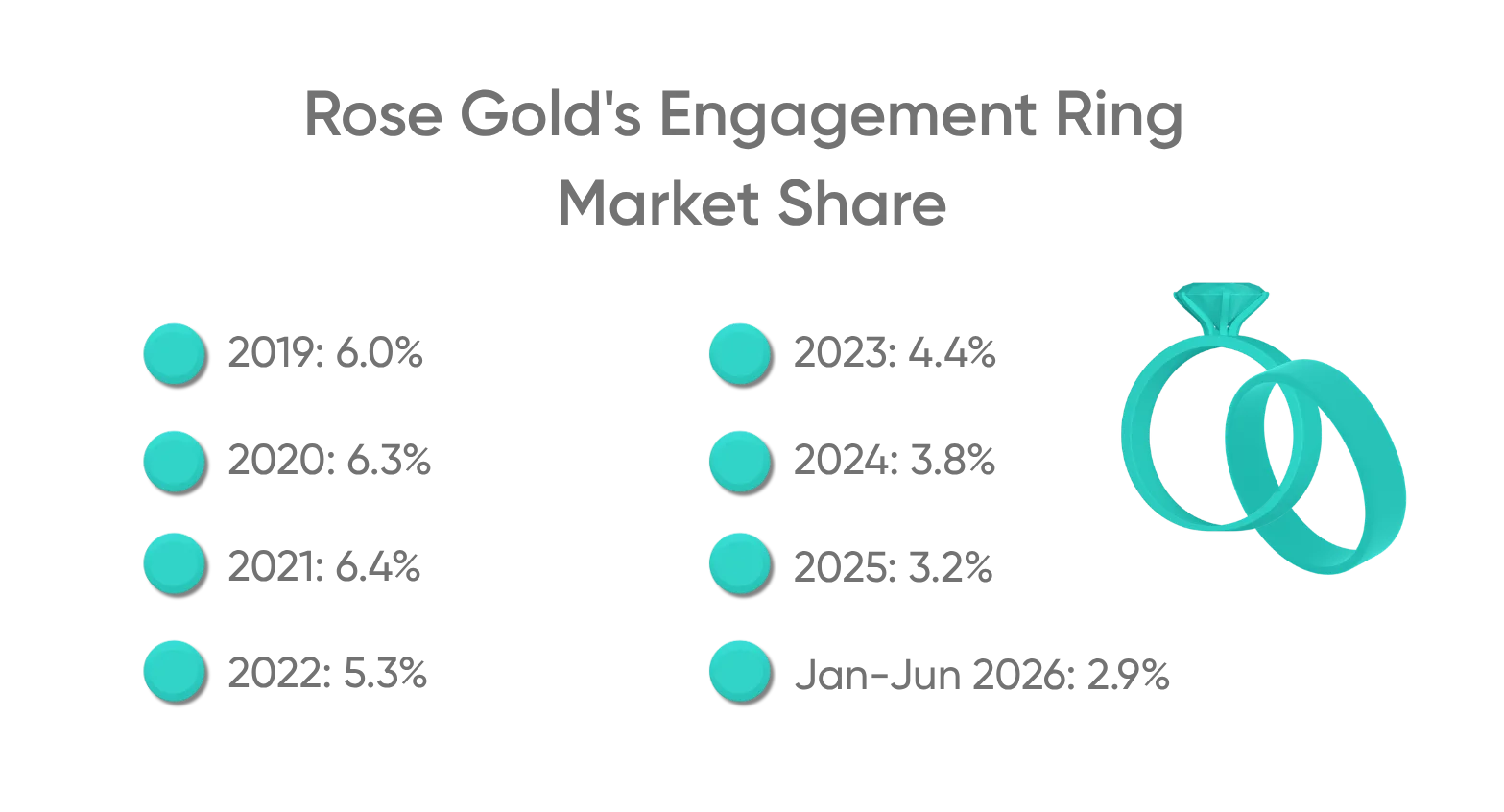
According to BriteCo, rose gold’s share of engagement ring metals increased from 6.0% in 2019 to 6.4% in 2021, then declined to 3.2% in 2025, with share for January-June 2026 at 2.9%.
A Smaller Share Doesn’t Make a Rose-Gold Ring a Bad Daily-Wear Choice
Popularity data like the above may measure how common a metal is, but it can’t tell you whether a particular ring will suit someone’s lifestyle, wardrobe, gemstone, or long-term taste.
Rose gold rings are still a good option for a daily wear engagement ring, as well as for statement jewelry, due to their durability.

What Yellow Gold, White Gold, and Platinum Tell Us About the Shift
BriteCo found that yellow gold has increased in popularity, from representing 32.1% of jewelry in 2019 to 38.8% in 2025, while platinum likewise increased in popularity from 10.5% to 15.7%.
Over the same period, BriteCo data shows white gold declined in popularity from 51.1% to 38.0%, while rose gold declined from 4.8% to 3.3%.
As such, it can be inferred that rose gold’s decline happened during a broader reshuffling of jewelry-metal preferences, and preferences for different colors of gold, such as yellow or white gold.
| Metal | 2019 | 2025 | Direction |
| Yellow gold | 32.1% | 38.8% | ↑ |
| White gold | 51.1% | 38.0% | ↓ |
| Platinum | 10.5% | 15.7% | ↑ |
| Rose gold | 4.8% | 3.3% | ↓ |
The Data Shows Rebalancing, Not a One-for-One Switch
Yellow gold and platinum gained share of the market while rose and white gold lost share, but the dataset does not establish that one specific group of buyers directly migrated from one metal to another.
Why Might Rose Gold Be Cooling Off?
Rose gold’s declining market share lends itself to speculation by fashion experts.
| What the data shows | What may explain the trend |
| Rose gold’s share of the jewelry market has declined steadily since 2021. |
|
What the Data Shows vs. What We’re Interpreting
These broader fashion movements could shed some light on why modern buyers are showing less and less interest in rose gold. While it’s a fact that rose gold has a smaller share of BriteCo appraisal records than it did several years ago, the dataset does not tell us any individual shopper’s reason for selecting or rejecting rose gold jewelry.
Does Lower Popularity Mean Rose Gold Looks Dated?
No, a declining market share means rose gold is less common within BriteCo’s appraisal data; it does not establish that an individual rose-gold piece looks dated.
A precious metal’s popularity is not binary and rose gold still holds timeless appeal. It’s been around much longer than the most recent rose gold trends.
Additionally, because it’s becoming a little less common, you may even find that a rose gold piece is more distinctive. Furthermore, precious metal alone does not make a piece “contemporary” or “outdated.” Other factors that play into the question include design, proportion, styling, and gemstones.
For example, “there was a healthy moment when rose gold was really big with morganites, beryls with a peachy, pink hue,” Akmakjian says. “Also pearls, especially akoya pearls, can have a pinkish hue to them, and so those are going to look really complementary in rose gold.”
At the end of the day, personal preference matters far more than whether or not the broader public considers a particular metal to be in style or not.
Rose Gold Has a History Beyond Its Recent Trend Cycle
Rose gold may’ve gained new popularity in the 2010s, but this precious metal has its own long history, with connections to Fabergé and an explosion of popularity in the 1800s, when it was known as Russian gold.
As such, avoid thinking that this precious metal was just a 2010s “fad” that might have a certain vintage charm a few decades from now; it holds a timeless elegance that stretches across centuries.
Should You Still Buy Rose Gold?
Yes, there are many reasons why you should still buy rose gold. Most importantly, though, you should buy rose gold because you like rose gold, not because you are betting on its popularity increasing again.
| If You… | Rose Gold May Still Make Sense Because… |
| Love warm tones, pink or blush tones | Your own personal preference matters more than how popular a certain metal is at any given time |
| Like a romantic aesthetic | Rose gold naturally supports that look |
| Want something less common | Lessened popularity makes for a more defined, unique look |
| Wear both warm and cool colors | Rose gold can bridge palettes and works well with many skin tones |
| Own yellow, white, or silver-toned jewelry | You can integrate rose gold when you’re mixing metals |
How to Make Rose Gold Feel Current
Make rose gold feel current by:
- Mixing rose gold with yellow or white metals
- Using one rose-gold piece as a focal element or statement piece
- Pairing streamlined designs with modern outfits
- Combing rose gold with gemstones or diamonds based on personal preferences
Rose Gold Ownership and Care Still Matter
Even though rose gold is durable enough for everyday wear, you still want to take precautions to prevent scratches and unnecessary damage.
Make sure rose gold earrings, bracelets, necklaces, and rings are stored separately and carefully, avoiding unnecessary contact between pieces. Whenever you need to clean the rose gold jewelry, just gently wipe each piece with a soft cloth.
For some pieces, you may need to consider piece-specific care instructions, depending on their design and other metals/gemstones.
FAQs About Whether Rose Gold Is Going Out of Style
Is Rose Gold Going Out of Style?
Rose gold is becoming less trendy, but it has not disappeared. According to BriteCo, rose gold declined from representing 4.8% of jewelry settings in 2019 to 3.3% in 2025, with January-June 2026 numbers at 3.2%.
Is Rose Gold Still Popular in 2026?
Rose gold is no longer one of the most popular types of precious metals, but it’s definitely still around. According to BriteCo, rose gold represented 3.2% of jewelry settings in January-June 2026.
When Did Rose Gold Start Declining?
The clearest decline begins after 2021. According to BriteCo, rose gold represented 4.9% of jewelry settings in 2021, then this number declined to 4.5% in 2022, 4.1% in 2023, 3.8% in 2024, and 3.3% in 2025.
Are Rose Gold Engagement Rings Still Popular?
Rose gold engagement rings remain available but represent a smaller share of the engagement ring market than before. According to BriteCo, rose gold engagement rings declined in popularity from 6.4% of all engagement ring metals in 2021 to 3.2% in 2025, with January-June 2026 at 2.9%.
Is Yellow Gold More Popular Than Rose Gold?
Yes, in BriteCo’s current dataset. According to BriteCo, yellow gold represented 38.8% of jewelry in 2025 compared with 3.3% for rose gold.
Rose Gold Is More Niche, Not Gone
Rose gold pieces are becoming more niche, not extinct. BriteCo’s data shows a real decline in rose gold’s share of jewelry and engagement ring settings, but market share cannot determine whether a rose gold piece suits someone’s style or deserves a place in their collection. Wear what you want!
To recap:
- Rose gold was roughly stable through 2021.
- Its broader jewelry share then declined consistently.
- Engagement rings show an even steeper drop in popularity.
- The decline in rose gold varies substantially by jewelry category (i.e., rose gold bracelets rose gold necklaces).
- Yellow gold and platinum gained greater popularity during this broader metal reshuffling.
- None of this means an individual rose-gold piece is automatically dated.
If rose gold complements your style, skin tone, gemstones, and existing collection, the fact that fewer shoppers now choose it can be a reason to see it as distinctive, not a reason to avoid it.
For rose-gold jewelry you would struggle to replace, whether it is an engagement ring, heirloom, bracelet, or another meaningful piece, keep current documentation and make sure your jewelry insurance protects its replacement value.
Get your jewelry insurance quote today.
Birthstone Guide:
Curious About Your Birthstone? Discover All The Details In Our FREE Guide!
UP NEXT: What Jewelry Gifts Actually Cost This Season, According to Real Appraisal Data

Author