Wedding Seating Chart Ideas Guests Can Actually Use
The best wedding seating chart ideas do two things at once: They help guests find their seats quickly and they reinforce the style of the reception.
As you get further into your journey of learning how to plan a wedding, questions about your seating plan are bound to come up. So let’s talk to wedding planner Joe Rogers, founder of Contagious Events in Boston, to help decide whether or not you even need a wedding table seating chart for your reception and how to handle seating arrangements.
What You Will Learn
- Do You Really Need a Wedding Seating Chart?
- Wedding Seating Chart vs. Escort Cards vs. Place Cards: What’s the Difference?
- How Do You Make a Wedding Seating Chart That Actually Works?
- Who Should Sit Where at a Wedding Reception?
- Should You List Guests Alphabetically or by Table Number?
- What Wedding Seating Chart Mistakes Should You Avoid?
- How Do You Display a Seating Chart So Guests Can Actually Use It?
- Can a Small Wedding Skip the Seating Chart?
- What Are the Best Wedding Seating Chart Ideas by Style?
- What Wedding Seating Chart Ideas Work Best on a Budget?
- Wedding Seating Chart Checklist Before You Print Anything
- People Also Ask About Wedding Seating Chart Ideas
- The best choices for seating your guests and protecting your wedding
Do You Really Need a Wedding Seating Chart?
No, not every wedding technically needs a seating chart, but seating charts usually help the wedding reception flow better and reduce confusion — especially at a larger venue or more structured event.
In Rogers’ opinion, “you do need to do assigned seating. It’s not about controlling where people sit in the room. It’s more just about being hospitable and creating an environment where your guests are able to sit with their party. If you do kind of a free-for-all, wedding seating is like a game of Tetris.”
If you want one, there’s no one stopping you from including a wedding seating chart within your reception, no matter how small your wedding is.
Wedding Seating Chart vs. Escort Cards vs. Place Cards: What’s the Difference?
A wedding seating chart is a central display or sign that tells guests their table assignments. Escort cards are individual cards often displayed for guests to grab and use to find their seats according to what’s listed on the card with their name. And place cards are cards listing guests’ names at the guests’ seats.
Which option you pick for your reception will depend on personal preference and wedding aesthetic.
(Planning your wedding with some help? Ensuring the chart or cards are properly displayed before the reception begins is something that should be on your wedding coordinator checklist.)
How Do You Make a Wedding Seating Chart That Actually Works?
Planning a table seating chart for a wedding that actually works is as simple as:
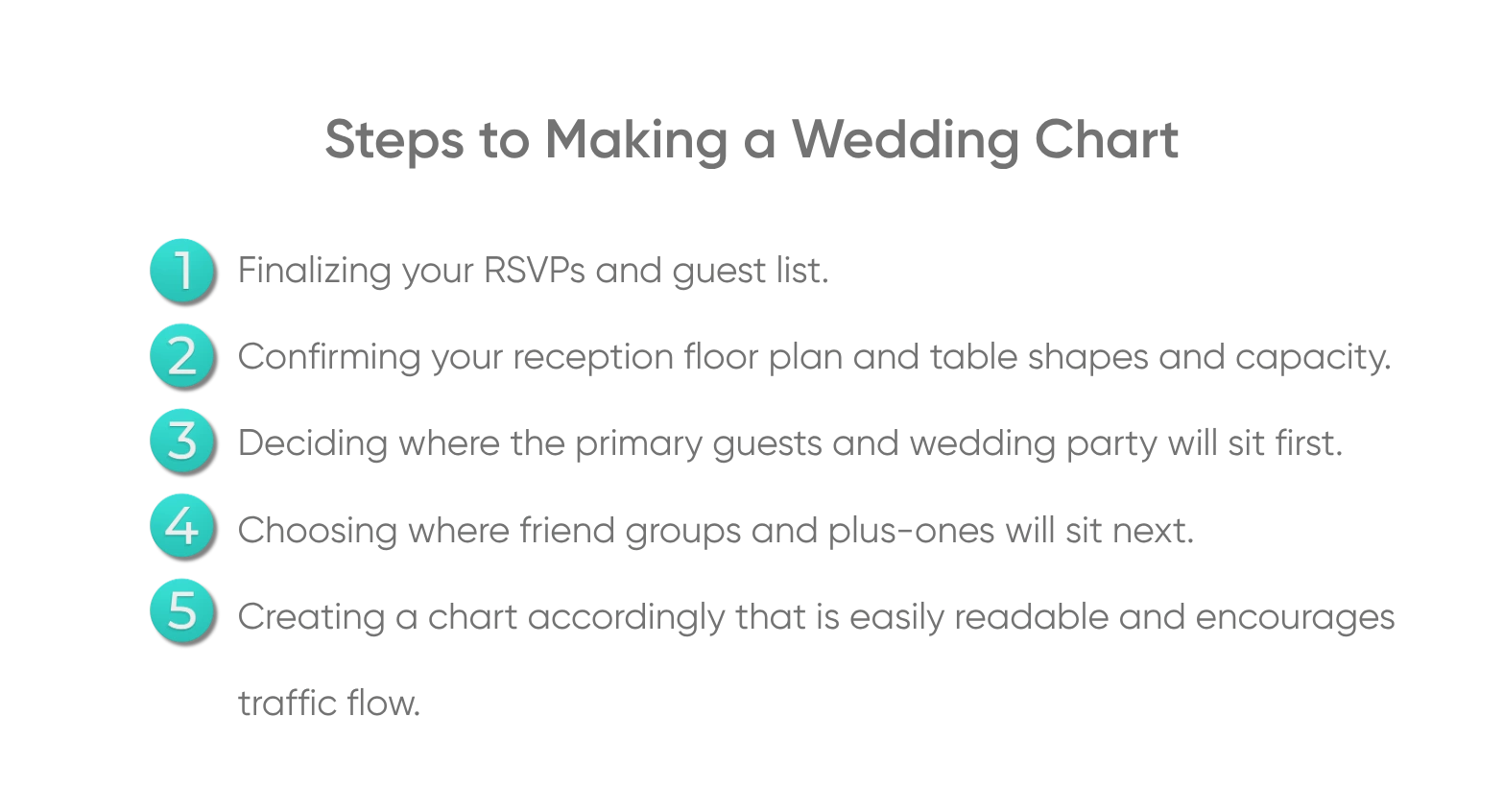 As you create your chart and organize your guests, keep in mind the wedding dinner menu (for example, buffet vs. food stations vs. seated dinners) and overall wedding-reception timeline (learn more in our guide to what is a wedding reception). The goal is to make finding seats and then moving around the reception space as easy as possible for guests.
Who Should Sit Where at a Wedding Reception?
When it comes to how to organize a wedding seating chart, the groom and bride are given the best seats in the house, followed often by the parents and immediate family, and then the wedding party and plus-ones.
Head Table vs. Sweetheart Table
When seating the newlyweds, there’s a choice between a head table and sweetheart table. A sweetheart table is reserved for just the two of them (providing a more intimate atmosphere, even if it does put the newlyweds on display) and the head table seats the newlyweds directly next to family members and the wedding party.
“I like the optics of a sweetheart table, especially during toasts. It’s an easier way to frame the shot of the toast giver and also the couple,” Rogers says. “The downside is that a sweetheart table is an invitation for people to approach and talk with the couple, and that may or may not be what the couple wants. We do want them to eat.”
Which option you choose is all up to personal preference (and can be informed by how you define what is a wedding reception according to your vision).
Parents and Immediate Family
Parents and immediate family are often seated nearest the newlyweds, either at the head table with them or at the closest table to the sweetheart table.
The Wedding Party and Plus-Ones
Traditionally, the wedding party would also be seated at the head table, or at a table nearer the newlyweds, without their plus-ones. However, this tradition has more or less fallen out of fashion, with couples realizing that many wedding party members want to have their plus-ones close by, in the same group.
“Most of our couples are sitting their wedding party plus-ones at the head table with them,” Rogers says. “Typically, we would put the plus-ones on the opposite side of the wedding party, so that when we’re getting the photos of a couple, the faces that you see are the faces of people in the wedding party. And we generally would not put chairs immediately across from the couple. so that there’s a clear shot for the photographer.”
Kids, Older Guests, and Guests with Accessibility Needs
After immediate family and the wedding party with their plus-ones are seated, the rest of the guest list can be organized as preferred, though special attention may be made to seating children, elderly guests, or guests with accessibility needs.
For example, young children should be seated with their parents, but children pre-teen and up may be seated at a dedicated children’s table. Consider positioning families with young children and the children’s table away from high-traffic areas and décor or equipment, and closer to venue exits.
Likewise, elderly guests should be given seats at tables that are easily accessible and further away from high traffic and loud noise. For those with accessibility needs, seat them in accessible spots that provide necessary space, and confirm that your reception venue can accommodate them. (Ensuring that accessibility requirements are met on the day-of can be something that you add to your wedding coordinator checklist.).
Should You List Guests Alphabetically or by Table Number?
As you begin to build out your seating chart for your wedding, the chart may list guests alphabetically or by table number. The former option is faster for guests to scan, while the latter offers a cleaner look, though it may be more suited to smaller events and design-heavy displays.
Rogers has a clear favorite between those options. “Seating charts absolutely need to be organized alphabetically by last name,” he says. “Your guests are going to the seating chart because they don’t know what table number they’re going to. So if you are organizing it by cable number, they have to read the whole thing in order to find their name vs. if you break it out alphabetically. they will be able to find their name a little bit faster.”
Like so many other aspects of learning how to plan a wedding, picking how you format your wedding seating chart will ultimately come down to ensuring your guests have an enjoyable time, with no unnecessary difficulties or confusion.
What Wedding Seating Chart Mistakes Should You Avoid?
When finalizing seating chart ideas for a wedding, make sure you’re avoiding the following mistakes:
- Creating a chart that’s difficult to read due to style or design
- Waiting too long to begin the process of finalizing your chart
- Ignoring accessibility and mobility issues in the space
- Packing too many people at too few tables
- Separating couples, families, or support systems carelessly
- Choosing to place the chart in the flow of guest traffic (as you build a wedding coordinator checklist, ask them to confirm the chart is placed correctly, before the reception begins)
“What I’ve noticed is that when you ask guests to make their way to the reception, even if they’ve already looked at the seating chart, they go back to it to look again and make sure that they know the right table number,” Rogers says. “Effectively what you have is 150, 175, 200 people all going to the same space to look at this installation and before they go to the next space that we’re asking them to shift to. So, wedding charts can cause a bottleneck.” The solutions: Factor in extra time for that transition, or skip the central chart and instead offer escort cards guests can pick up anytime and have ready when reception time comes.
Again, as you determine how to plan a wedding that fits your vision, avoiding these mistakes will better guarantee a smooth, seamless transition from ceremony to reception.
How Do You Display a Seating Chart So Guests Can Actually Use It?
To ensure a wedding seating chart is actually used…
- Display it during the cocktail hour, so guests have plenty of time to read it in advance
- Display the chart right at the reception entry point
- Keep the chart at eye level so it’s easier to read
- Avoid placing the chart in high-traffic areas, such as next to the bar or dance floor
- Make names readable from a short distance
- Put a light on the chart if the space is dark or if the event is at night (this can be especially crucial if you’re trying to figure out how to turn a backyard into a wedding venue)
“For a large wedding, we might encourage having two seating charts that are exactly the same, just in two separate locations,” Rogers says. “And we will have a planning team at the entrance to the reception space with a paper copy of the seating chart. That way, if the transition is taking too long, we can let guests know that there is a team that can help them find their seat.”
As you decide what is a wedding reception and what will a reception look like for you and your spouse-to-be, making sure guests actually use the seating chart and end up at the right tables is crucial — but following these basic guidelines can ensure guests stay where they’re intended.
Can a Small Wedding Skip the Seating Chart?
Smaller weddings sometimes can skip a formal seating chart, but even intimate events benefit from a plan when there are family dynamics at play, reserved seating, or multiple tables. For example, you might not want certain family members to mix, college friends may not want to sit with random cousins, and there still may be accessibility concerns at play.
As such, even if you’re considering ideas for a small wedding (and saving for a wedding at a lower price point), a seating chart can still be a good idea.
What Are the Best Wedding Seating Chart Ideas by Style?
Unique wedding seating chart ideas can really range, and go far beyond a simple page with a basic chart showing tables and names. More creative seating chart ideas for weddings include everything from neon signs to interactive displays.
“We have seen everything,” Rogers says. “We have done seating charts with names printed on records for a music-themed wedding. We have done seating charts on walls with attached flower boxes for a floral kind of moment. We did a seating chart last October where every guest had their name printed on one of those plastic capsules that you would get out of a vending machine, and then inside was a note from the couple.”
Modern Wedding Seating Chart Ideas
- An acrylic panel display with floating text and tables
- A mirror sign featuring text overlaid onto the reflective background
- A digital seating chart on a screen
- A neon sign showing names and tables
- A QR code that guests can scan to access the seating arrangements
Rustic Wedding Seating Chart Ideas
- Seating chart details painted onto a vintage windowpane
- Seating charts written onto an old-fashioned chalkboard
- A seating chart tacked onto a vintage or antique piece, such as a door, hutch, or table
Elegant and Minimalist Seating Chart Ideas
- A seating chart printed onto fabric or luxury paper
- A framed calligraphy chart
- A gold or silver embossed chart
- A seating chart incorporated into a work of art, such as a watercolor
Interactive or Playful Seating Chart Ideas
- The seating chart served up with a side of Champagne or another drink
- A wall of envelopes with guests’ names, revealing the seating arrangements
- Seating arrangements printed onto leather luggage tags, books, or pots for plants (all of which can double as favors)
DIY and Budget-Friendly Seating Chart Ideas
- A simple bulletin board with guests listed alphabetically
- Hanging the seating chart from a ribbon
- Creating a sticky note wall with color-coded tables
- A handwritten seating chart on butcher paper
Whether you’re saving for a wedding or trying to decide how to turn a backyard into a wedding venue, the above ideas should spark some inspiration as to how you can create a wedding seating chart design that’s so much more than average.
What Wedding Seating Chart Ideas Work Best on a Budget?
If you’re saving for a wedding and trying to be as budget-friendly as possible, you might want to opt for one of these affordable wedding seating chart ideas:
- One large sign that you print at your local office supply store
- A seating chart displayed on a foam board or poster
- DIY alphabetical seating cards
- A seating chart hand-drawn onto the glass of a thrifted mirror or frame
- Seating cards pinned to a pegboard or corkboard
- A simple alphabetical list with table numbers
A low-cost option Rogers suggests is “printing out five or six 8.5-by-11 sheets of paper and framing them. The first frame could be, last name is A through C, the 2nd frame, D through F. And you just put those frames on a table. So we’re just talking about frames and a few sheets of paper.”
If you’re cost-conscious, online wedding seating chart templates don’t need to be expensive or difficult to pull off. You can often customize a chart for near-free. (And if you need more help making budget-conscious decisions, check out our wedding budget calculator.)
Wedding Seating Chart Checklist Before You Print Anything
Before you print or order a wedding seating chart, be sure that you have:
- Finalized all of your RSVPs
- Confirmed your table counts
- Verified all plus-ones
- Reviewed your chart to confirm that it takes into account all family dynamics
- Considered any guest accessibility needs
- Spell-checked guest names
- Chosen a format, either alphabetical or by table
- Decided on where you’ll display your chart
- Readied a backup plan, such as extra cards or another print
This is all part of wedding planning that is ultimately seamless and easy — and to make things easier, consider adding to your wedding coordinator checklist the backup and confirming the chart is where it needs to be.
People Also Ask About Wedding Seating Chart Ideas
Do You Need a Wedding Seating Chart?
As you consider how to plan a wedding, keep in mind that most weddings benefit from a wedding seating chart, but if you have an especially small or micro wedding, you may choose to forgo one.
Should Wedding Seating Charts Be Alphabetical?
Wedding seating charts should be alphabetical if your wedding is on the large side, but smaller weddings can generally get away with a table-organized seating chart format.
Where Should You Put the Seating Chart?
The seating chart should be somewhere that guests can easily view it (such as at the entrance of the reception venue), but also out of the way and beyond the flow of guest traffic.
Can a Small Wedding Skip a Seating Chart?
A small or micro wedding may be able to skip a seating chart, but if it’s within your budget, consider investing in one regardless, as it can add extra personality to your reception and clear up any seating confusion. Even if you have a wedding coordinator, avoid asking them to add overseeing seating to their wedding coordinator checklist, when a chart can do the job.
What Wedding Seating Chart Mistakes Should You Avoid?
Avoid making a wedding seating chart that’s difficult to read, puts too many people at the same tables, ignores tradition, or sits in the flow of guest traffic.
When you think about what a wedding reception is to you, keeping all of the above frequently asked questions in mind will ensure you pull off your desired effect, without sacrificing guest comfort.
The best choices for seating your guests and protecting your wedding
The best seating chart idea is the one that balances clarity, guest flow, and style. A gorgeous display that confuses people is not a good seating chart; a simple display that moves guests efficiently often is.
Once your reception logistics are organized, it makes sense to protect the larger event investment too. BriteCo’s wedding insurance covers liability, cancellations, postponements, vendor failures, and other wedding-day disruptions.
Affordable Wedding Insurance: More Coverage, Less Cost!

UP NEXT: What to Write in a Wedding Card: Templates & Examples

Author