INDEPENDENT INSURANCE AGENT SURVEY
The Homeowners Insurance Crisis and Stand-Alone Jewelry Policies
Data Review & Insights: A BriteCo Research Report October 2024
Data Review & Insights: A BriteCo Research Report October 2024
 HO premium increases and non-renewals are a major concern for clients and agents, especially in high-risk states that create additional pressures.
 Most clients clearly lack awareness about the impact of jewelry claims on HO premiums and renewals.
 Agents are increasingly aware that it is important to educate clients about the impact a jewelry claim associated with an HO policy can have on the client’s HO premium/renewal.
 Agents, however, face challenges in convincing clients to buy Stand-Alone Jewelry Insurance.
 Agents should consider a conversation with HO policy clients about the advantages of Stand-Alone Jewelry Insurance and explain their options.
The past few years have brought endless disruption and multiple challenges to independent insurance agents and agencies offering homeowners (HO) policies. Not surprisingly, anyone following the property and casualty industry recognizes the hard market facing carriers and agencies and the unprecedented proliferation of non-renewals and premium increases among their clients.
In September 2024, BriteCo conducted a nationwide survey of independent insurance agents offering homeowners policies. Based on 228 agent respondents, this report explores the survey results, sharing key takeaways and insights. The survey specifically focused on attitudes and behaviors related to stand-alone jewelry insurance.
While many clients have relied on HO riders/floaters to cover their higher-value jewelry items, there is growing awareness that a stand-alone jewelry policy separate from HO insurance may benefit clients. This is especially relevant because a jewelry claim under a homeowners policy could result in a premium increase or even a non-renewal, depending on the client’s claims history.

The survey data suggest that for clients facing premium increases and non-renewals, the primary drivers are increased repair costs, climate-related events, and being located in high-risk areas.
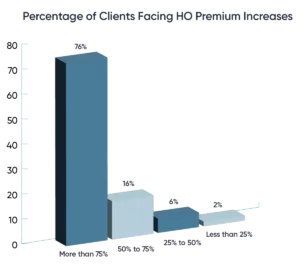
Over the past year a significant majority of agents (nearly 3 out of 4 agents) have seen more than 75% of their clients experience an HO premium increase. This indicates widespread premium hikes across the client base.
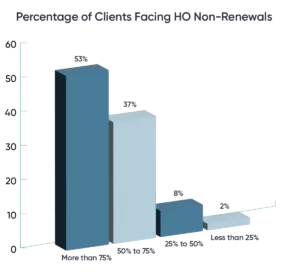
Non-renewal rates are relatively low compared to the premium increases. Over the past year about 1 in 3 agents have seen 25% to 50% of their clients receive a non-renewal notice for HO insurance.
Inflation in construction and repair costs leads insurance companies to adjust premiums upward to cover potential higher payouts. Some agents also report that these rising costs have contributed to non-renewals.
Many agents cite the rise in environmental hazards due to climate-related events (i.e., tornadoes, hurricanes, hail storms, etc.) as increasing premiums and issuing non-renewals. Insurers are adjusting premiums to compensate for elevated risks and are pulling back from regions particularly vulnerable to environmental hazards.
Clients in areas prone to natural disasters (i.e., floods, wildfires, earthquakes, etc.) are experiencing significant premium increases and non-renewals. More than 75% of clients in these high-risk areas have experienced premium hikes, indicating that insurers are raising premiums substantially to compensate for the elevated risks associated with these regions.

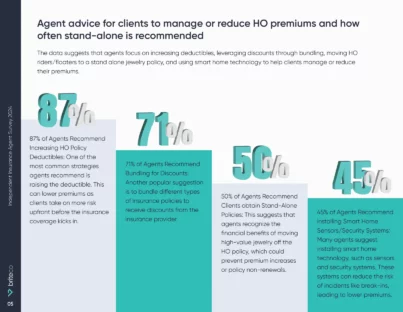
The data suggests that agents focus on increasing deductibles, leveraging discounts through bundling, moving HO riders/floaters to a stand alone jewelry policy, and using smart home technology to help clients manage or reduce their premiums.

Since, a majority of agents either always or often recommend stand-alone jewelry insurance, this highlights that many agents see it as a valuable alternative to the standard HO policy riders. This might indicate that stand-alone policies oer better protection or more favorable terms for clients with valuable jewelry
of agents consistently recommend stand-alone jewelry insurance for their clients, indicating a strong preference for this approach.
of agents frequently recommend it, suggesting that it is a common strategy, though not in every case.
of agents occasionally recommend stand-alone jewelry insurance, likely depending on the specific client or situation.
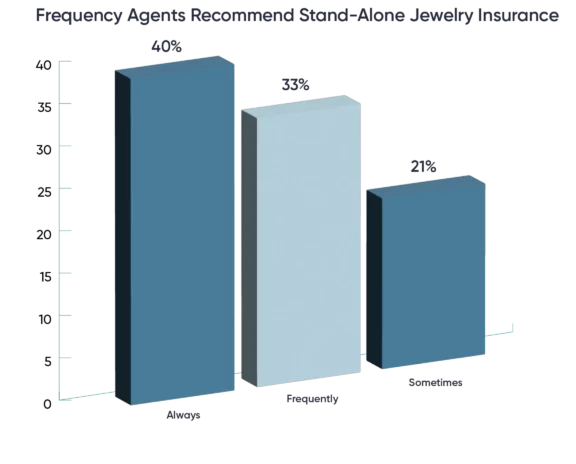
These insights suggest that a majority of agents either always or often recommend stand-alone jewelry insurance to their clients, indicating its perceived value for more comprehensive or specialized coverage.
Stand-alone jewelry policies do not report claims to third-parties such as CLUE or A-Plus.

Awareness Gap: A significant portion of agents (nearly 1 out of 3) are unaware of the privacy benefits associated with stand-alone jewelry insurance, specifically the fact that claims are not reported to third-party databases like CLUE or A-Plus.
Education Opportunity: There’s an opportunity to educate these agents on the benefits of stand-alone policies, especially since this feature may be a selling point for clients who want to avoid their claims impacting other insurance policies or premiums.
Potential Business Impact: Agents who are unaware of this key detail may not fully leverage it during client consultations, potentially missing opportunities to promote these policies effectively.
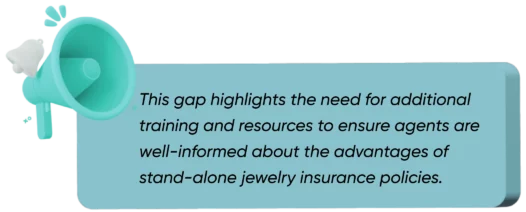

Lack of Client Awareness: A slight majority of agents (54%) believe that their clients are unaware of how filing a jewelry claim could Affect their homeowners’ insurance premiums or renewal status. This suggests that there may be a communication gap between agents and clients regarding the consequences of such claims.
Educational Opportunity: With 46% of agents believing their clients are aware, there’s room to improve client education to close this gap. Agents could benefit from offering more detailed explanations to help clients make informed decisions about how to handle jewelry claims.
Potential Risk for Clients: If clients are unaware of the impact, they might make decisions that negatively affect their premiums or policy renewals. This reinforces the need for agents to proactively explain the implications of filing jewelry claims under homeowners’ policies.
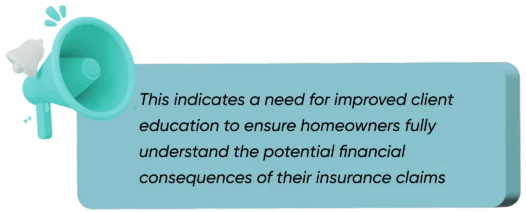
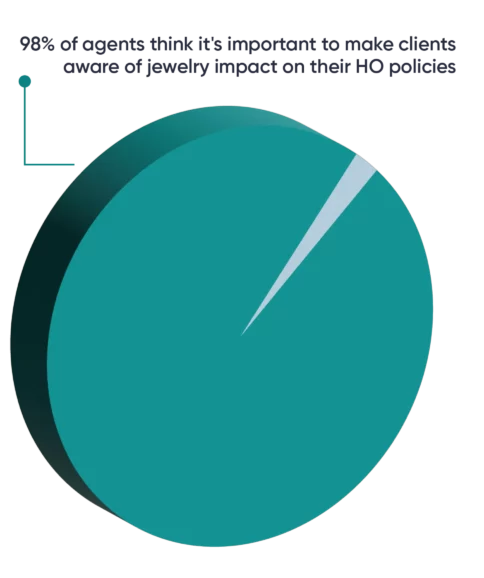
Consensus on Importance: There is near-unanimous agreement among agents that it is crucial to educate clients about the impact of jewelry claims on their homeowners’ insurance premiums or renewal status. This highlights the importance agents place on client education in managing expectations and making informed decisions.
Best Practice for Client Communication: The fact that almost all agents see the need for this explanation suggests that it should be a standard practice in client-agent interactions. Ensuring clients are aware of the consequences of filing jewelry claims can help prevent future misunderstandings or negative outcomes, such as increased premiums or policy non-renewals.
Educational Focus: This finding further emphasizes the need for agents to proactively discuss the potential financial and policy-related impacts of claims, particularly for high-value items like jewelry.

33% of agents mentioned that there are limited options available from providers, making it harder to offer competitive or suitable policies for clients. The complexity of the process also contributes to the difficulties in selling these policies, highlighting the need for more streamlined options or better provider support.
27% of agents mentioned this as challenge. Agents find it challenging to persuade clients to purchase stand-alone jewelry insurance. This suggest that clients either do not see the value or are hesitant to purchase stand-alone jewelry insurance..

24% of agents indicated that there is a general lack of interest, either from themselves or their clients, in pursuing stand-alone jewelry insurance. This could be related to a general perception that such insurance is unnecessary or too expensive, which agents might need to overcome with better education and sales strategies.
20% of agents find the quoting and underwriting process too time-consuming and cumbersome, which discourages both agents and clients from moving forward with policies.

Survey respondents were given the opportunity to provide comments as part of the survey. Shown here are highlights from some of the agents.


Agent survey respondents operating in key states, including Florida, Texas, and California, were highly represented, likely due to their high insurance demand from natural disasters and regional risks. However, a significant portion of agents operate across multiple states, with 11.4% covering all 50 states, demonstrating the broad reach of their business.
Premium increases for over 75% of clients were consistent across the Southwest, Southeast and West regions, indicating a near nationwide trend driven by similar causes such as climate-related risks like hurricanes and wildfires.
Consistent with national trends, agents in the survey highlighted premium increases, particularly in regions like Southeast (Florida), (Southwest) Texas and (West) California. This is tied to the high risk of hurricanes, floods and wildfires in these areas.
Agents in the Southeast, particularly in Florida, frequently mentioned rising repair costs as a major driver for premium increases. This is largely due to the high demand for rebuilding after storm-related damages. Texas saw a similar pattern, where agents mentioned the impact of severe weather.

Non-renewals were less frequent in comparison to premium increases, though they still affected some clients, particularly in regions with significant weather-related risks like Florida and California.
Florida was a significant region experiencing non-renewals. Agents frequently reported that insurers were choosing not to renew homeowners’ insurance policies due to the high risk of storm-related events.
California is another region where non-renewals were frequently mentioned. Agents noted that insurers were pulling out of fire-prone areas, especially in regions highly affected by wildfires.
Across all regions, agents frequently mentioned challenges in convincing clients to convert to stand-alone policies with clients traditionally bundling jewelry insurance with their homeowners’ policies.
Time-consuming quoting and underwriting processes were particularly noted in the Southwest (Texas), where agents reported diculties with policy customization for jewelry insurance. Agents across different states face unique difficults based on regional risks, such as wildfires in California and hurricanes in Florida, with tailored advice provided to manage both premiums and risks.
Agents often recommend bundling HO insurance with other policies to get discounts, especially in high-risk areas like Florida and California where premiums are high. In these regions, agents also suggest increasing deductibles for risks like wind or fire damage to help manage costs. Stand-alone jewelry insurance is more frequently recommended in high-risk and high-value areas but faces challenges in other regions.
BriteCo conducted the online survey in September 2024, with 228 respondents from independent insurance agents across the United States. Respondents represented agents offering homeowners insurance policies in a wide variety of states and geographic areas.
Agent survey respondents were highly represented in states such as Florida, Texas, and California, likely due to their heightened claims experiences with natural disasters and regional risks. However, a significant portion of agents operate across multiple states, with 11.4% covering all 50 states, demonstrating the broad reach of their business.

BriteCo is a leading tech-driven provider of jewelry and watch insurance. Created by a third-generation retail jeweler, BriteCo offers best-in-class jewelry and watch insurance, available in all 50 states. Its top-rated insurance is accessible to customers wherever they prefer, directly online, through an independent insurance agent or broker, or at luxury jewelry retail partners around the country. BriteCo policies have $0 deductibles, are backed by an AM Best A+ rated insurer, and provide worldwide coverage. For more information, visit brite.co