Most watch owners should follow the service schedule recommended by their watch’s brand or a qualified watchmaker. But schedule service sooner if the watch is making unusual sounds or showing signs of poor accuracy, moisture damage, winding resistance, or reduced power reserve.
How often should you service a watch?
- Mechanical and automatic watches need regular maintenance and periodic service, at least every 5-10 years, because they rely on moving parts and lubrication to work properly.
- Quartz watches may need battery changes, gasket checks, and occasional service, but less regularly than mechanical and automatic watches.
- Vintage and complicated watches may need service more frequently, as they come with special considerations.
Service costs will vary by watch movement, complication, brand, parts availability, and the watchmaker, but don’t wait to service your watch just due to cost. Putting off maintenance can lead to future, costlier repairs. Additionally, as high-value watches are worth protecting beyond mere maintenance, also consider investing in watch insurance, which can cover repairs and watch replacement after severe damage, theft, loss, or mysterious disappearance.
Keep reading for tips from BriteCo founder and CEO Dustin Lemick, a major watch enthusiast, regarding regular service, warning signs that a watch needs to be serviced soon, and service costs.
What You Will Learn
- Service Timing by Watch Type: Mechanical, Automatic, and Quartz
- Signs Your Watch Needs Service Sooner
- What Happens During a Complete Watch Service?
- How Much Does Watch Service Cost?
- Mechanical and Automatic Watch Service: Why Timing Matters
- Quartz Watch Service: Battery Changes, Gaskets, and Water Resistance
- Vintage Watches and Complicated Watches May Need a Different Schedule
- Authorized Dealer Vs. Independent Watchmaker: Who Should Service It?
- How to Keep Your Watch Running Between Services
- Watch Service FAQs
- Conclusion: Service Before Small Issues Become Expensive Repairs
Service Timing by Watch Type: Mechanical, Automatic, and Quartz
Different types of watch movements come with different service needs, with mechanical and automatic watches sometimes requiring more frequent and extensive service than quartz watches.

(Note that automatic watches are still mechanical watches; they simply wind through wrist motion. That’s why their service needs are similar. Additionally, remember that, while quartz watches are lower-maintenance, they’re not completely maintenance-free.)
| Watch Movement or Type | What Usually Needs Attention | Service Guidance |
|---|---|---|
| Mechanical watch | Manual winding movement, oils, gears, seals | Follow the brand’s recommended service intervals, but take the watch in for inspection sooner if the watch’s accuracy changes |
| Automatic watch | Rotor, mainspring, movement oils, seals | Treat the watch like you would a mechanical watch; keep in mind that daily wear may affect timing |
| Quartz watch | Battery, circuit, gaskets, seals, hands, case | Take it in for battery changes as needed, as well as periodic gasket/water-resistance checks |
| Complicated watch | Extra modules and more moving parts | Service will usually be more expensive and you may need specialist service |
Lemick compares the simple movements of a quartz watch to Toyota car engines that “run forever and usually don’t have very many issues, and they don’t need a lot of service. Now, high-end German cars, for example, have a reputation of having to be serviced pretty regularly. And that would be your high-end watches, too.”
Signs Your Watch Needs Service Sooner
Signs that your watch needs service sooner rather than later include:
- A noticeable difference in the watch’s accuracy, including time gain or loss
- The watch stopping unexpectedly
- Reduced power reserve
- The watch being hard to wind
- The crown feeling gritty or loose
- The rotor making new or unusual sounds
- Moisture or fog under the crystal
- The date, moon phase, or calendar function sticking
- Generally dropping or hitting the watch
- Water exposure (specifically after seals may have aged)
Especially where moisture is concerned, if you can see condensation under the dial or crystal, stop wearing the watch immediately and have it inspected as soon as possible.
You can sometimes prevent future, urgent maintenance by learning how to properly clean your watch, and inspecting the watch for dirt, oil, scratches, grime, and buildup during routine upkeep.
What Happens During a Complete Watch Service?
A complete service by a professional watchmaker goes beyond polishing or changing a strap and can include:
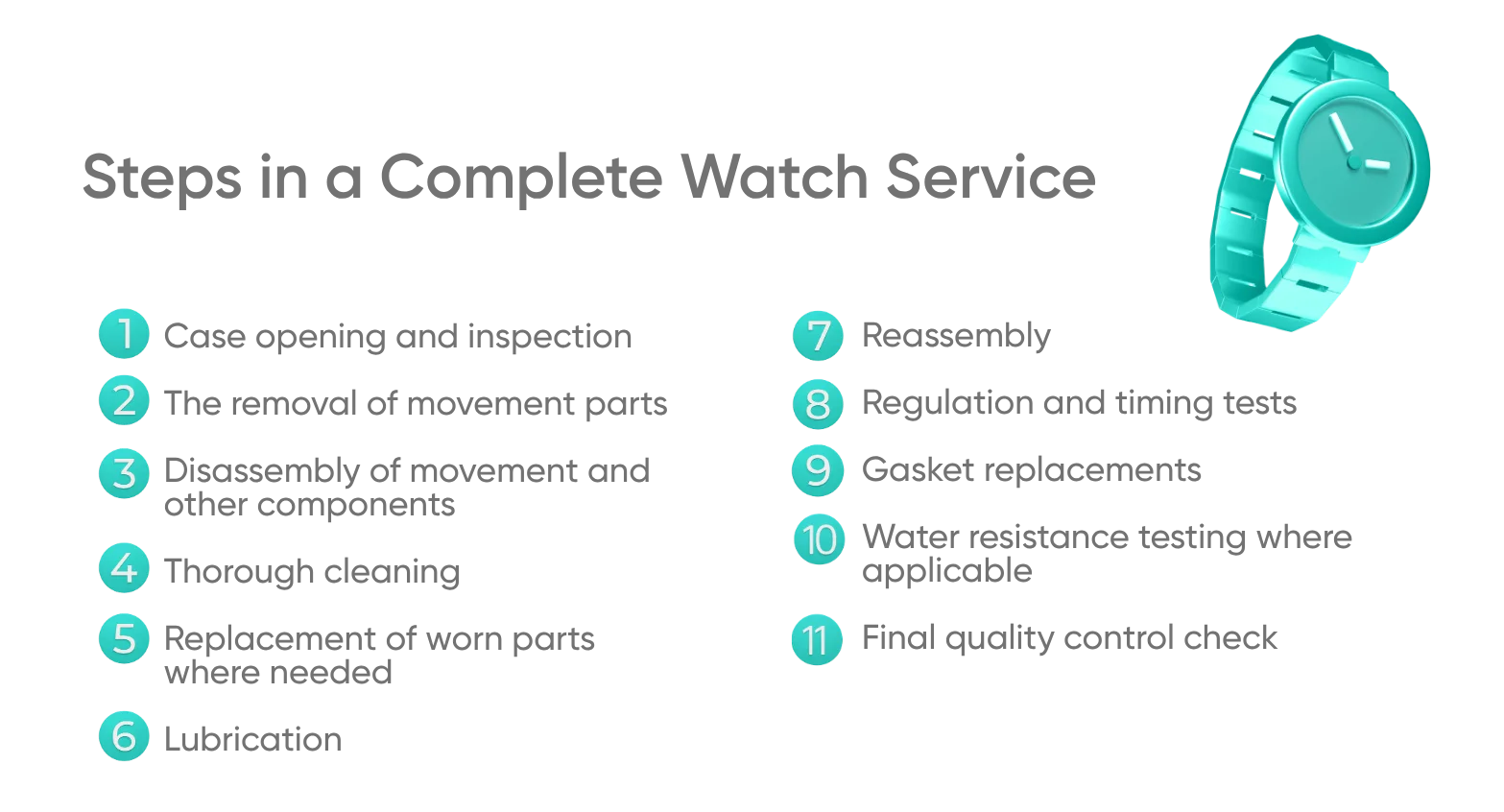
Due to this thoroughness, a complete watch service costs more than a simple cleaning.
It’s essential that complete services be performed by a qualified professional, especially for luxury, vintage, complicated, or water-resistant watches.
How Much Does Watch Service Cost?
The cost of having a watch serviced varies, of course, as different watches will require different amounts of time, parts, tools, and expertise.
| Factors That Can Impact Your Watch Service Cost | Why It Matters |
|---|---|
| Movement type | Mechanical and automatic watches require more labor than basic quartz watches |
| Complications | Moon phase, perpetual calendar, chronograph, and calendar functions add complexity to the service |
| Brand | Some brands require the use of proprietary parts or authorized service |
| Age | Vintage watches may need harder-to-find parts during a service |
| Condition | Damage or neglect can turn a simple service into more intensive and costly repairs |
| Water resistance | Gaskets and testing add work to the service |
| Parts availability | Discontinued or rare parts can increase your cost |
| Watchmaker | Authorized service and independent specialists may price their services differently |
Regardless of cost, though, actively keeping up with watch maintenance is still usually cheaper than waiting to take the watch in until it needs some sort of repair, especially in the case of expensive watches. There’s also a flip side, Lemick says: “It sounds kind of crazy, but there are people who get their watches serviced every year, every other year. From my experience, it’s too much. There’s more that can go wrong doing that than just actually leaving it if it’s running well.”
Regular maintenance is an investment in your watch’s future needs — and the same is true for watch insurance. Watch insurance costs a minimal percentage of a watch’s value per year, but can cover the entirety of repair or replacement costs (which can sometimes add up to tens of thousands of dollars) if a watch is stolen, damaged, or lost — so you can rest easy knowing your watch is fully protected.
Mechanical and Automatic Watch Service: Why Timing Matters
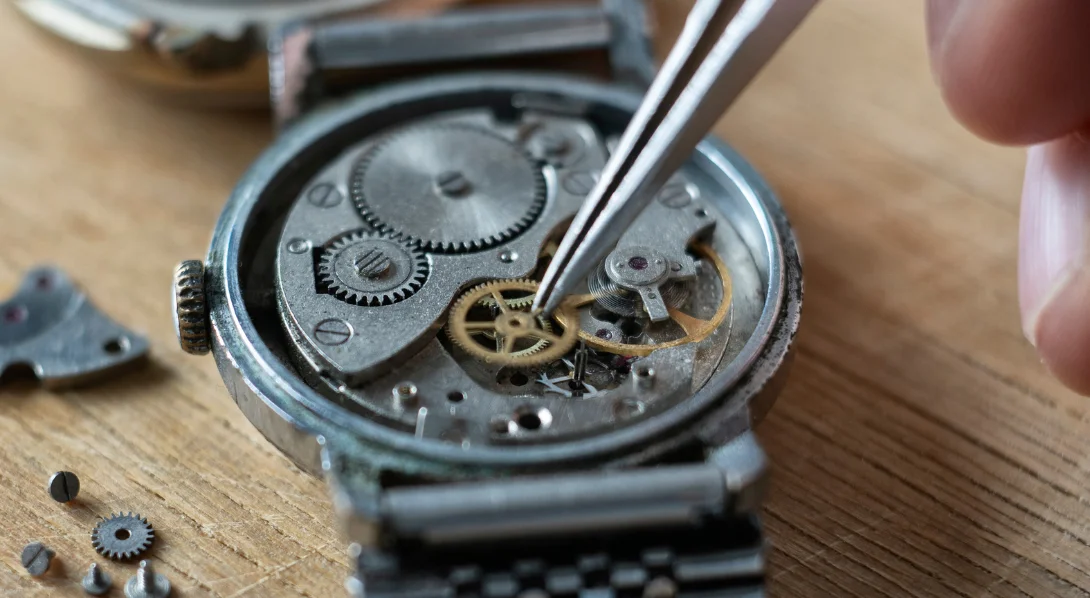
Mechanical and automatic watches depend on precise movement parts, lubricants, springs, gears, jewels, and seals. Over time, synthetic oils age, parts wear, and accuracy can decline — making regular watch service crucial to the watch’s performance.
These complicated movements don’t just fail all at once, signaling the need for service. Instead, performance degrades slowly, over time. Needed lubrication dries up or migrates. Gaskets and seals break down and daily wear exposes the watch’s many moving parts to potential damage.
You need to have your automatic watch serviced regularly even if it’s kept on a watch winder, as the motion can negatively affect the watch’s lubricants, causing them to break down more quickly than they might otherwise.
Two clues that your watch is starting to show subtle signs that it’s time for a service?
- If the winding feels “off” — think too stiff or too loose — that’s a sign of dried internal oils. “You can definitely feel if it’s not smooth or if it gets stuck or very hard to wind,” Lemick says.
- The watch’s accuracy is likewise “off,” even if only by a small degree. That could signal a range of issues, including the need for new parts.
Don’t be tempted, though, to service the watch yourself. While regular servicing helps prevent friction-related wear, a luxury watch is extremely delicate and should not be opened casually.

Quartz Watch Service: Battery Changes, Gaskets, and Water Resistance
Quartz watches often need a battery change more frequently than they do a full service, but when that full service is needed, it should include:
- Battery replacement
- Case gasket checks
- Water resistance testing
- Crown and pusher checks
If this requisite maintenance is put off too long, it could result in hand or date function issues or battery leakage.
So, before you schedule a quartz watch service, ensure you’re truly getting a full service, not just a battery change. A battery change keeps the watch working, but a full service checks that the watch is sealed, all its components are functioning, and it’s protected from future preventable damage.
(The full service may also determine if you need a quartz movement replacement vs. a repair, with the former typically being more affordable, given the amount of labor often needed to repair a quartz movement.)
Vintage Watches and Complicated Watches May Need a Different Schedule
Older, rare, and more complicated watches with more moving parts may need more frequent servicing, so avoid following a generic service timeline.
| Watch Type or Feature | Why It Needs Special Care | Service Guidance |
|---|---|---|
| Vintage watch | Parts may be scarce and retaining the watch’s originality matters; unnecessary polishing or non-original parts can affect the watch’s value | Use a watchmaker experienced with vintage pieces, and one that will balance watch function with originality and preservation |
| Moon phase | The watch’s calendar module adds complexity | Avoid forcing adjustments during restricted hours |
| Perpetual calendar | This is a highly complex mechanism | Use authorized or highly specialized servicers |
| Rare luxury watch | The watch’s value may depend on keeping its original parts | Document your service history carefully |
| Daily worn, older watch | Seals, oils, and parts face premature wear | Inspect the watch more often than you might a safe-kept collector piece |
Authorized Dealer Vs. Independent Watchmaker: Who Should Service It?
Use your watch brands’ authorized dealer to service newer watches with warranties or proprietary parts, but consider talking to qualified watchmakers and specialists about servicing vintage, out-of-warranty, or collector watches. “I do recommend, for any fine watch, to go back to an authorized repair center or the manufacturer,” Lemick says.
| Service Route | Best For | Potential Downside |
|---|---|---|
| Authorized dealer / brand servicer | Newer watches, warrantied watches, watches that have proprietary parts | Service may cost more or take longer |
| Independent watchmaker | Vintage, out-of-warranty, collector-sensitive watches | While many watchmakers are legitimate, you’ll have to independently verify their credentials and ensure they have access to any needed parts |
| Local jeweler | Basic battery, strap, cleaning, or sizing work | Not always an appropriate choice for complex movements |
| Specialist restoration shop | Vintage or damaged watches | You’ll need to make it clear that originality and documentation matter |
“A vintage watch needs to go to a specialist,” Lemick says. “What happens is sometimes you’ll send a vintage piece to the manufacturer, and they’ll replace a bezel, for example, with a brand new one. But vintage people don’t want brand new. It’s like cars. You want original parts. And even if they’re not in great shape, you still want the original parts.”
Before taking in your watch for service, ask the servicer:
- Are you certified or brand-authorized?
- Will you use original parts?
- Will replaced parts be returned?
- Will water resistance be tested?
- Will the work be documented?
- Do you offer a service warranty?
How to Keep Your Watch Running Between Services
Even if you have your watch serviced regularly, you should protect it from daily wear and tear, and preventable damage and accidents, by:
- Wiping the case and bracelet when you take it off each day.
- Keeping leather straps dry.
- Only rinsing watches that are rated and sealed for water exposure.
- Avoiding magnets, hard shocks, and extreme temperature changes.
- Not using the crown or pushers underwater unless the brand approves.
- Checking the watch’s water resistance periodically.
- Storing all watches in a dry, secure location.
- Using a watch winder only when it makes sense for the watch and your routine.
- Keeping service receipts and watch records (like the watch appraisal) somewhere safe.
“If you have a fine watch — a Rolex, a Patek, a Pasha — these are generational,” Lemick says. “Your watches get passed down generations. I have my grandfather’s watch that he bought in the ’70s, probably. And certainly there are watches getting close to 100 years old, and they still run.”
Watch Service FAQs
How Often Should You Service a Watch?
Typically, you should take a mechanical or automatic watch in for service every five years or so, but follow the maker’s guidelines for regular servicing rather than relying on approximate timelines.
Do Quartz Watches Need Servicing?
Yes, while quartz watches may require less overall maintenance than a mechanical or automatic watch, they do still need full servicing, in addition to more frequent battery replacements.
Is a Battery Change the Same as a Watch Service?
No, a battery change is not the same as a full watch service, which will ensure that the entirety of the watch’s functions are in ideal working order.
Why Is Watch Service Expensive?
Watch servicing can be expensive due to the complexity of the watch, luxury or collector’s status, time and parts needed for the service, and servicer expertise.
Should You Insure an Expensive Watch After Servicing It?
Though separate, both regular service and watch insurance are important aspects of watch maintenance — so, yes, if you have a luxury watch, like a Rolex or Patek Philippe that is not currently insured, insure it to protect it from loss, theft, damage, and mysterious disappearance.
Conclusion: Service Before Small Issues Become Expensive Repairs
Watch service is preventive and the best time to service a watch is before accuracy problems, dry oils, worn gaskets, or small damage require a major repair.
“The best watch service schedule is not just based on the calendar,” Lemick says. “It is based on the movement and complications, the brand, how often the watch is worn, and the first signs that something is no longer working as it should.”
If the watch is valuable enough to service professionally, it may also be worth documenting, appraising, and protecting with dedicated watch insurance. Check your price and insure your watch today.
Buying Guide:
The Secret to Diamond Buying: Natural vs Lab Grown

UP NEXT: Watch Crystal Replacement Cost: The Price of Scratches, Chips, and Cracks

Author