Choose watch insurance based on what policy will sufficiently protect your watch at its current value, while also protecting it from common risks such as theft, loss, accidental damage, and mysterious disappearance, worldwide. Your ideal policy will align with the risks you encounter based on how you wear, store, and travel with the watch, as well as how you’ve documented it thus far.
How to choose watch insurance:
- Pick coverage that protects your watch’s current value, not your original purchase price
- Don’t settle for homeowner’s insurance if it won’t cover your watch’s full value
- Look for comprehensive watch insurance that clearly covers theft, loss, damage, and travel
- Review any potential provider’s appraisal, receipt, and documentation requirements
- Compare providers’ deductible and replacement terms
- Make sure that any chosen provider allows you to file claims easily
BriteCo will give you a quote in seconds and secure your coverage in minutes, with protection that includes fully covered watch replacements after theft, loss, or mysterious disappearance.
Let’s hear advice from BriteCo founder and CEO Dustin Lemick about what you’ll want to consider when choosing watch insurance, and what your watch insurance should cover.
What You Will Learn
- Start With What You Need the Policy to Protect
- Choose Coverage That Matches Real Watch Risks
- Make Sure the Policy Reflects the Watch’s True Value
- Do Not Assume Homeowners Insurance Is Enough
- Compare Cost Against Replacement Risk
- Review Deductibles, Limits, and Out-of-Pocket Costs
- Check the Claim Process Before You Buy
- Choose Coverage for One Watch or a Whole Collection
- Consider Travel, Storage, and Everyday Care
- Watch Insurance Selection Checklist
- Watch Insurance FAQs
- Conclusion: Choose Watch Insurance Based on Value, Coverage, and Claim Confidence
Start With What You Need the Policy to Protect
When choosing watch insurance, start by really thinking about how you use your watch and the risks that you’re most likely to encounter; this will inform you of the kind of policy you need for thorough protection. For instance, if you have a high-value timepiece that you use for everyday wear, you may need more protection than someone who keeps their high-end watches in a safe.
| Ask Yourself | Why It Matters |
|---|---|
| Do I wear the watch daily? | Everyday wear raises damage, loss, and theft risk |
| Do I travel with it? | Travel increases the need for portable protection |
| Would I replace it immediately if lost? | Replacement urgency affects coverage needs |
| Is it vintage or difficult to replace? | Replacement may require higher documentation |
| Is it part of a collection? | Multiple watches may need broader protection |
| Would a claim affect my home policy? | Homeowner’s claims can create broader insurance issues |
Choose Coverage That Matches Real Watch Risks
Once you understand the very real risks that your watch faces, you can choose comprehensive coverage that matches your risk profile, opting for a policy with features suitable for your needs.
| Coverage Feature | Why It Matters |
|---|---|
| Theft | Watches are portable and visible |
| Loss | Watches are often removed during travel, exercise, or routine activity, and covered loss ensures you can purchase a replacement |
| Worldwide coverage | Important if the watch is worn during travel |
| Accidental damage | Repairs can be expensive |
| Repair coverage | Useful when the watch can be restored |
| Replacement coverage | Important when the watch cannot be recovered or repaired |
| Mysterious disappearance | Helps when the watch vanishes without a clear explanation |
“Mysterious disappearances can include theft with no evidence, robbery with no witnesses, misplaced jewelry, or someone claiming ownership of your jewelry,” Lemick says. “Most homeowners and renters insurance policies don’t offer coverage for mysterious disappearance, leaving you to foot the bill for replacement completely.”
Make Sure the Policy Reflects the Watch’s True Value
Watch insurance should fully protect your watch’s insured value (sometimes also called the appraised value or replacement value), aka what it would cost to repair or replace the watch today — not just what you paid for it originally.
This is why it’s so important to purchase coverage from an insurer who bases your coverage on an official insurance appraisal. An appraiser will determine your watch’s current value per the market, so your insurer can base your amount of coverage and premium on current repair or replacement costs.
This prevents both under- and overinsurance. If you’re underinsured, your policy may not actually pay out your full replacement or repair costs after a claim. If you’re overinsured, you’re paying too much for your policy.
Given all the above, a sales receipt is not an ideal proof of watch value for your insurance policy, though it can be useful documentation that you should hold onto. (Along these lines, prioritize robust documentation for higher-value pieces and realize that watch value can change over time — necessitating frequent appraisal updates.)
Do Not Assume Homeowners Insurance Is Enough
For many luxury watch owners, standard homeowners insurance will not provide enough coverage, as covered events are limited (with loss and mysterious disappearance often not included), deductibles apply to claims, and payouts for approved claims often cap out at $1,000-$2,000 (far beneath the average value of a luxury watch).
Additionally, claims can impact the overall policy, increasing premiums in the future and potentially resulting in policy non-renewal.
Accordingly, separate coverage apart from your home insurance is usually advisable.
| Coverage Type | What to Check Before Choosing |
|---|---|
| Standard homeowners policy | Jewelry/watch limits, deductible, and exclusions |
| Home policy rider | Whether the watch is scheduled and still tied to home policy terms |
| Separate watch coverage | Whether the policy is built around high-value watches |
| BriteCo watch insurance | Whether coverage better fits worn, stored, lost, stolen, or damaged watches |
When comparing stand-alone jewelry insurance vs. a homeowners policy, specialty jewelry insurance usually offers broader, item-specific protection, while a standard homeowners policy may not cover loss or accidental damage, and may have limits, caps, or deductibles.
Compare Cost Against Replacement Risk
Don’t just choose a provider based on the upfront watch insurance cost; opt for the provider that’s going to offer the greatest protection. If a cheaper policy does not fully cover your watch’s replacement cost, comes with a high deductible or coverage limits, or makes claims difficult, it may not be ideal.
How to decide on insurance = Annual premium price vs. What you would lose if the watch were stolen, lost, or damaged
| Watch Value | What to Consider |
|---|---|
| Under $2,000 | Does the watch have sentimental value? Do you wear it often? Despite its low monetary value, you may still need more coverage. |
| $2,000-$10,000 | Specialized coverage makes sense, especially if you wear the watch regularly. |
| $10,000+ | There’s a strong case for dedicated watch insurance, as paying $10,000 suddenly to replace the watch is financially stressful for many. |
| Whole collection | Depending on the collection’s full value, you may need specialized insurance. |
Watch insurance rates mostly depend on the value of the timepiece, and most watch insurance premiums cost about 1%-5% of the watch’s value per year.
Review Deductibles, Limits, and Out-of-Pocket Costs
Beyond premiums, you also should look at a policy’s deductible, coverage limits, and out-of-pocket costs that come with a claim, as all can ultimately impact how much you end up paying to protect your watch.
| Policy Detail | What to Ask |
|---|---|
| Deductible | What would I pay during a claim? |
| Higher deductible | Does a higher deductible lower the premium enough to be worth it? |
| Coverage limits | Is the policy’s maximum coverage limit high enough for a full replacement or repair after a claim? |
| Full replacement cost | Will replacement terms be enough to cover the watch’s current value? |
| Repair coverage | Will the policy support repair when a replacement is not needed? |
| Out-of-pocket costs | How much money would I pay if something happens? |
A low premium with high out-of-pocket costs in the form of, say, a high insurance deductible, may not be ideal for an expensive watch. “Unlike some other types of insurance, stand-alone jewelry insurance policies typically do not have a deductible,” Lemick says. Watches insured for their full value with BriteCo are 100% covered.
Check the Claim Process Before You Buy
Before choosing a watch insurance policy, ask the following about the insurer’s claims process:
- Can a claim be filed online?
- What proof is needed for damage?
- Is a police report needed for theft or loss?
- Are photos required?
- Does the policy already store appraisal or inventory details?
- How are repairs handled?
- Can the user work with a preferred jeweler?
- Are deductible costs clear?
- Is replacement cost handled clearly?
BriteCo claims can be filed online, generally take less than five minutes, and may just require photos for damage or a police report for loss.
Choose Coverage for One Watch or a Whole Collection
A single-watch owner and a collector should evaluate their coverage differently, with watch collectors asking the following when choosing coverage:
- Is each watch documented on the policy?
- Are all watch values listed separately?
- Are all appraisals current?
- Does coverage apply to vintage or higher value pieces?
- Is the whole collection insured under one policy or are watches itemized?
- Are storage and travel habits clearly covered?
- Does the policy cover loss, theft, accidental damage, and mysterious disappearance?
Consider Travel, Storage, and Everyday Care
How you travel with, store, and care for your watches should also influence the type of coverage you purchase.
| Ownership Habit | Question to Ask About Your Insurance |
|---|---|
| Daily wear | Does accidental damage coverage apply? |
| Frequent travel | Is worldwide travel coverage included? |
| Storage at home | Is theft covered? |
| Gym, hotel, or airport use | Is loss or mysterious disappearance covered? |
| High-value collection | Are all pieces documented? |
| Weather or extreme event concerns | Are exclusions clear? |
While some of the above concerns — like those related to everyday wear or natural disasters — can be mitigated through proper storage and watch care best practices, it’s still important to ensure you’re covered from all potential risks via insurance.
Watch Insurance Selection Checklist
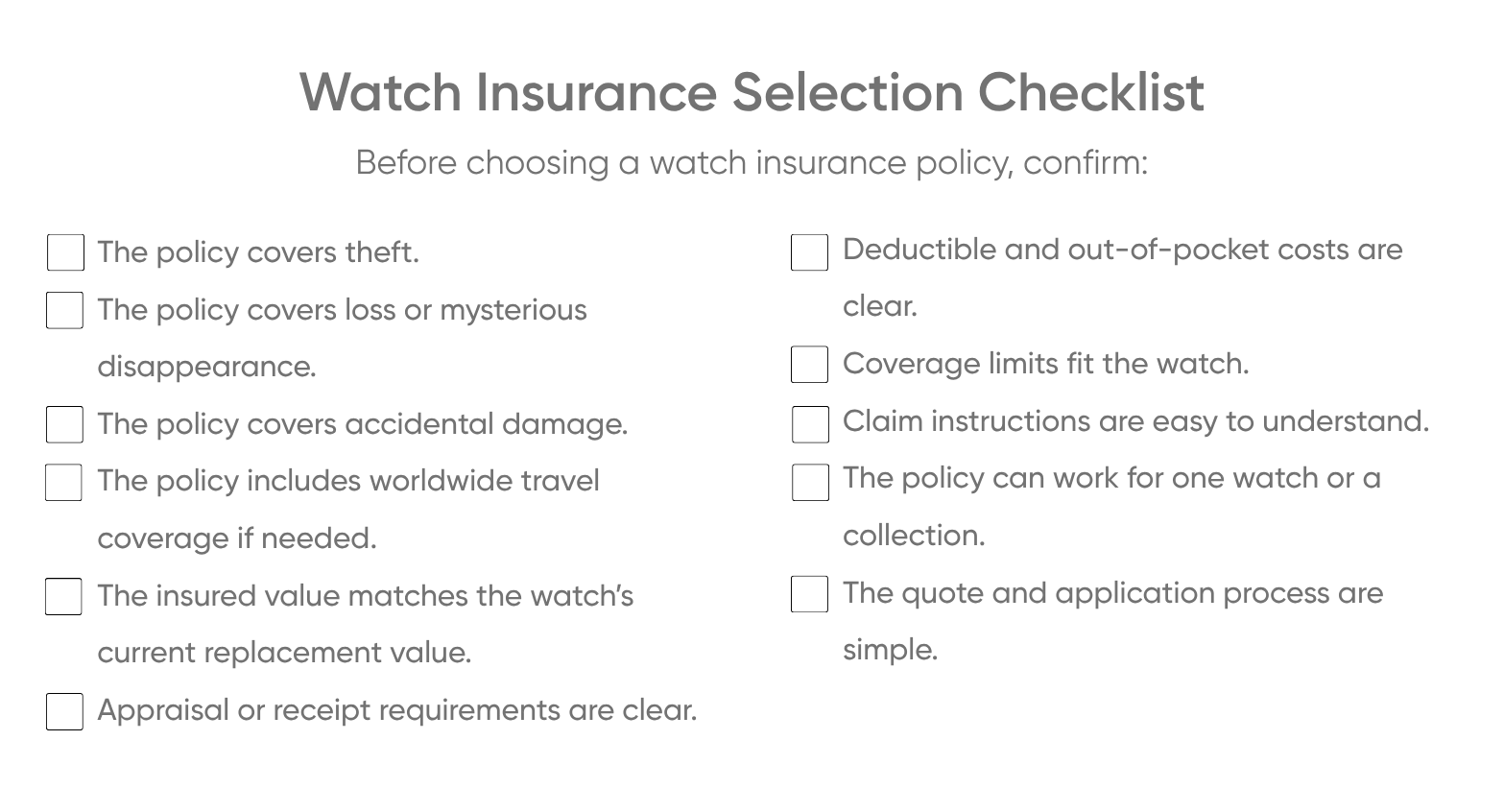 With BriteCo, you can apply online and receive quotes and coverage options in minutes.
Watch Insurance FAQs
How Do I Get a BriteCo Watch Insurance Quote?
You can get a quote in seconds and coverage in minutes, by submitting just a few details and choosing your payment option (monthly or annual). Worldwide coverage applies to theft, loss, mysterious disappearance, and accidental damage. If you have to make a claim, you can do so online, with $0 deductibles.
Do I Need an Appraisal Before Buying Watch Insurance?
Yes, an appraisal can be helpful when purchasing watch insurance, as it confirms your watch’s insurable value, allowing your insurer to set your coverage amount and premium accordingly.
Should Watch Insurance Cover Full Replacement Cost?
Yes, watch insurance should cover full replacement cost. Otherwise, if you make a claim, you will not have enough coverage to fully replace the timepiece without paying something out of pocket.
Does Watch Insurance Cover Accidental Damage?
Specialized watch insurance typically does cover accidental damage, but watch insurance under a homeowners or renters policy typically does not.
What Should Watch Insurance Cover?
Comprehensive watch insurance covers the greatest watch risks, including theft, loss, accidental damage, and mysterious disappearance.
Conclusion: Choose Watch Insurance Based on Value, Coverage, and Claim Confidence
“The right watch insurance will protect your watch the way it is actually owned, worn, stored, traveled with, documented, and valued today,” Lemick says. The best watch insurance is not simply the cheapest policy. It is the coverage that fits the watch’s true value, protects against realistic risks, avoids major claim-time surprises, and makes it easy to repair or replace the watch after theft, loss, or accidental damage.
What’s next?
- Check your price.
- Confirm your coverage options.
- Protect your watch before loss, theft, or damage happens.
Get your watch insurance quote now.
Get a Quote:
The Easy Way to Insure Your Jewelry - and Save Money!
UP NEXT: How Often Should You Service a Watch? Signs, Costs, and Timing

Author